
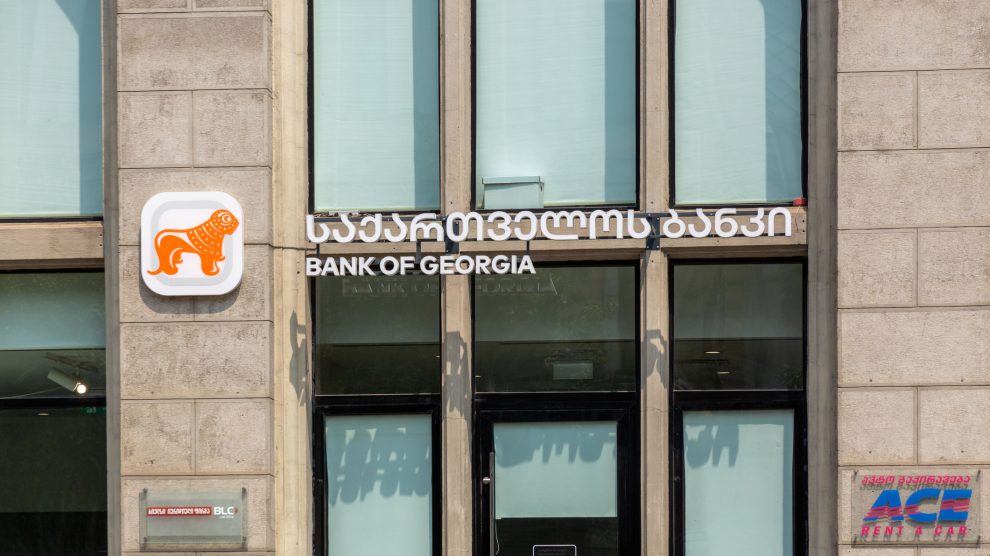
A new study suggests the South Caucasus’s banking transformation has less to do with who’s winning now than who might win tomorrow.
The South Caucasus has rarely been mistaken for a banking paradise. Wedged between Russia, Turkey and Iran, the trio of Armenia, Georgia and Azerbaijan have spent much of the past three decades navigating wars, geopolitical upheaval and the sort of economic volatility that makes investors reach for the whisky. Yet a comprehensive new study of the region’s financial landscape suggests something curious: the banking sector’s most interesting story isn’t Georgia’s comfortable lead, but rather what happens when conflict shifts to connectivity.
The South Caucasus Banking & Investment Review 2025, published on November 21, ranks the three nations across 17 financial pillars—from sovereign credit ratings to fintech adoption. Georgia unsurprisingly tops the list with a score above 82 out of 100, testament to its decade-long cultivation of investor-friendly reforms and relative political stability. Armenia trails at 52.4, whilst Azerbaijan languishes further behind, hampered by sanctions and an economy still overly dependent on hydrocarbons.
On the surface, this reads like a predictable league table. Georgia wins, Armenia tries hard, Azerbaijan struggles. But dig into the 100-page report and a more intriguing pattern emerges: Armenia’s supposed “backwardness” may prove advantageous. The country is posting the steepest improvements in regulatory quality, ease of doing business and—perhaps most tellingly—banking sector diversification. Georgia’s maturity, by contrast, increasingly resembles a ceiling rather than a foundation.
The timing matters. In August 2025, Armenia and Azerbaijan signed a peace framework at the White House, the first serious attempt to normalise relations since the 2020 Nagorno-Karabakh war. Sceptics—and there are many—view this as yet another false dawn in a conflict stretching back decades. Yet the report’s author, Ivan Tchakarov of GlobalSource Partners, argues that financial markets are systematically underpricing what he calls the region’s “peace dividend.”
His reasoning is straightforward. The Armenia-Azerbaijan conflict has cost both nations an estimated 100 billion US dollars in foregone trade, investment and economic integration since 1991. Even a partial thaw unlocks new transport corridors linking Azerbaijan’s Caspian coast to Armenia’s connections with Iran and, crucially, the European Union. Suddenly, investors aren’t choosing between two hostile neighbours but evaluating complementary economies with differentiated risk-return profiles. Armenia’s comparative advantage in technology and services pairs neatly with Azerbaijan’s energy infrastructure and Caspian access. Peace doesn’t just end a war; it creates a market.
Georgia, oddly enough, may have the most to lose from regional reconciliation. For years it has marketed itself as the South Caucasus’s safe haven—the stable, predictable alternative to its quarrelsome neighbours. Should Armenia and Azerbaijan normalise relations, Georgia’s geographic monopoly as the region’s transit hub begins to erode. The Zangezur corridor, long blocked by Armenian-Azerbaijani hostilities, would offer a direct route between Turkey and the Caspian, bypassing Tbilisi entirely. Georgia’s banks, comfortable in their regional dominance, could find themselves squeezed between newly competitive neighbours with cheaper operating costs and hungrier growth appetites.
The report highlights another uncomfortable truth: credit-rating agencies appear spectacularly ill-suited to frontier markets in geopolitical flux. The study’s comparative 17-pillar index provides “a more rounded methodology for assessing risk in banking and investment terms” than the blunt instruments wielded by Moody’s and Fitch. Armenia, for instance, carries a speculative-grade sovereign rating that reflects past instability rather than present trajectory. Investors fixated on those ratings miss the country’s rapid financial deepening—remittance flows have surged 40 per cent since 2022, driven partly by an influx of Russian émigrés, whilst banking sector capital adequacy ratios now exceed many EU members.
Azerbaijan presents the inverse puzzle. Flush with hydrocarbon revenues and fiscal buffers, it scores poorly on transparency and diversification—precisely the metrics that matter in a post-oil future. Baku’s banks remain stubbornly focused on state-directed lending and resource-backed credit, a model that worked brilliantly in the 2000s but looks increasingly anachronistic. The country’s challenge isn’t managing today’s liquidity but building tomorrow’s financial infrastructure.
The report examines all this across themes ranging from regulatory environment and fintech adoption to diaspora remittances and green finance. What emerges is less a static ranking than a dynamic snapshot of three economies consciously reinventing their financial sectors amid geopolitical realignment. Armenia is leveraging its Commonwealth of Independent States connections whilst courting EU integration. Azerbaijan is attempting to diversify beyond oil without upsetting domestic political arrangements. Georgia is defending incumbent advantages in an increasingly competitive neighbourhood.
Tchakarov’s central insight—that the South Caucasus demands “differentiated risk-return profiles” rather than homogeneous emerging-market analysis—challenges how investors typically view frontier regions. Markets prefer neat categories: safe or risky, developed or emerging, stable or volatile. The South Caucasus defies such simplicity. Its banking sectors are transforming not despite geopolitical complexity but because of it. The question isn’t which country wins today’s league table. It’s which has positioned itself for tomorrow’s peace dividend—assuming, of course, that peace actually arrives.
Smart money, suggests the report, would bet on the underdog with room to grow rather than the champion with nowhere left to climb. In banking as in war, transformation favours the insurgent.
Photo: Dreamstime.