
A discussion that should focus on environmental impact and economic benefits risks becoming a proxy for ideological and cultural anxieties.
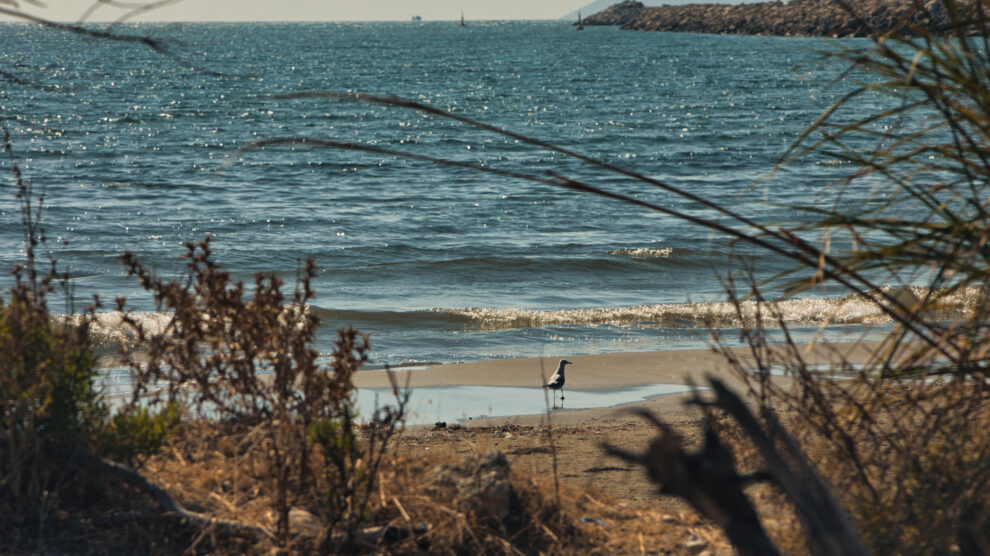
The controversy current surrounding a proposed luxury tourism development on Albania’s southern coast has been presented largely as a battle between economic development and environmental protection. Critics warn of damage to a sensitive ecosystem near the Vjosa-Narta protected area. Supporters argue that the project could bring jobs, investment, and international visibility to one of Europe’s most promising emerging tourist destinations.
Environmental concerns deserve serious consideration. Any project affecting protected areas should be subjected to rigorous scrutiny, transparent oversight, and strict environmental standards. Albania’s natural beauty is among its greatest assets, and protecting it is a matter of national interest.
Yet recent protests suggest that something larger than environmental activism may be at play.
Photographs emerging from demonstrations reveal messages that go far beyond concerns about wetlands, biodiversity, or sustainable development. Some protesters have carried signs depicting an alleged future “colonisation” of Albania by Israelis, accompanied by imagery warning of a gradual loss of Albanian territory and identity. This rhetoric deserves attention.
One may oppose a tourism project for environmental reasons. One may question government decisions regarding zoning, permits, or development strategy. Portraying a proposed investment as part of an imagined foreign colonisation project represents something fundamentally different.
It reflects a broader political narrative—one that increasingly appears across parts of Europe and the Balkans, where foreign investment is often viewed not as an economic opportunity to be regulated, but as a threat to national identity and sovereignty.
The result is that a discussion that should focus on environmental impact assessments and economic benefits risks becoming a proxy battle over ideology, geopolitics, and cultural anxieties.
As a journalist who has spent decades covering political developments in the Balkans, I have learned that major investments in this region are rarely viewed as purely economic projects. Ports, airports, highways, energy infrastructure, telecommunications networks, and tourism developments often carry strategic significance. They create partnerships, shape influence, and alter economic realities for generations.
In today’s world, economic security has become a pillar of national security. Nations compete not only through military strength and diplomacy but through their ability to attract investment, technology, talent, and strategic partnerships. This reality is particularly relevant in the Balkans, a region where geopolitics has never been far from economics.
Throughout modern Balkan history, economic questions have frequently become political questions. Decisions about infrastructure, energy, and foreign investment have often reflected broader struggles over national orientation, alliances, and influence. Albania’s tourism sector is now part of that equation.
Investment from whom?
Over the past decade, Albania has emerged as one of the Mediterranean’s fastest-growing tourist destinations. International publications have celebrated its coastline, natural beauty, and untapped potential. Tourism has become a major driver of economic growth and one of the country’s most important strategic sectors.
As Albania’s international profile grows, competition inevitably follows. The question is no longer whether Albania will attract foreign investment. The question is what kind of investment it will attract, from whom, and under what conditions. This is where the current debate becomes particularly significant.
A noticeable portion of the opposition to the project appears to be framed not only by environmental concerns but also by broader ideological assumptions common among certain activist movements throughout the West. These movements frequently view large-scale investment through the lens of colonialism, globalisation, displacement, and exploitation. Such frameworks can become simplistic, treating all major investment as inherently suspect regardless of context.
In Albania’s case, some activists appear to have moved beyond environmental objections and toward a narrative that presents foreign investors as existential threats to the nation itself. The imagery displayed at some demonstrations reflects precisely this shift.
What is particularly striking is that the rhetoric has increasingly focused on Israel and alleged Israeli influence rather than on environmental concerns. This raises legitimate questions about how and why the debate evolved in this direction.
Single issue, multiple agendas
Albania has historically maintained positive relations with both the United States and Israel. During one of humanity’s darkest chapters, Albanians famously protected Jewish families fleeing Nazi persecution. The country’s tradition of religious tolerance and hospitality remains a source of national pride.
Against this backdrop, rhetoric portraying Israeli involvement as a form of colonisation represents a troubling departure from that legacy.
It is also worth asking why a tourism investment has become associated, in some circles, with broader fears of demographic replacement and foreign domination. Such narratives increasingly resemble political campaigns built on identity politics rather than serious discussions about environmental policy.
This does not mean that every protester shares such views. Nor does it mean that environmental concerns are insincere. But it does suggest that multiple agendas may be converging around a single issue.
That distinction matters because Albania faces a genuine challenge. The country must preserve its natural heritage while also creating opportunities for economic growth. It must protect environmentally sensitive areas while remaining attractive to international investors. It must encourage democratic debate without allowing misinformation, conspiracy theories, or ideological extremism to dominate public discourse. These challenges are not unique to Albania. Democracies across the world are grappling with similar tensions.
Yet in the Balkans, where history, identity, and geopolitics remain deeply intertwined, the stakes are particularly high. Albania is not a wealthy country. Despite significant progress over the past three decades, it continues to face challenges including emigration, youth unemployment, regional inequality, and the need for greater economic diversification. Tourism has become one of the country’s most promising engines of growth, attracting international attention and creating opportunities that did not exist a generation ago.
Scrutiny should not become obstruction
This is why debates about major investments must be approached with both responsibility and perspective. Every project deserves scrutiny. Environmental concerns must be taken seriously. Governments must remain transparent and accountable. But scrutiny should not become obstruction, and legitimate questions should not be replaced by fear-driven narratives that portray every foreign investor as a threat. Countries do not prosper by chasing away investment. They prosper by creating clear rules, enforcing high standards, and providing the stability that serious investors seek.
If Albania develops a reputation as a country where billion-dollar projects can be derailed by conspiracy theories, misinformation, or political hysteria, the consequences will extend far beyond a single resort. Investors have choices. Capital moves where it is welcomed, protected by law, and supported by predictable institutions.
The real danger is not that Albania will attract too much investment. The danger is that it will miss opportunities that may not return. The debate over the country’s coastline should therefore focus on facts rather than fear, evidence rather than speculation, and national interests rather than ideological reflexes. Albania has every right to protect its environment. It also has every reason to pursue investment that creates jobs, strengthens its economy, and increases prosperity for future generations.
The challenge is not choosing between development and preservation. The challenge is ensuring that Albania does not allow political extremism, conspiracy theories, or manufactured fears to undermine opportunities that could benefit the country for decades to come.
The decisions made today will shape not only the future of Albania’s coastline but also the country’s economic trajectory in the years ahead.
Photo: Dreamstime.