
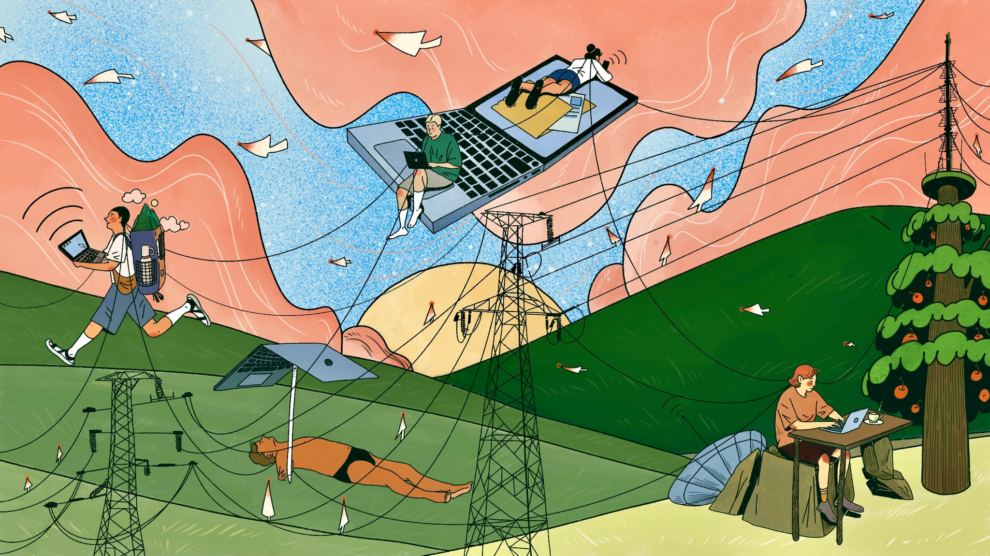

Debate around worker compensation focuses on regulation. Far less attention is paid to the technology required to implement fair systems.
The future of work is one of the defining debates of our time. As artificial intelligence transforms labour markets, a central question is emerging: how do we know what work is, who is doing it, and how much workers should be paid?
Technology can serve very different purposes. On one side, workplace surveillance has become so invasive that organisations such as Oxfam have accused companies of treating workers like “interchangeable mechanical parts”. At the same time, the UK’s Trades Union Congress (TUC) estimates that around 21 per cent of UK workers regularly perform unpaid overtime, contributing an average of 7.2 hours of unpaid labour every week.
How we measure, evidence, tax, and compensate work will become one of the most important policy and economic issues of the AI era.
The rise of ambient technology
In 1991, computer scientist Mark Weiser famously wrote that, “the most profound technologies are those that disappear”. Weiser envisioned a world where technology operated quietly in the background rather than demanding constant human attention. He called this “ubiquitous computing”, a concept later expanded into what became known as ambient technology.
Advances in AI have accelerated the development of ambient systems, particularly in healthcare. Ambient ‘scribing’ tools now sit silently during patient consultations, transforming natural conversations into structured clinical records. Doctors no longer need to spend hours completing paperwork or staring at computer screens. In some cases, these systems reduce documentation time by up to 40 per cent.
This reflects what might be called a ‘Light Pattern’ approach to technology—one that supports humans rather than controlling them.
When ambient technology goes dark
Unfortunately, workplace applications of ambient technology have often taken a darker direction.
Oxfam America’s report At Work and Under Watch describes how Amazon and Walmart use extensive workplace surveillance to monitor employee productivity. In Amazon warehouses, workers’ movements are tracked continuously through scanners and camera systems. Algorithms calculate ‘Time Off Task’ (TOT), automatically penalising workers for pauses as short as stretching or speaking with colleagues.
This is algorithmic management: automated systems making decisions about workers with little human judgement or empathy.
Walmart has similarly adopted extensive tracking systems to monitor workers and managers. According to Business Insider, these systems create a “penetrative system of observation, measurement, and feedback” that restricts worker autonomy.
The problem is not simply surveillance itself, but asymmetry. Workers often do not know how their data is collected, interpreted, or used.
Yet outside controlled environments such as warehouses, the challenge reverses. In sectors including social care, gig work, logistics, freelancing, and remote work, employers frequently struggle to determine how much work has actually been completed and what counts as compensable labour.
The data gap in modern work
Traditional workforce management systems were designed for fixed workplaces and standard schedules. They are poorly suited to hybrid work, platform labour, and fragmented employment patterns.
Millions of workers still rely on manual timesheets based on memory, calendar invites, or fragmented records. This creates major inefficiencies and opportunities for abuse. Wage theft through unpaid overtime, shift shaving, or inaccurate timesheets remains widespread.
The issue is especially acute in sectors such as social care. Under UK law, travel time between client appointments counts as working time for minimum wage calculations. Yet many care workers remain effectively unpaid for large portions of their travel, damaging morale and retention.
The wider scale of unpaid labour is enormous. The TUC estimates UK workers performed 28.5 billion UK pounds worth of unpaid overtime in 2025 alone.
At the same time, platform work continues to expand across Europe and beyond. As Matthew Cole argues in Unpaid: “as app-based gig work becomes increasingly common, exploitation grows more sophisticated and harder to detect.”
A better model for ambient technology
Most debates around worker compensation focus on regulation and enforcement. Far less attention is paid to the technology required to implement fair labour systems in practice.
This is where ambient work-tracking could play a transformative role.
Like ambient scribing in healthcare, ambient work-tracking would operate passively in the background. Instead of forcing workers to manually document every task, the system could automatically build an accurate timeline of work activity using schedules, communication tools, travel data, and contextual information.
Unlike invasive surveillance systems, however, worker-centred ambient technology must reject practices such as keystroke logging, constant screen recording, or employee ranking algorithms. The goal is not to spy on workers, but to reduce the administrative burden of documenting work while ensuring fair compensation and compliance.
In a well-designed system workers and employers share the same data transparently; workers remain able to review and challenge records; all tasks are accurately recognised; payroll, tax, and compliance calculations become automated and audit-ready. This creates a fundamentally different relationship between workers and technology.
The future of human-centred work
Ambient technology will inevitably become part of the future workplace. The question is whether it evolves into a system of surveillance and control or a tool for worker empowerment.
Used responsibly, ambient systems could eliminate one of the oldest inefficiencies in business: the gap between real human activity and how organisations measure work. They could reduce unpaid labour, improve compliance, simplify payroll, and return thousands of administrative hours back to workers and employers alike.
The challenge now is ensuring that ambient technology serves workers rather than simply observing them.
Image: Yutong Liu & Digit betterimagesofai.org