
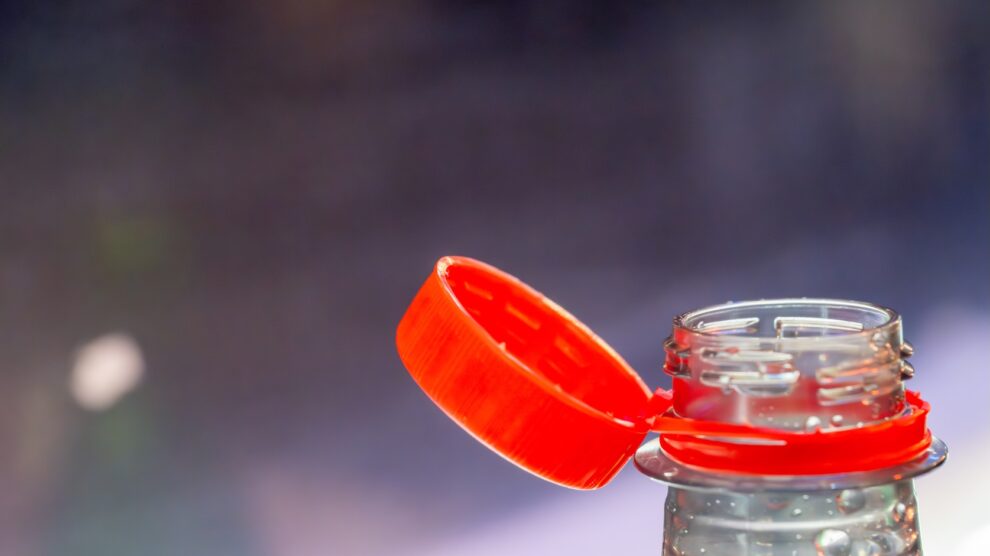
A viral video from Paris this week revived the case against tethered caps. The evidence that might settle the argument arrives in July 2027.
Volodymyr Zelensky reached for a bottle of water in Paris on July 14, twisted the cap, and kept twisting until it came away in his hand. He set it down on the table beside him. Clash Report, an aggregator, posted the clip that afternoon. Within a few hours it had been repurposed as evidence that a man who cannot manage a cap is not ready for the European Union. Zelensky had spent the previous day at a meeting of the Coalition of the Willing and the morning of the 14th watching Ukrainian troops march down the Champs-Élysées. Article 6(1) of the Single-Use Plastics Directive, which requires caps be tethered to bottles, does not apply in Kyiv.
Beatrice Timgren, a Swedish member of the European Parliament, filed a priority question in May 2025 asking whether the tethering rule, introduced in 2019 and obligatory since 2024, might be reviewed, adjusted or abolished. Her evidence came from Håll Sverige Rent, or Keep Sweden Tidy. It counts litter on six beaches along the Bohuslän coast three times a year for the Swedish Agency for Marine and Water Management. Plastic caps on those beaches rose from 46 per 100 metres in 2023 to 144 in 2024. Timgren borrowed her explanation from local litter-pickers: drinkers were tearing the caps off in irritation and using nature as a bin. The count had been drifting downwards for years before that.
Jessika Roswall, the EU’s environment commissioner, answered in June 2025. Caps and lids had been turning up on European beaches more than twice as often as the bottles they came off, she noted. That was the finding that put them in the directive to begin with. She declined to read one stretch of one coast as a verdict on the whole market. The rule had been in force for under a year when Timgren wrote. The Commission will evaluate the directive by July 3, 2027.
Johanna Ragnartz, who runs Håll Sverige Rent, told Göteborgs-Posten in July 2025 that she doubted the grumbling registered in her data at all. “I don’t think it shows up in the statistics,” she said. The Bohuslän coast is exposed and much of what washes up there was dropped in another country. In a statement the day before she had called these the first generation of attached caps. Producers would keep working on the design, she said. Her organisation has been counting the same six beaches since 2012.
What the machines see
Kara Pochiro of the Association of Plastic Recyclers explained the mechanics of tethering to Packaging Dive in July 2024. A loose cap is too small for the optical sorters at a materials recovery facility, so it drops out into the residual stream and is burnt or buried. Elizabeth Balkan, who directs Reloop North America, pointed to the places where this does not happen. In deposit-return systems, bottles come back with the caps still on and the whole object moves as one. The directive pairs the tether with a separate collection target of 90 per cent in 2029, and a rule that PET bottles contain 25 per cent recycled plastic from the same year.
Michael Krueger, the chief executive of Corvaglia, a Swiss closure maker, put his engineers on the problem after the Commission first announced its plans in May 2018. His brief was that the new caps run on existing bottling lines. Tetra Pak spent 100 million euros on its Châteaubriant plant in France in 2021 and shipped the first tethered caps for cartons the year after. Riccardo Vellani, a product director at the firm, says most of its tethered range uses between seven and 55 per cent less plastic than what it replaced. The tether arrived alongside a general thinning of the cap. INTRAVIS, a German maker of inspection systems, puts the industry’s conversion bill at between 2.7 billion and 8.7 billion euros. Tetra Pak had delivered 12 billion of the caps by June 2024.
Jasenka Gajdoš Kljusurić and Jasna Čačić published a survey in Beverages in April 2026. They asked Croatian drinkers what they made of the caps in 2024 and again in 2025, before the rule became obligatory and after. Attitudes were negative the first time and slightly more negative the second. Steve Padilla, a California state senator, met the objection from the other direction. He introduced a copy of the European rule in December 2024. William Dermody of the American Beverage Association said in March 2025 that the tethering would “create more plastic waste in the environment, not less”. Padilla’s bill was returned to the Secretary of the Senate in February.
Mark Murray, who runs Californians Against Waste, said in December 2024 that Californians bought more than 14 billion plastic beverage containers that year. More than 70 per cent of the bottles came back through the state’s deposit system. Most of the 14 billion caps did not. Lionel Ferchaud, the vice-president of operations at CG Roxane, did not wait for politicians in Sacramento to reach the same conclusion. The family firm behind Crystal Geyser put a tethered EZ-Cap on its 8oz bottles in August 2024, the first American bottled-water brand to do it. Americans may laugh at Europeans and their fussy bottle tops, but may soon follow them. The EU’s evaluation of the policy due next year will be read with great attentiveness.
Photo: Dreamstime.