
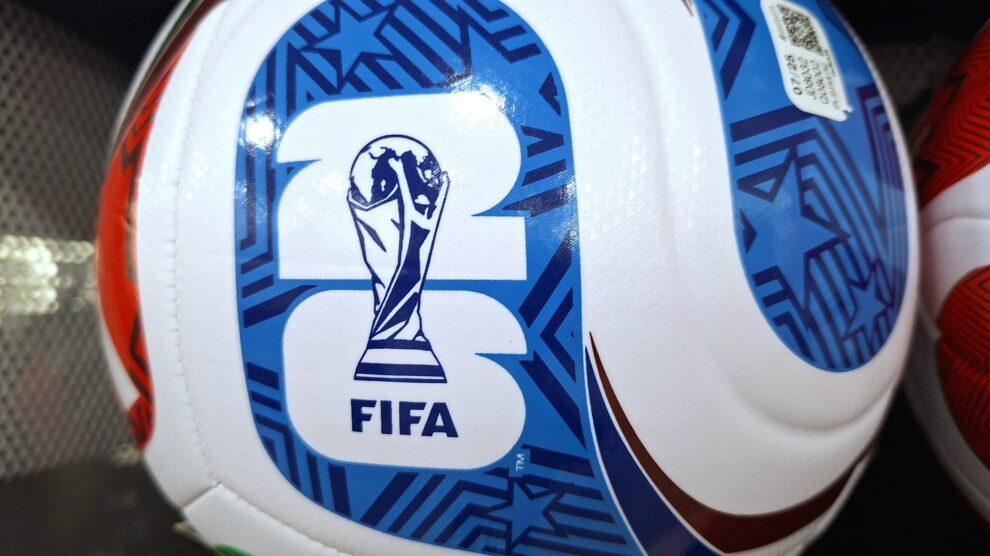
Football needs no reinvention. FIFA, the non-profit that runs it, has decided to put a fifth of its commercial heart up for sale regardless.
The three-minute hydration breaks at the recent FIFA World Cup, ostensibly introduced to allow players to take on water during matches but widely seen as a tool to allow TV rights holders to show more adverts, were summarily booed by match going supporters and criticised by commentators for interrupting the flow of the game. No longer is football a game of two halves, but one of four quarters. “The biggest change to the basic structure of the game since 1897, when it was codified that teams would play two halves of 45 minutes,” wrote Barney Ronay in The Guardian, who added, “It’s an advert break. We know this… the pretence that this is driven by player welfare is classic FIFA, the perfect way of Trojan-horsing this into existence.”
Hydration breaks were not the only ‘innovation’ at the World Cup. In order to squeeze in a ‘half-time show’ during the final, played between Spain and Argentina, the usual 15-minute break was lengthened to 30 minutes, a clear breach of the sport’s own rules which state that half-time should be no longer than 15 minutes. “I thought it was crap,” said former England international Wayne Rooney, on the BBC, echoing the thoughts of an entire nation.
There was political meddling too, when US President Donald Trump brazenly claimed to have personally asked FIFA president Gianni Infantino to review a red card shown to US forward Folarin Balogun, which ruled him out of the US team’s match with Belgium. Balogun was subsequently allowed to play in the game, which the US, to the delight of most of the football world, lost.
Football, arguably, is a rare example of a highly successful business (for it is a business, however much purists may grumble) that needs anything but reinvention. Its fundamentals have remained unchanged for more than a century and it remains a blissfully simple game (kick or head a ball into a goal) that is by far the most popular sport in the world. There have been tweaks to the rules (notably a rule change in 1992 that prevents goalkeepers from using their hands when receiving passes from their teammates), and technology such as video-assisted refereeing (VAR) has been introduced to reduce human error (many will argue it has largely failed). Most innovation has been centered around the commercial side of the game, however, such as how it is packaged and sold to broadcasters, something which has massively increased revenues for clubs, national football associations, governing bodies, and players, whose salaries (not long ago healthy but unexceptional) have ballooned. The average annual salary in England’s Premier League, the most valuable in football, was around 77,000 UK pounds in 1992. Today it is in excess of 3.1 million UK pounds.
A reinvention too far
This week, FIFA announced plans for its greatest reinvention of football yet. On July 28, it said that it wanted to create a new company, FIFA Forward Enterprise, and seek to sell a roughly 20 per cent stake in a deal valuing it at about 20 billion US dollars. Currently a non-profit organisation, FIFA intends to bring together all of its commercial and event operations in the new entity, in which stakes would be sold to private investors. FIFA claimed that the money raised would be paid out to its 211 member associations as one-off payments of 20 million US dollars each. Payments to each association would then increase from two million US dollars per year each to five million between 2027 and 2030. Thrive Capital, an investment company founded by Joshua Kushner, the brother of Donald Trump’s son‑in-law Jared Kushner, is expected to be the lead investor, with JP Morgan heading the search for others.
The announcement provoked immediate negative reaction from UEFA, which runs football in Europe. “The soul and governance of football are not assets to trade. None of us are the owners of football. It is not FIFA’s to sell,” UEFA said.
The concerns are valid. Private investors in the World Cup would almost certainly want control over how the tournament is played, where and when it is played, and who plays in it. Private investors would not tolerate the ongoing absence of Italy, for example, once a powerhouse of international football (and home to a fanatical, huge TV audience) but which has failed to qualify for a World Cup since 2014. Would private investors make room for little Cabo Verde, who exceeded expectations in its first ever World Cup by advancing to the knock-out stage where it gave Argentina a mighty fright before eventually losing in extra time?
It is highly likely that FIFA’s proposed changes will be nodded through. The kind of money FIFA is promising to share with national football associations is, for most of them, eyewatering. What might make them rethink is the realisation that it could lead to them being locked out of football’s premiere international competition. That realisation will probably come too late, however.
Photo: Dreamstime.