Nadya Zhexembayeva began discussing the need for Chief Reinvention Officers in 2015. A decade on, reinvention is more relevant than ever.
Nadya Zhexembayeva was 14 when she took a job selling insurance in a country that had never had any. The Soviet Union was coming apart, Almaty was short of money, and most of her classmates were doing much the same. “Everyone I knew between the ages of 14 and 18 was working in very, very serious companies,” she says. “Privatisation, funds, insurance, sales. We needed to eat.” One friend started dealing cards in a casino at 15 and now runs a large company. Their parents’ generation reacted differently. “They had a more risk-averse response, and many of them just froze.”
A scholarship brought her to America in 1998. She began a doctorate at Case Western Reserve University in 2001, at the school that had awarded the world’s first PhD in organisational behaviour. Enron filed for bankruptcy that December, and she settled on why some large systems come out of an existential shock stronger while others disintegrate. Teaching executive education at the IEDC-Bled School of Management in Slovenia six years later, she was interrupted mid-presentation by a chief executive in the audience. “He said, well, you speak so well I almost believe you, but you haven’t worked in real business.” He became her first consulting client that summer.
Fourteen years in mining followed, along with projects at other enormous companies such as Coca-Cola and L’Oreal. Mark Levy, a positioning consultant, kept pressing her on what her job title would be inside a company. Chief strategy officer left out the execution, chief transformation officer left out the innovation, and none of them covered the legacy assets. “Finally I said, well, maybe it would be chief reinvention officer. It connects the past, the present and the future. Keeping the best but bringing the new.” Levy went quiet for a long time, then told her the URL was free. Her Reinvention Academy opened that December.
Julie Sweet, Accenture’s chief executive, announced last June that the firm would fold strategy, consulting, technology and operations into one unit called Reinvention Services. PwC has built its annual survey of bosses around the same word; the 29th edition, published at Davos in January, found 30 per cent of 4,454 chief executives confident about revenue growth, down from 38 per cent. Dr Zhexembayeva thinks the argument has been won at the top and lost everywhere else. “The forefront is finally catching up with us. The rest of the business [world] is still hoping and praying that this is all temporary and they can go back to a predictable world of long-term planning and annual budgets, where you take three per cent on top of last year’s items and you have a new budget.”
No return to ‘normal’
The recession she dates the problem from began 18 years ago, and she still hears the same sentences in meetings. “When things stabilise. When things go back to normal. We are waiting until the recession is over, until Covid is over, until inflation is over, until the war in Ukraine is over, until the next thing is over. Until AI.” The Disruptive Futures Institute named ‘metaruptions’ its word of the year in December, meaning interrelated disruptions that amplify one another. She calls the result a post-stability economy. “Running a business in a world of permanent volatility, versus one of low uncertainty and relative stability, are completely different things.”
Business schools have split on it. Calgary’s Haskayne School of Business has asked her to build new courses, and BTU in Georgia and AlmaU in Kazakhstan have put reinvention into curricula. Lois Agnew, Syracuse University’s provost, wrote to staff on April 1 to say it would close 93 programmes out of roughly 460, among them 41 bachelor’s degrees. Twenty-three per cent of job-seeking Harvard MBAs in the class of 2024 were still looking for work three months out, against 10 per cent in 2022. Speaking to an association of Slovenian energy producers this spring, Dr Zhexembayeva was told by one chief executive that the youngest recruits were the hardest to work with. “The newest employees, just out of college, are less adaptive than we are. We have to spend time un-educating the new graduates, because they were taught to stick with one thing, that there is one right answer. And they freeze.”
North Dakota created a chief reinvention officer post in August 2018 and gave it to Julie Cabinaw, a former Amazon executive; Kevin Parker took it on a year later; the office was wound down in 2020. That remains the closest any government has come to the second half of her 2015 argument, which was that governments need ministers of reinvention as much as companies need chiefs. Kazakhstan, where she was born,set up a ministry of artificial intelligence and digital development last September under Jaslan Madiev, which she counts as part of the job rather than all of it.
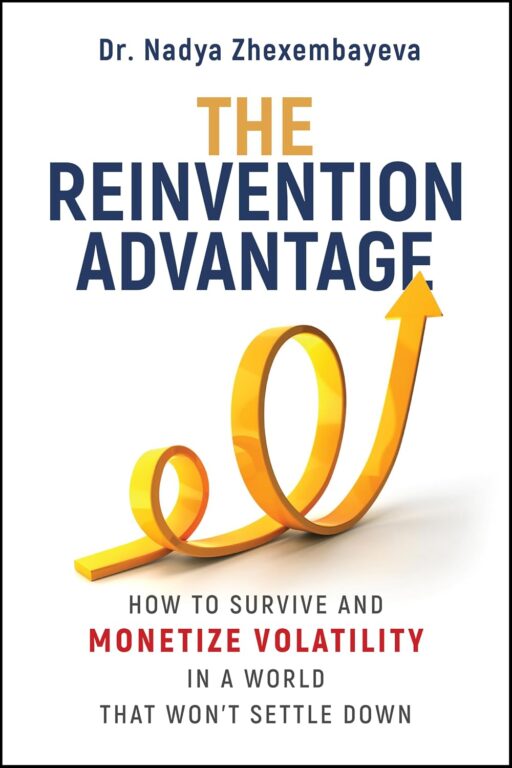
Her one-line definition, and the sentence her fifth book, The Reinvention Advantage, turns on, is that reinvention is the continuous capability to rethink and redesign what already exists while it is still running. “You have a working, functional TV set, plugged in and broadcasting a show, and you need to turn it into a working, functioning vacuum cleaner without unplugging it. Creating continuity between two states, and proactively choosing the next state, so that you are not swallowed by disruption.” She does not hand out templates. “Maths is maths anywhere. In one industry you create complex derivative instruments out of it, and in another you calculate the correct pivot.” Regulated industries take an age to reach a decision and then implement briskly; in other sectors the pattern runs the other way.
Creating reinventive organisations
Gallup’s latest survey put global employee engagement at just 20 per cent in 2025, with 64 per cent not engaged and 16 per cent actively disengaged. Getting employee buy-in for reinvention is important. Dr Zhexembayeva starts clients at the smallest of the Academy’s nine types of reinvention for that reason.
“Your employees are in full-on change fatigue or active resistance. You need to show your people that improvement is possible, and it doesn’t need to be five years down the road. It can be three weeks down the road,” she says.
What she prescribes is beginning with small, micro-reinventions. This can be as little as half-hour “reinvention coffees”, bringing everyone together in discussions that create a mindset that normalises volatility rather than being constantly surprised by it. “Reinvention is making sure that there is a very tight relationship between strategy, innovation, and change because in my experience the majority of companies work in silos,” she says. Innovation, she adds, is often mistaken for reinvention, but is in fact just one part of it. “Innovation on its own is not enough.”
Besides employee buy-in, one of the major stumbling blocks companies face on their reinvention journey is overcoming the idea that reinvention is either too little, or too much, for their organisations.
“Both camps are wrong,” says Dr Zhexembayeva, “because reinvention is managing a portfolio over diversified initiatives. At certain stages in your business, you might need reinvention that is more tame and incremental. At other times you need something more radical. Ultimately, reinvention is a continuous process of managing your organisational renewal ahead of disruption.”
And that is what builds towards future relevance, which she describes as, “a built-in capacity to stay relevant no matter how the wind turns.”
The Reinvention Advantage is published on November 24.