
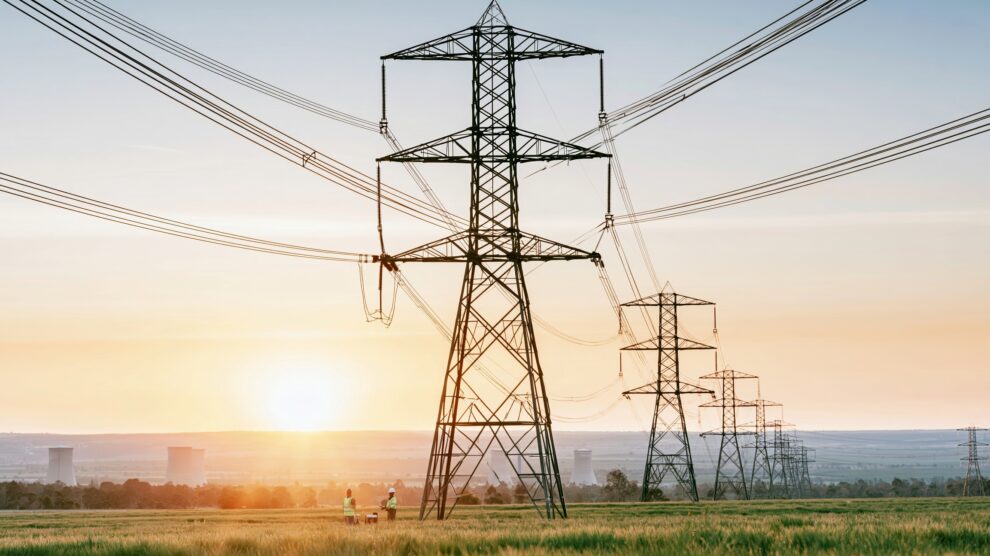
Building infrastructure is a game for giants. Keeping it running, especially the clean-energy grid, is where nimble start-ups now break in.
As anyone who has driven over a pothole, struggled to get through airport security, seen trains delayed, or suffered a power outage will not hesitate to tell you, building and maintaining decent infrastructure is a global headache (with only a very few exceptions, mainly small countries such as Singapore). Even the world’s richest countries suffer from chronic underinvestment in the things people rely on most, day to day. Germany’s railway services are a prime example. Infrastructure is expensive to build, costly to maintain, reaps only belated returns for governments and politicians (often long after they have left, or been booted out of office), and continues to be viewed as a non-starter for disruptors and start-ups given the (perceived) high cost of entry.
There are, however, ways for start-ups to get their foot in the infrastructure door that go beyond pouring cement, and digitalisation is perhaps the most obvious. Long regarded as one of the least digitised sectors of all, the adoption of digital technology is accelerating, according to a report published last month by Deloitte. Based on a survey of 954 construction and engineering businesses across Australia, Hong Kong, India, Japan, Singapore and Vietnam, the report finds that data analytics is now used by 56 per cent of businesses, construction management cloud software by 50 per cent, and mobile apps by 47 per cent. AI or machine learning tools are used 46 per cent of businesses, up from around one-quarter in the first edition of the report in 2023.
McKinsey meanwhile says that global construction spending is projected to escalate from 13 trillion US dollars in 2023 to a 22 trillion US dollars in 2040, which would require a CAGR of 3.2 per cent, a huge opportunity for disruptors of all kinds.
For a small firm or start-up without a sovereign wealth fund behind it, the key to entry is the realisation that the increasingly vague word ‘infrastructure’ no longer means pouring concrete alone. McKinsey redefined the term in another report last September, saying that alongside roads and grids now sits what it calls “a supporting layer of specialised services”, meaning maintenance, inspection, compliance, and (increasingly) remote monitoring, which the firm now classes as infrastructure in its own right. Of themany trillions of US dollars it believes that the world must invest by 2040, energy alone swallows 23 trillion US dollars. Not all of that is cement.
Balancing the grid
Clean energy is perhaps where the smaller entrant can fit in with only minimal investment. Wind and solar capacity grew by about 20 per cent a year between 2010 and 2023, which is at once both a welcome development and yet also the beginning of a painful headache for network operators. Previously, grids were designed and built to send power in just one direction, from large power plants into millions of homes. Networks now also have to cope with electricity coming back the other way, primarily from solar panels on rooftops. Somebody has to make sense of the mess, channeling it to storage facilities that can keep the energy until it is needed by consumers (which usually means after dark). Virtual power plants (a somewhat more grandiose name than they actually deserve) bring together thousands of small solar set-ups and home batteries into something that behaves more like a power station. Vehicle-to-grid schemes, meanwhile, are already being piloted across some Chinese cities, and let electric cars sell power back to the network distributor at busy times.
Then there is the boring but ultimately essential business of network maintenance, of keeping things running and the lights on at home. Predictive maintenance (a sector that includes sensors of various kinds, models, and someone to read the output) has cut downtime at utilities by up to 75 per cent and maintenance costs by up to 30 per cent. A great deal of the American electricity grid was built during the middle of the last century (and grids in many European countries are even older), and the country’s civil engineers believe that failing to modernise it could cost as much as 10 trillion US dollars in lost output by 2039. The European Union says that the increase in demand and deployment of clean energy sources puts strong pressure on network needs, best (or worst?) exampled by grid connection queues being present in at least 16 EU countries as of mid-2026, with data pointing to some 120 GW of mature renewable projects including 1.5 million household installations at risk of not getting timely grid access by 2030. There are multiple root causes leading to emergence of grid connection queues, which are linked to inadequate planning and delays in network development, lack of transparency on available capacity and locational incentives for users, and grid connection procedures not accounting for maturity of the projects requesting the connection. A start-up with a clever inspection drone need not build a solar or wind farm to profit from keeping that solar or wind farm providing electricity. This is arguably where the greatest infrastructure opportunity exists for start-ups, in maintaining somebody else’s expensive and capital-intensive investment. There is profit for the innovative in infrastructure without owning, or even building, that infrastructure.
That’s not to say that there are no more barriers to entry, nor that infrastructure maintenance is easy money (far from it). Barriers remain, and some of them remain high, but these days they tend to have very little to do with the cost of cement (instead, the cost might be patience). Infrastructure clients tend to be governments and utilities, which by their very nature move at speeds that often appear to be glacial when compared with the fastest-moving start-ups and tech firms. But for founders who possess a little patience however, for founders who are prepared to wait, prepared to deal with myriad bureaucratic procedures and government committees, the chance to shine is at the end of the power line. And it might be a lot closer than many think.
Photo: Dreamstime.