
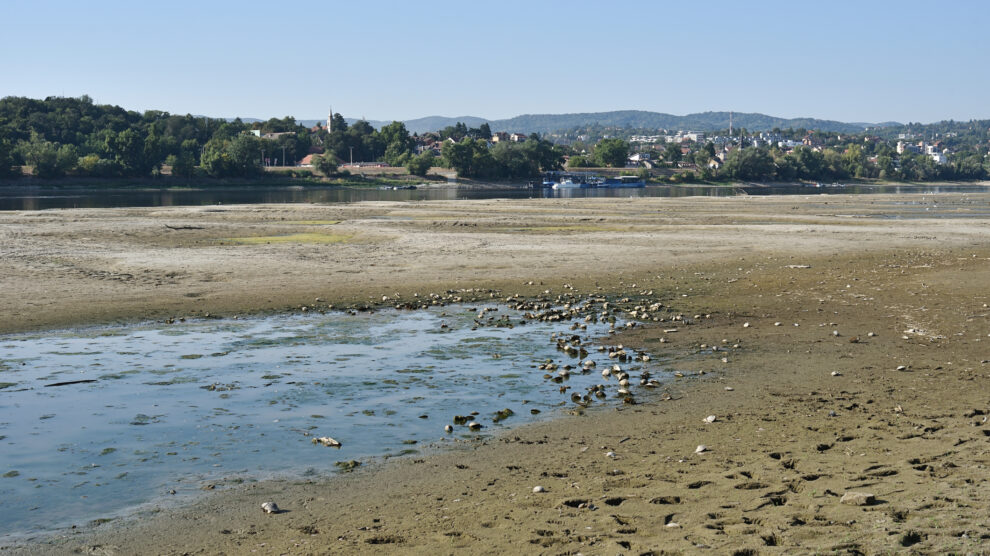

The shrinking Danube looks like drought. But draining its wetlands and floodplains left the region far less able to weather what comes next.
The exceptionally low water levels of the Danube have caused major disruption across the region, dominating headlines over the past week. Vessels have been stranded, water supplies threatened, nuclear reactors forced to shut down, and even mammoth remains exposed by the receding waters.
Across the Danube basin, 79 million people rely on a river system that supports drinking water supplies, agriculture, industry, energy production, navigation, tourism, and fisheries. This dependence makes the condition of the river system a question not only of nature, but of the resilience of economies and societies across Central and Eastern Europe.
The scale of the current situation becomes clearer when compared with long-term conditions. At Giurgiu hydrological station, on the Romanian-Bulgarian stretch of the Danube, water discharge on August 10 stood at around 1,480 m³/s, compared with a long-term August average of approximately 4,600 m³/s. In other words, the river was carrying less than a third of its usual August flow.
What we are seeing on the Danube is part of a much wider economic challenge. A study led by Dr Sehrish Usman at the University of Mannheim, together with economists from the European Central Bank, estimated that heatwaves, droughts and floods caused at least 43 billion euros in short-term economic losses in Europe in 2025 alone, with total costs expected to reach 126 billion euros by 2029.
Putting the urgent need for ambitious climate change mitigation measures aside for the moment, let´s first look into the questions why are we so vulnerable in the first place, and how do we make our societies, economies and ecosystems more resilient to extremes that are becoming increasingly difficult to call exceptional?
What makes us so vulnerable
Think of what happens to your body on a hot day. You sweat and lose water. Without enough to replace what you have lost, eventually your body struggles to function. Nature is not so different. As climate change pushes temperatures higher and makes extreme heat more frequent and intense, more water evaporates from soils and water bodies, while plants lose more water to the atmosphere. When rainfall cannot replenish these losses, soils dry out and drought deepens.
The consequences appear in different ways across the landscape. The shrinking Danube and the wildfires burning through forests across Europe are not separate stories, but of the same increasingly dry conditions.
It may seem that rain is therefore the obvious answer. After all, we know the scene from countless films: the rain finally comes, signalling that the crisis or conflict has passed and a new chapter can begin. But nature does not follow a Hollywood script. Rainfall alone cannot guarantee a happy ending. What matters just as much is what happens to that water once it reaches the ground, and whether our landscapes still have the capacity to retain it.
So what has happened to that capacity?
Try a simple test: what is the first thing that comes to mind when you hear the word ‘flood’? Most probably, disaster. Yet floods are also part of the natural rhythm of a river. The problem is that, over generations, we have taken away much of the space rivers once had to accommodate them. We have straightened and regulated rivers, drained wetlands and floodplains, and built infrastructure where water would naturally spread. More than 80 per cent of the original wetlands and floodplains along the Danube and its main tributaries have disappeared over the past 150 years.
This is not about demonising engineering or human progress. It is about recognising that rivers are living systems whose water levels naturally rise and fall and planning our landscapes to accommodate those fluctuations rather than fight them. When water is abundant, healthy floodplains and wetlands give it space to spread, slow down and seep into the landscape. Take that space away and water has fewer places to go, increasing the risk that a natural flood becomes a human disaster while reducing the landscape’s capacity to retain water for drier times.
The Tisza River offers a striking example from within the Danube basin. Historically a slow, meandering river connected to extensive floodplains, it was straightened and shortened by around 30 per cent, from approximately 1,400 km to 966 km, and confined by embankments, while wetlands across the surrounding plain were drained. This transformed the landscape from a water-retaining to a water-draining system, sending water downstream faster instead of allowing it to soak into the ground and replenish groundwater reserves. Today, groundwater levels across the Hungarian Great Plain are falling by an average of one to three centimetres per year and have declined by several meters in some areas over recent decades. This means less water stored within reach of soils and vegetation, making the landscape increasingly vulnerable during prolonged dry periods.
And the problem does not stop at the riverbank.
Healthy soil works much like a sponge. Its structure, roots and organic matter create tiny spaces where water can soak in and be stored. But decades of intensive land use have weakened that capacity in many places. Heavy machinery compresses those spaces, intensive cultivation can deplete organic matter and damage soil structure, while roads and buildings seal the ground altogether. According to the European Environment Agency, around 62 per cent of European soils already show signs of degradation.
We have, in other words, gradually weakened some of the natural systems that help us deal with both too much water and too little.
How do we become more resilient to the next extreme
The principle is remarkably simple: give water somewhere to go when there is too much of it and help the landscape hold onto it for when there is too little.
Nature already does much of this remarkably well. We do not need to reinvent the wheel, but we do need to start working more consistently with natural processes rather than against them. Restoring wetlands and reconnecting rivers with their floodplains can give rising waters space to spread and slow down, while allowing more water to infiltrate and remain within the wider landscape.
For the Tisza, addressing the pressures described earlier means putting these principles into practice. Proposed nature-based measures include reconnecting floodplains, reactivating former meanders, increasing wetland areas, and improving infiltration across the catchment to help replenish groundwater reserves. The potential is significant: at least 150,000 hectares of floodplain depressions have been identified that could be safely reconnected to the river system and used for floodplain farming, helping keep more water in the landscape while also increasing its capacity to store carbon.
The benefits of nature restoration reach far beyond drought and flood resilience. Wetlands and floodplains can filter pollutants and improve water quality while providing some of Europe’s richest habitats for wildlife. They are also places where people fish, walk, watch wildlife or simply escape the heat. Giving water more space does not necessarily mean taking that space away from people. Done well, it can give something back to both.
The same thinking applies to the land we farm. This is especially important in the Danube basin, where more than half of the land is under agricultural cultivation. As drought and water scarcity become more frequent and intense, the ability of agricultural landscapes to retain water will increasingly matter for farmers, food production and the wider regional economy.
Nature-positive agriculture may sound complicated, but the idea behind it is simple: farm in ways that keep soil and water healthy and able to recover. Keeping the ground covered with plants protects it from the sun and heavy rain, while roots help water soak in and hold the soil together. Reducing how often and how deeply soil is ploughed helps preserve that structure and the life within it. Returning organic matter, and maintaining or restoring trees, hedges and other natural features, can promote its sponge-like qualities. For farmers, that means soil that holds onto precious water for longer, loses less of its fertile top layer during heavy rain, and gives crops a better chance when the next dry spell comes.
Yet this will only make a meaningful difference if we do it at scale.
Europe already has many of the tools. The Nature Restoration Regulation commits the EU to putting restoration measures in place across at least 20 per cent of its land and sea by 2030. The upcoming European Framework for Climate Resilience is another opportunity to put nature at the heart of how Europe prepares for droughts, floods, fires and other climate extremes.
But there is an uncomfortable contradiction. Just as the economic and human costs of climate extremes are becoming impossible to ignore, environmental safeguards are coming under pressure and measures designed to restore Europe’s resilience risk being weakened or delayed. Too often, we still spend heavily once disaster strikes while investing too little in the healthy rivers, wetlands, forests and soils that can reduce our vulnerability before it does.
Resilience cannot remain something we talk about after the river runs dry or the forest catches fire.
And adaptation alone will never be enough. Restoring nature can help us mitigate and live with some of the climate change already underway, but it cannot stop the underlying problem from getting worse. Europe must also accelerate the phase-out of fossil fuels and the transition to a renewable, electrified energy system. We need to do both: tackle the causes of climate change while rebuilding nature’s capacity to protect us from its consequences.
Eventually, the Danube will rise again, and the headlines will move on. We should not. The shrinking river has exposed more than mammoth remains and stranded vessels. It has exposed how vulnerable we have become, and how much of that vulnerability is still within our power to change.
Photo: Dreamstime.