
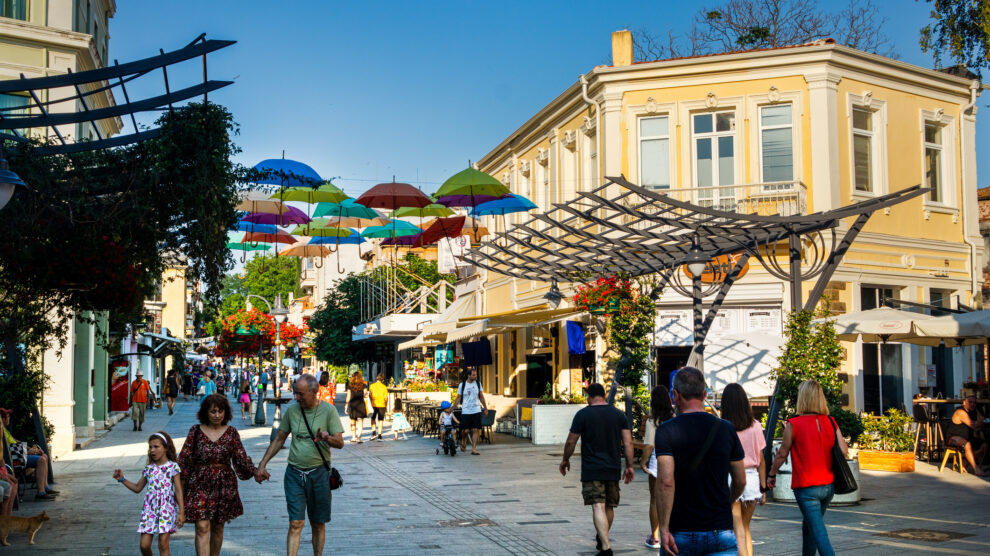
Bulgaria’s fourth-largest city will be a fabulous host of next year’s 71st Eurovision Song Contest. The many naysayers need to get a grip.
Be it boycotts over Israel’s participation, smaller countries not being able to afford the hefty entry fee, rows over voting, costume malfunctions, or conservatives claiming the whole thing is all a bit too ‘gay’, the Eurovision Song Contest is rarely short on drama. One year, the contest will come and go with the minimum of fuss and not a single row.
That year, alas, will not be 2027. Last week, the European Broadcasting Union (EBU) and Bulgarian National Television (BNT) announced that the Black Sea city of Burgas will host the event next May, the 71st edition of Eurovision. That shouldn’t be controversial. Bulgarian act Dara won the 2026 event with the song Bangaranga, and Bulgaria with it the privilege of hosting the next contest. This, however, is Eurovision, so there has to be some controversy, in this case the fact that a regional city (Burgas is only the fourth largest city in the country) has been chosen over the capital, Sofia.
If the social media reaction is anything to judge the public mood by, Eurovision fans are not all that happy. Burgas has been labelled dull, difficult to get to, and in some extreme cases simply not worthy of the contest. Residents of Sofia are unhappy too, taking the selection of the port city as a personal affront.
Strangely, the Eurovision fan community had no such reservations when Basel, not Zurich or Geneva, hosted the 2025 contest. Or Malmo (and not Stockholm) in 2024. Ditto Liverpool (not London) in 2023. Indeed, of the last six Eurovisions, only one (this year’s event in Vienna) has been hosted in a capital (or largest) city. It’s not unusual to choose a regional location, and, arguably, it’s the right thing to do.
Capital city syndrome
Burgas (where, by complete coincidence, your correspondent found himself earlier this month), is a nice enough city more than capable of hosting the event, which will take place at the modern Burgas Arena, opened in 2023. The arena fits around 15,000 people, much the same as the Wiener Stadthalle which hosted the 2026 event, and significantly larger than the arenas used in Basel and Liverpool in recent years. Burgas may find itself short of hotel rooms (one of the arguments that has been thrown at it), but add in the many nearby beach resorts and there will be more to go round than are needed. In May of this year the city hosted two stages of the Giro d’Italia, world cycling’s second most important stage race (only the Tour de France tops it for prestige), and did so with honours. Hosting 22 international cycling teams of eight riders each, their entourages, the publicity circus that precedes the riders, and tens of thousands of fans is a logistical challenge far greater than hosting the static Eurovision Song Contest.
It’s not, then, the credentials of Burgas that people actually have a problem with, more the idea that in Central and Eastern Europe the capital is the only city that matters. There would likely be similar consternation if Romania chose Constanța over Bucharest, Hungary Debrecen over Budapest, Czechia Brno over Prague, Poland Gdańsk over Warsaw. Capital city syndrome is a real thing in this part of the world, in heavily-centralised countries where all roads lead to the capital and those capitals have a grand sense of their own importance. Investors are no different: we have worked on several campaigns trying to convince foreign businesses that work gets done just as well (if not even better) in smaller cities. (In the case of Burgas, investors actually appear to be ahead of the Eurovision crowd: the city ranked second in our 2024 survey of investment promotion experts, asked to nominate the region’s most business-friendly smaller cities).
Reinventing smaller cities should be a key part of any country’s overall strategy. And in Bulgaria, which has seen its population fall from a peak of nearly nine million in 1989 to approximately 6.4 million people today, mostly from its regions (Sofia’s population over the same period has increased by around 10 per cent), promoting and rejuvenating regional cities is perhaps more crucial than anywhere else in the European Union. Burgas will see its economy and profile boosted by hosting Eurovision. That should be a cause for celebration. So enjoy the party, and stop moaning. You can visit Sofia another time.
Photo: Dreamstime.