
Artificial intelligence is the technology of the moment, and Central and Eastern Europe can meet it as eleven competitors or as one region.
Artificial intelligence (AI) is becoming a key engine driving the machine of the Fourth Industrial Revolution (4IR). The driver still matters, which means that Central and Eastern Europe now has to decide which direction it wants to take. This is not just an overwrought metaphor; it separates a region that treats AI as a fashionable chapter of technology policy, confined to a few pilots in public administration, a debate about regulation and a season of conferences and roundtables, from a region that treats it as the foundation of its next economic model.
For Central and Eastern Europe this distinction carries outsized weight since the growth model that carried the region for three decades, built on cheap labor (and other low costs), rising employment and integration into Western European supply chains, is running out of road. AI and the Fourth Industrial Revolution are quite possibly the region’s best available answer to the question of replacing a soon-to-be exhausted model, though an answer is not the same as a plan, and a plan for one country is not the same as a strategy for a region.
Where Central and Eastern Europe stands
Let me state the thesis plainly, because I am to liberate not deflate the readers. No CEE country will win the race to build frontier AI models, and none should try, since that contest is being run between a handful of Great Powers and a handful of companies with budgets larger than most states. The race this region can win is a different one, the race of adoption, infrastructure, skills and social adaptation, measured less by who invents the better AI than by who puts it to work the fastest and most intelligently.
AI does not arrive alone: it meets robotics, automation, energy, semiconductors, cloud computing, data, defence, biotechnology, and advanced manufacturing, and out of that convergence the Fourth Industrial Revolution is built, with stakes that are not only geopolitical but reach into economics, competitiveness, the labour market and the social contract all at once. A country that files AI under ‘digital agenda’ will always be a step behind, and so will a region that files cooperation under ‘press statements’.
To make this practical, I propose a simple framework of four A’s for AI in Central and Eastern Europe, Adoption, Abilities, Assets and Alliances, together with a fifth A above them that holds the others together, the Adaptation of the state. Each of the five has a competitive face and a cooperative face, and the region’s whole future turns on getting the balance between them right.
Adoption: A race Central and Eastern Europe can win
The objective for CEE is less to invent everything than to become the part of Europe that adopts AI fastest, across administration, SMEs, industry, energy, agriculture, healthcare and defence. The real measure of success is how many firms use AI productively and how much their productivity rises, well beyond how many AI conferences a capital manages to host.
Here the competitive instinct is healthy, and letting Warsaw, Prague, Bucharest, Sofia, Tallinn and Ljubljana compete to be the region’s adoption leader drags everyone’s diffusion/adoption rate upward, though diffusion also carries a cooperative logic the region routinely ignores. A shared approach to AI standards, education, cybersecurity, procurement templates and cross-border deployment for SMEs would let a solution proven in one market scale across ten others overnight. So far, in the adoption race, the Single Market has been the CEE’s most underused asset.
Germany’s Mittelstand offers a useful precedent here: a network of highly specialised, often family-run companies that took most of a century to mature into the hidden champions anchoring its industrial base. Central and Eastern Europe’s own family businesses, from Poznań to Kraków and from Bucharest to Sofia, are compressing a similar transition into a fraction of that time, and they are not trying to become the next SAP or Siemens. Instead they are aiming to be quietly dominant in one narrow domain, built to last rather than to sell. That combination of family ownership and technical specialisation is exactly the vehicle that can carry AI adoption into corners of the economy that large national programmes rarely reach, and the shared standards and procurement templates proposed above would put the Single Market’s most underused asset to work precisely where these firms operate.
Abilities: The social contract of the Fourth Revolution
Here the argument becomes larger than technology, since the Fourth Industrial Revolution poses a social-contract question the region cannot dodge: what happens to the teacher, the accountant, the civil servant, the engineer, the doctor, the industrial worker and the entrepreneur whose jobs do not necessarily disappear but are profoundly transformed? The only serious answer is preparation, since fear solves nothing, and it means CEE needs mass AI literacy, reskilling and upskilling, beginning in school and continuing across the working life (and in retirement), with the aim of preparing people to work well and safely alongside AI.
The competitive danger here is quite real, since talent moves, and a region that lets its AI-capable graduates brain-drain away to its own richer members and then to the West will hollow itself out. The cooperative opportunity is equally real, and includes shared talent pipelines, mutual recognition of AI skills credentials, and regional mobility that keeps talent inside CEE even when it crosses a border. A Romanian engineer working in Krakow is a regional win, while a Romanian engineer working in Munich is a regional loss the whole bloc absorbs.
Assets: Where cooperation stops being optional
Artificial intelligence does not live in the cloud in any metaphorical sense; it lives in physical infrastructure, consuming electricity and needing grids, land, capital, compute and infrastructure and policy predictability. The assets that matter are energy, data centres, digital infrastructure, computing power, datasets and cybersecurity, and this is the domain where CEE’s competition-versus-cooperation dilemma stops being theoretical.
The evidence is already in plain view: by 2026, the EU had built out a network of AI Factories across the bloc (19 sites across 16 Member States, complemented since by 13 AI Factory Antennas across seven Member States and six partner countries), and the region is well represented. Czechia, Lithuania, Poland (Piast-AI), Romania were added in the October 2025 round, joining earlier selections in Bulgaria, Poland (Gaia-AI) and Slovenia from March 2025 and Greece from the first round in December 2024, while Slovakia secured one of the Antennas linking smaller ecosystems into the wider network.
The sharper test is the next tier. An initial call for expressions of interest for AI Gigafactories drew 76 proposals from sixteen Member States in 2025, worth more than 230 billion euros in indicative investment, and on 30 July 2026 the European Commission and EuroHPC formally opened the tender for up to seven AI Gigafactories, with bids due by 12 November 2026 and selection expected in early 2027 (the joint EU and Member State funding is meant to act as an anchor for more than 20 billion euros in private investment). Every capital wants one, but only a handful will get one, and a region that sends nine competing national bids will split its own chances while a region that assembles one or two serious cross-border consortia gives itself a genuine shot at hosting compute at continental scale. Competition here risks a collective loss, while cooperation offers a greater chance for a seat at the table.
The CEE region should also be honest about which parts of the stack it can realistically own. Intel’s cancellation in July 2025 of its planned 30 billion euro Magdeburg megafab and its 4.6 billion US dollars assembly-and-test plant near Wroclaw, abandoned for lack of committed demand, dealt a real blow to Europe’s ambition of doubling its share of global chip production by 2030. The lesson should be about selectivity rather than defeatism, since, while Intel retreated, the TSMC-backed ESMC fab in Dresden pressed ahead, targeting the mature automotive and industrial chip nodes Europe consumes. CEE’s edge is unlikely to be bleeding-edge lithography, and is far more likely to be energy, data centre capacity, back-end manufacturing, automotive-grade silicon and the industrial base to provide sustained demand. Poland already holds ready-to-build sites with regulatory frameworks in place, and Asian and American investors are increasingly reading the CEE region as an alternative to costlier Western locations, an option for the region to engineer deliberately.
The energy side of this equation is essential, since AI’s appetite for electricity has to be met by an actual grid. Poland’s first nuclear plant, three Westinghouse AP1000 reactors under construction at Lubiatowo-Kopalino, runs on an American technology partnership, and an earlier plan for a second, Korean-backed plant at Pątnów collapsed when KHNP withdrew in 2025, leaving Warsaw’s smaller reactor programs, NuScale and GE Hitachi’s BWRX-300 among them, to run through American and Canadian partners instead. Romania is pursuing a parallel track, completing units 3 and 4 at Cernavodă while advancing a NuScale small modular reactor at Doicești that secured its final investment decision earlier this year. Neither project was built with Artificial Intelligence compute in mind, but both will feed the same grids the region is now asking to carry AI Factories and Gigafactories, which means energy policy and Artificial Intelligence policy in this region are effectively the same policy.
Alliances: Small alone, consequential together
No CEE country is large enough for technological autarky, though each is important enough to have choices, and the task is to steer intelligently between the American ecosystem, which remains the West’s principal technology engine, European sovereignty ambitions, which supply the regulatory and funding frame, and Asian supply chains, which remain indispensable for semiconductors, hardware and the industrial value chain. The EU has put real money behind this ambition, with the InvestAI initiative aiming to mobilise 200 billion euros for AI in Europe, on the understanding that smart sovereignty is measured by resilience in what truly matters more than by self-sufficiency in everything.
The alliance CEE consistently underuses, however, is the one closest to home, the alliance with itself, and this is where a coopetition doctrine, competing hard for investment and talent while cooperating hard for scale and negotiating power, becomes a critical strategy rather than public discourse boilerplate. Taken as a single bloc, Central and Eastern Europe is an economy of continental weight that negotiates as if it were eleven small ones, and ASEAN, a far more heterogeneous grouping, extracts advantage from a coordination that CEE leaves untapped every year. A region that bargains together on compute, energy interconnection, chip supply and AI standards is a region with options, while a region that free-rides on Brussels and competes only against itself will remain a rule-taker in the most consequential technology shift of the century.
The hybrid dimension of this coordination problem is no longer hypothetical either. Artificial Intelligence sits inside this picture as both a target and a tool, since the same drone and cyber threats testing the region’s air defenses are also the fastest-growing market for the AI-enabled detection and response systems its own defense industry could supply, if the region treats this as shared infrastructure rather than as eleven separate procurement lists.
Ukraine’s reconstruction adds a second, more constructive layer to the same alliance logic. The World Bank, the European Commission, the United Nations and Ukraine’s own government now put the cost of recovery at close to 588 billion dollars over the next decade, a bill that will move mostly through the region, since Romania’s ports and rail corridors and Poland’s logistics networks are the physical route most of that investment has to take. A reconstruction effort of this scale needs digital infrastructure, data standards and Artificial Intelligence-enabled planning and monitoring tools from day one, and CEE countries that position themselves now as the technical backbone of that effort, rather than merely its neighbours, stand to gain a foothold in Ukraine’s rebuilding that will still matter long after the last invoice is paid.
The fifth A: Adapting the state at regional scale
The four A’s do not run themselves, and this is where most strategies falter. CEE does not need eleven more national strategies sitting handsomely in the office drawers of eleven PM offices. It needs implementation architecture, and increasingly a regional layer to it. Nationally, that means a high-level AI + 4IR coordination mechanism bringing together government, private sector, academia and civil society, with measurable 2030 targets and clear accountability for each, while regionally it means treating coordination as infrastructure in its own right.
That this can work is no hypothetical, since EuroHPC already stands as a working proof that pooled European infrastructure delivers what fragmented national efforts cannot, and the frontier keeps widening, with Moldova joining as the 37th participating state and extending the region’s supercomputing perimeter eastward. The institutions exist. What is usually missing is the political decision to use them collectively rather than one country at a time.
The luxury of the warning
Central and Eastern Europe missed the beginning of several industrial revolutions and caught up later, always at a steep cost and and investing in yesterday’s new thing. This time, for once, the region has the luxury of the warning: we know the change is coming, we know roughly in which direction, and we know its speed will only increase. The question is no longer whether Artificial Intelligence and the Fourth Industrial Revolution will transform this region; it centers instead on whether CEE will meet them with wishes alone, which are cheap, or with options, which have to be built, funded and negotiated together.
None of this is happening on the periphery of Europe anymore, whatever the old habit of calling this region its Eastern edge might suggest. Supply chains now run through it, energy corridors now cross it, and Artificial Intelligence is one more system in which engineering talent decides who sits at the center, regardless of geography. A region that spent thirty years catching up has the chance, in this one respect, to help write the rules instead of only following them.
For Central and Eastern Europe, the future in AI and in the Fourth Industrial Revolution will have to be built and negotiated deliberately, engineered as a region rather than gambled on eleven separate hands.
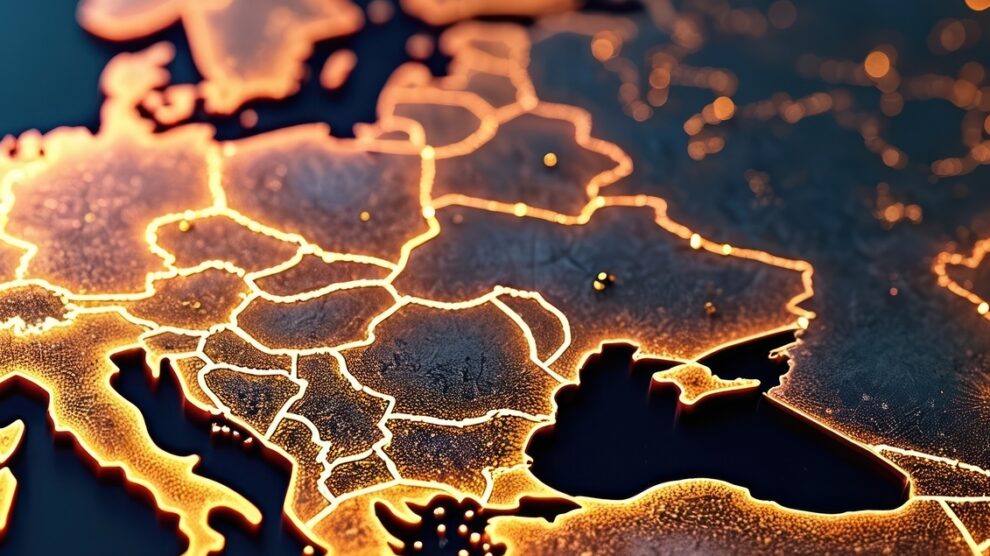
Photo: Dreamstime.