
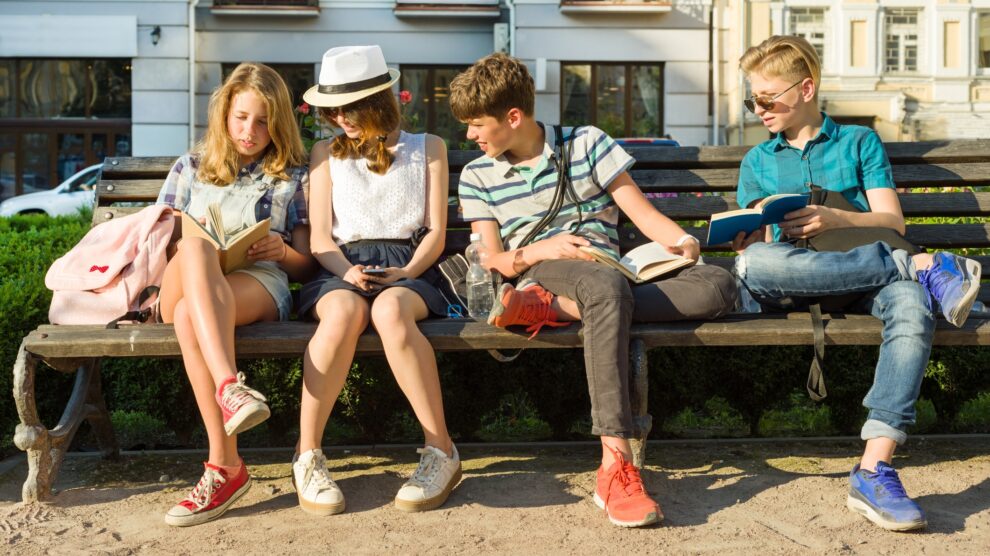
Teenagers read worse than they did, the newest PISA scores find. Ban their social media if you like; the adults, who vote, fare no better.
Amidst a deluge of short-form video content across so many different social media channels, content which these days can cover anything from politics to food, sport to travel, dating advice to film reviews, can anyone still be bothered to actually read anything? The evidence put forward by the latest results of the Organisation for Economic Co-operation and Development’s (OECD) PISA scores is that the next generations are increasingly disinclined (or able) to do so. More than 760,000 15-year-olds took the PISA science, mathematics and reading test in 2025, across 91 countries and economies. While overall performance of OECD members (mainly rich countries) declined across all three disciplines, the fall in reading performance was the most notable, with scores falling in skills that matter most in the AI age: evaluating information, making connections across multiple sources, and thinking critically about what we read. What’s more, instances of what the OECD calls ‘hasty reading’ (in which students read quickly but inaccurately) nearly doubled to nine per cent between 2018 and 2025. This does not bode well for the immediate future.
These developments, the OECD says, are part of a longer-term trend. The weakening of performance predates the Covid-19 pandemic in many countries, pointing to deeper and more persistent challenges within education systems. In reading, increased digitalisation, longer screen time, and falling rates of reading for enjoyment have coincided with weaker literacy outcomes. Interestingly, countries with the largest declines in reading also tended to record the largest drops in mathematics and science.
Digital and AI tools are increasingly embedded in students’ learning, but their relationship with performance depends on how they are used. Across OECD countries, moderate use of digital devices for learning is associated with stronger science performance, while excessive use and digital distraction are associated with weaker outcomes. More than one in four students report that their classmates are distracted by digital devices in most or every science lesson.
Policymakers, the OECD’s secretary general Mathias Cormann suggests, have several levers to make education systems more effective and efficient. The starting point is focus: set high, consistent expectations for every student in reading, mathematics and science. Education systems need to favour depth over breadth (better to teach a smaller set of core topics well enough for genuine mastery than to rush through a long list only superficially). That focus only pays off, though, if the rest of the system supports it: curriculum, teaching and assessment need to reinforce each other rather than pull in different directions, and classrooms need to be kept free of avoidable digital distractions, for instance by limiting non-instructional phone and device use during lessons. And as artificial intelligence becomes part of the classroom, it should be used in a targeted way for feedback and personalised practice. It should add to students’ effortful learning rather than replace it, since real understanding comes from doing the thinking, not from having a tool do it instead.
What about parents?
Beyond schools and education systems, broader societal trends may also have affected how young people learn and engage with school, in general, and with written texts, in particular, the report finds.
PISA 2018 results already showed that students’ reading habits were changing. Compared with 2009, larger proportions of both boys and girls reported that they read only if they have to. Across OECD countries, the index of enjoyment of reading declined over the decade to 2018. At the same time, students reported that they read fewer fiction books, print magazines and physical newspapers, and that they engaged increasingly with text through online activities such as searching for information, chatting and reading news online.
Parents also play an important role in shaping children’s attitudes towards reading from the earliest years. Previous PISA analyses have shown that students whose parents were seen reading at home, or whose parents reported that they enjoyed reading, tended to report greater enjoyment of reading themselves. Although results from the PISA parental questionnaire in 2009 and 2018 cannot be compared directly because of changes in response options, parents’ responses suggest that reading lost ground as their ‘favourite hobby’, and therefore that reading enjoyment declined among parents, not just their children, across many of the countries and economies with available data. Changes in 15-year-olds’ reading engagement therefore seem to have coincided with broader changes affecting other age groups too, including their parents, who are important role models and can strongly influence young people’s reading habits at home.
This suggests that attempts to limit the access of young people to, for example, social media (as Australia has done in full, and a few other countries partially) might not bring about any real change in habits. It may make children safer online (the stated goal), but might do little to prepare them to critically assess the disinformation they will be exposed to once they come of age. Indeed, the fixation on protecting children from social media’s worst excesses misses the rather more pressing problem that adults aren’t faring much better. The same manipulation, the same disinformation, the same algorithmic amplification of rage and nonsense that allegedly warps young minds works just as effectively on their parents. Possibly more so. After all, 15-year-olds can’t vote. Adults persuaded by a candidate’s bot-charged social media campaign can.
Photo: Dreamstime.