
Firms worked hard to make their supply chains greener. The more urgent threat is the weather now breaking them, and few have a plan for it.
Nearly nine in ten (87 per cent) of pharmaceutical companies across the G7 expect climate-related disruption to their medicines supply chains to increase in the years ahead, according to research from the British Standards Institution (BSI). A rather different kind of remedy, coffee, faces climate change-linked supply gaps of up to 30 per cent in Western Africa and Latin America over the next 20 years: together they account for 90 per cent of the world’s total coffee exports. Europe’s baking hot summer and drought this year rendered parts of the Rhine all but unnavigable, with barges carrying raw materials and containers into Germany often restricted to a fraction of their normal carrying capacity. Elsewhere, extreme heat has disrupted fashion’s supply chain, and then there’s food: according to the United Nations Food and Agriculture Programme (UNFAO), approximately 14 per cent of the world’s food (worth around 400 billion US dollars annually) is lost within the supply chain between the post-harvest and retail stages, often as a result of climate-induced problems. DP World, an Emirati multinational logistics firm, says that extreme weather events are now structural rather than seasonal. Temperature shifts, droughts and flooding repeatedly disrupt transport, cold storage and inventory planning, which turns reliability into a climate adaptation challenge.
For as long as CEOs have been talking about sustainability development goals (SDGs), discussion around supply chains has centered on the need to make the supply chains themselves more sustainable, through the deployment of technology, clean energy, the optimisation of shipping routes, upgrading vehicle fleets, sourcing closer to markets, and use of more environmentally-friendly packaging. All admirable, all well and good. But this focus on the environmental impact of supply chains has meant that the arguably more pertinent (and urgent) problem of supply chains breaking down precisely because of environmental impact has been forced to take a back seat. The consequences are now clear for all to see.
Climate change doesn’t respect borders
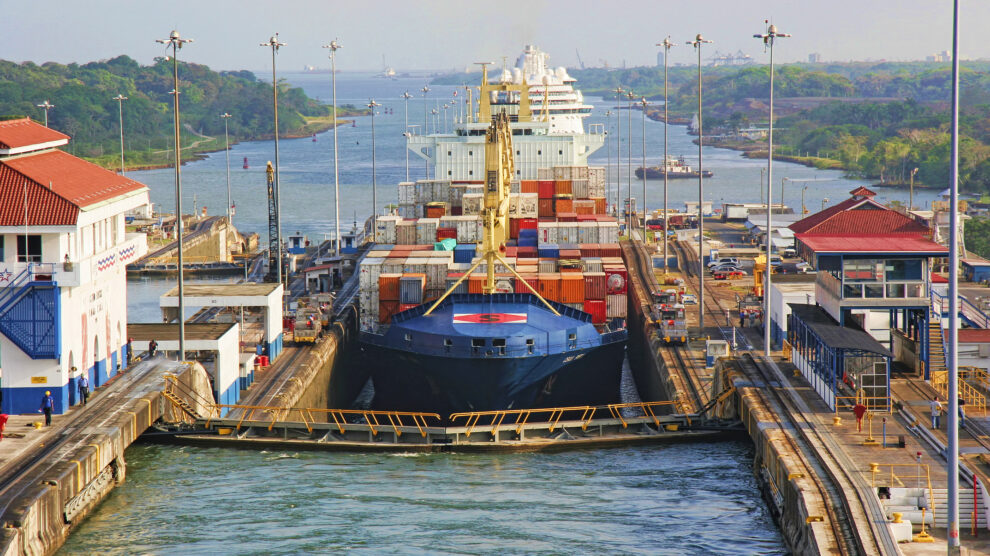
Ricaurte Vásquez, the Panamanian economist who runs the Panama Canal, spent much of 2023 and 2024 rationing access to what is one of the world’s busiest and most important trade routes. Drought impacted Gatún Lake, the rain-fed reservoir that allows ships to sail through the canal’s locks, and the canal authority at times needed to cut daily crossings from 38 a day to 24, with the total number of crossing in the 2024 fiscal year falling by 29 per cent. The cargo that was regularly left queuing at either end included children’s toys and, on some vessels, the rather more urgent insulin. This year has been disruptive too, and on September 4 the canal’s operators capped its larger locks at nine slots a day, following rainfall between May and August that was more than one-third (34 per cent) below average.
The Business Continuity Institute reported in 2024 (with Zurich Resilience Solutions) that more than a quarter of organisations had suffered weather-related disruption to their supply chains in the previous twelve months, while more than a third did not analyse climate risk at all. In Europe, which often takes the view that it is somehow sheltered from climate extremes, nearly half had never factored it in. Everstream Analytics, a risk consultancy, put extreme weather at the top of its 2025 supply-chain threat list and gave it a risk score of 100 per cent. Business-continuity planning, and the ISO 22301 standard built around it, has largely been designed for one-off events, and as the past couple of years have demonstrated, it does not cope quite so well with disruption that is continuous, and never really ends. “Climate change doesn’t respect borders,” notes Andrew Forsyth of Zurich Resilience Solutions.
The World Economic Forum says that extreme weather is the gravest long-term danger facing the planet, as it has for the past three years, although in its 2026 survey the risk slipped down the two-year ranking, pushed aside by trade wars and geopolitics. Barge operators on the Rhine do not have the luxury of the ten-year view.
Barry Callebaut, the world’s largest chocolate maker, issued a profit warning in April, its third cut to guidance in a year. Hein Schumacher, who became chief executive in January, blamed a “turbulent period” of price swings, after West Africa (source of about 70 per cent of the world’s cocoa) lost roughly a tenth of its 2025-26 crop to disease, ageing trees and unreliable rains. Back in December the firm had gone further, weighing a split of its volatile cocoa-trading arm from its chocolate business. Mondelez, the maker of Cadbury, had already warned investors to expect earnings down by a tenth.
When Hurricane Helene flooded Baxter International’s plant at North Cove, North Carolina, in September 2024, production at the site (which at the time supplied roughly 60 per cent of America’s intravenous fluids) came to a halt, leading hospitals to ration saline and, on some wards, reportedly hand patients Gatorade, a sports drink, instead. Baxter admirably had North Cove running again by February 2025, but from medicine to food, coffee to chocolate, the warnings should by now be far too loud for firms not to heed: supply chains are under threat from climate change and for many, the very continuity of their businesses relies on urgent adaptation and increased resilience. The evidence so far suggests that many will fail the test.
Photo: Dreamstime.