
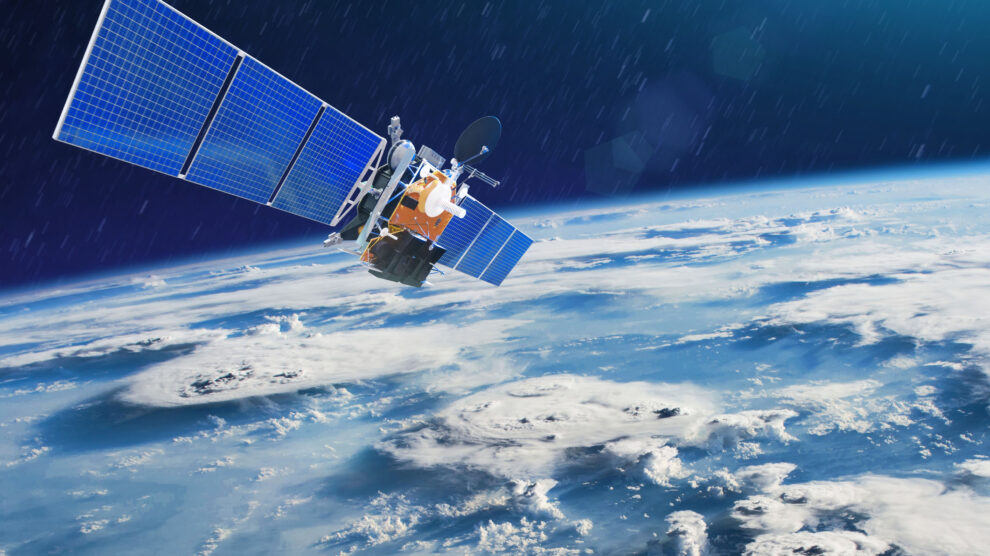
Governments are pouring record public sums into space. But the returns, and above all the rockets, still belong mostly to America and China.
Space may well be the final frontier, but there’s money to be made on Earth, too, and a lot of that is public money. Governments around the world made a global public investment of 119 billion euros in the sector last year, according to the European Space Agency (ESA). The upstream market, focusing on spacecraft manufacturing and launch service provision, is valued at 75 billion euros, with 80 per cent institutional demand now dominated by defence. The largely commercial downstream market, comprising satellite communications, Earth observation, and Global Navigation Satellite System (GNSS)-related activities was valued at approximately 490 billion euros in 2025 is largely commercial. GNSS services dominate, accounting for 77 per cent of the market. Satellite data, signals and services continue to be increasingly embedded in the wider digital economy, says the ESA.
The Organisation for Economic Co-operation and Development (OECD), a club of mostly rich countries, agrees. Its own report looking at the space sector, published this week, finds that while space’s direct footprint in GDP is still relatively small, its strategic and economic importance extends far beyond the sector itself. Space-based systems already support more than half of the most critical infrastructures and services across OECD countries. “Our transport systems, energy grids, communications and food supply all depend on the commercial space economy,” notes OECD Secretary-General Mathias Cormann.
If governments (and agencies such as the ESA and NASA) remain central to steering the development of increasingly competitive commercial space markets, influencing both the pace and direction of market development through public R&D, procurement, commercialisation support, data-access policies, incubators, technology transfer, regulation and finance, private investment is also playing a growing role in the space economy. Industry estimates put private capital flows to the sector at 11-13 billion US dollars in 2025, the highest level since 2021, with investment concentrated in mature firms and capital-intensive activities such as space manufacturing and launch. Maintaining civil R&D investment, the OECD believes, will be important for long-term competitiveness as public funding priorities increasingly shift towards defence. Civil space accounted for 6.3 per cent of government civil R&D budget allocations across the OECD’s members in 2024. While remaining modest in scale, civil space R&D is strategically important, and slowing growth could have implications for future innovation and competitiveness.
The next wave of space innovation is already visible in scientific output and patent data. Space-related scientific output has more than doubled since 2009, while participation in global research networks expanded from 80 countries in 2000 to 119 in 2024. Innovation is increasingly focused on areas including AI-enabled analytics, quantum applications, debris mitigation, in-orbit systems and advanced power technologies. Spacecraft electrical power alone represented 46 per cent of space-related patent applications in 2023.
By the end of 2025, 109 countries had put at least one satellite into orbit. This increased participation means that keeping Earth’s orbit safe and usable is becoming an economic resilience issue. The OECD’s report shows that almost 200 billion US dollars of economic activity is exposed to space debris risks. This makes orbital safety and future space traffic management essential not only for protecting the space environment, but also for safeguarding economic resilience, security and critical service continuity.
Nevertheless, while participation is broadening, independent orbital launch remains heavily concentrated, with only 12 countries, and Europe with the ESA, possessing such capability by mid-2026. The United States accounted for 55 per cent of orbital launches and 87 per cent of launched objects in 2025, China for 28 per cent of launches and 8.4 per cent of objects. Participation in the space economy is broadening but the capacity to launch and operate at scale is not.
Europe’s problem
Europe recognises the problem, the ESA highlighting that more than 80 per cent of the global launch and manufacturing market value are not accessible to European primes (European launch service provider and spacecraft manufacturers) because of captive demand from institutional programmes, in particular defence and human spaceflight (most notably US and China) and from vertically integrated constellations.
With that problem very much in mind, European leaders spent two days last week trying to change that, at the first International Space Summit. It pulled in around 20 billion euros of announced investment and 51 signed deals. Emmanuel Macron, the French president, pressed for shared rules over an unregulated scramble. Ursula von der Leyen, the European Commission president, confirmed that the bloc would enlarge its IRIS2 constellation to more than 350 satellites and speed up deployment. IRIS2 is specifically designed to provide connectivity to European government and military users without dependence on commercial providers operating under the laws of other jurisdictions (notably SpaceX’s Starlink, which did not attend the event).
Amazon was present, however, and signed on for six more Ariane 6 flights, making Jeff Bezos’s firm the European rocket’s biggest commercial customer. Europe can keep buying access to space from providers bound by other governments’ laws, or it can build the infrastructure others depend on, said Josef Aschbacher, the ESA’s director-general. Shortly before the event, on September 5, Isar Aerospace, a German start-up, became the first firm to reach orbit with a privately built rocket from European soil.
As welcome as these developments are, the OECD says that despite the space economy now closing on the size of the semiconductor industry, the money and the rockets stay concentrated in a handful of American and Chinese hands. Europe has the budgets and a sovereign constellation on paper, but IRIS2 will not be ready fully until 2030, France and Germany are still arguing over whose secure network comes first, and the continent’s own heavy launcher is kept aloft by an American billionaire. Its space ministers will meet in Rome in December to decide how much of what was promised in Paris will actually be paid for.
Photo: Dreamstime.