
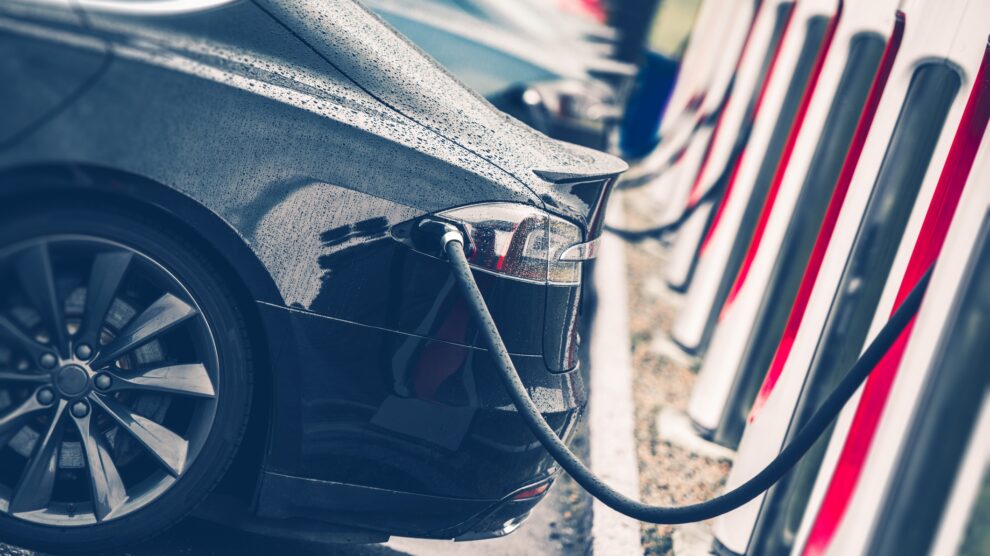

The European Commission now says plainly that electric cars make Europe more secure, not just greener. Yet its policies still too often treat energy security as an afterthought.
At the Paris World Exhibition of 1900, visitors could inspect an engine built to Rudolf Diesel’s design by the French Otto company. It ran on peanut oil. Diesel himself later predicted that vegetable oils might one day become as important as petroleum. It did not work out that way. His name became shorthand for a fuel European transport cannot do without—and whose raw material Europe buys almost entirely from abroad.
The price of dependence
Since 2022 oil prices have lurched from one shock to the next. In June that year, months after Russia’s full-scale invasion of Ukraine, Brent crude averaged more than 120 US dollars a barrel. In March 2026 the near-collapse of shipping through the Strait of Hormuz pushed the price up by 65 per cent in a single month, the largest monthly rise the World Bank has on record. In mid-September a barrel cost around 107 US dollars, more than 50 per cent up on a year earlier.
Whoever controls oil supply has leverage over prices. In 2024 the European Union relied on imports for 96.6 per cent of its oil and petroleum products. Europe’s refineries turn crude into petrol and diesel, but the crude itself arrives by tanker and pipeline from suppliers over whose decisions Europe has limited control.
That is why electrifying transport makes sense for reasons that go well beyond the climate. Europe’s electricity comes from solar and wind, nuclear and hydro, gas and coal, and an electric car runs on whichever of them happens to be feeding the grid. You cannot put diesel in a typical petrol engine, or the other way round. With an electric car, the source of the energy can change without anything changing under the bonnet.
A late conversion
None of this is news in Brussels. On July 17 the European Commission published its Electrification Action Plan, which says electrification will reduce dependence on imported fossil fuels and Europe’s vulnerability to geopolitical shocks, and could cut the EU’s fossil fuel import bill by 260 billion euros a year by 2040. It also notes that driving a battery-electric car can cost up to 78 per cent less than running an equivalent fossil-fuelled one. A month earlier the Commission acknowledged that high oil prices were helping to drive electric car sales, and that EVs already save the EU an estimated 140,000 barrels of oil a day.
The Commission has finally got the diagnosis right. For years, though, the political case for electric cars rested mainly on CO2 standards, ‘climate neutrality’ and bans. Brussels spent more time lecturing than persuading, and Europeans have responded much as lectured people usually do.
The polling bears this out. A YouGov survey for CLEPA, the European association of automotive suppliers, asked 5,221 adults in Germany, France, Spain, Italy and Poland about their next car. Only 8 per cent named a fully electric model as their preferred option, although the sample included people with no plans to buy a car. In 2024 Bloomberg Intelligence found that only 18 per cent of prospective buyers in five major European markets, Britain included, would choose a battery-electric car, while 68 per cent wanted the 2035 deadline for ending sales of new petrol and diesel cars dropped or pushed back. In December 2025 the Commission itself proposed softening that target from a 100 to a 90 per cent cut in exhaust emissions.
That may say less about electric cars than about being told how to live. Drivers in Łódź or Lyon are unlikely to buy a car to save the polar bears. They will buy one if the sums show that charging is cheaper and more predictable than filling up. The Commission now has those sums. It took an oil shock to put them front and centre.
Poland’s million
Poland shows how the same inconsistency plays out at national level. In 2016 Mateusz Morawiecki, then a minister in Poland’s conservative government and later prime minister, spoke of an aspiration to move towards a million electric cars within a decade. The target was widely mocked. Since 2022 its logic has looked rather better.
The current government, led by Donald Tusk—who in opposition promised petrol at 5.19 złoty a litre, against almost eight złoty today—has gone the other way. Until August 31 it cut VAT on fuel to eight per cent and capped pump prices, in effect subsidising petrol and diesel. Meanwhile NaszEauto, the national subsidy for buying electric cars, funded from Poland’s share of the EU recovery fund, ran out of money in January and closed to applications in April. There will be no successor scheme, the deputy climate minister has said.
Registrations then began to fall. Between January and August Poles registered 20,926 new battery-electric cars, 2.1 per cent fewer than a year earlier; in August alone sales dropped by a third, the fourth monthly decline in a row. The Polish car industry association cites the end of subsidies as the main reason. In Germany, by contrast, cars registered since January 1 qualify for grants of up to 6,000 euros, and battery-electric registrations rose by 48 per cent in the first half of the year. Across the EU, electric cars now take 20.7 per cent of new registrations. Britain, outside the EU, has its own Electric Car Grant, which knocks up to 3,750 UK pounds off a new EV.
Coal underfoot, oil overseas
In 2025 Poland produced 97 per cent of the EU’s hard coal. Germany burns close to half of the bloc’s lignite, which is also mined in Poland, the Czechia, Bulgaria, Romania and Greece. None of it has to pass through the Strait of Hormuz. Coal is leaving Europe’s power mix regardless—it generated just 9.2 per cent of EU electricity in 2025—so the real question is how fast it goes, and at what cost to the countries that still rely on it.
Carbon pricing is where the inconsistency is sharpest. Under the EU Emissions Trading System, a power station pays around 88 euros for every tonne of CO2 it emits, whether it burns domestic or imported coal. That cost feeds straight into the price of the electricity that charges an electric car. The petrol and diesel in a conventional car, refined from imported crude, will not be brought into EU carbon pricing until 2028, after the EU decided this year to delay the new system for road fuels. Fuel is heavily taxed, of course, but not through the carbon market. For now, then, Brussels puts a carbon price on the home-grown energy that could power Europe’s cars, but not yet on the imported oil it is meant to replace.
Nor is there a single, EU-wide scheme to help people buy an electric car. The Social Climate Fund can pay for social leasing and similar support, but whether drivers actually get help depends on national governments—in Poland’s case, the one that promised cheap petrol.
Security first
Brussels ought to like the next point. Even in the worst case—a car with a Chinese-made battery charged from Poland’s still coal-heavy grid—an electric car emits 37 per cent less CO2 over its lifetime than a petrol one, according to the campaign group Transport & Environment. There is no real trade-off here between climate and security: every additional electric car cuts transport’s demand for imported oil, and its lifecycle emissions are lower too.
So Europe should reverse the sales pitch. Lead with price, convenience and security rather than moral pressure, and manage the shift away from coal at a pace that does not undermine Europe’s own sources of power while oil prices remain hostage to conflict in the Middle East. Electrifying transport is climate policy, but it is also a question of strategic autonomy, as the Commission itself now acknowledges.
Rudolf Diesel wanted an engine that could run on more than one fuel. The electric car gets closer to that idea than he could have imagined: the power station changes, the car stays the same. Brussels has the argument. The question is whether it will use it before oil gets cheaper and drivers forget why switching was worth it.
Photo: Dreamstime.