
Why three regions that believe in their future should discover each other now.
Walk through São Paulo, Mumbai or Bucharest and, beneath the obvious differences, you feel the same thing: ambition, expressed less as the performative optimism of a conference stage than as the working assumption, held by ordinary people, that tomorrow can be bigger than today. Entrepreneurs want to scale, families want the next generation to do better than the last, companies want to internationalise, cities want investment and recognition, and countries want a larger place in the world.
That shared assumption is rarer than it should be.
Most of today’s international debate is organised around decline: demographic, industrial, Western, institutional, the decline of order itself and of rulesets. It is an entire vocabulary of managed retreat. Yet there are other regions of the world that are far more interested in historic rise than in managed decline, and it does not map neatly onto the old North-South line.
India belongs to it. Brazil belongs to it. And, while this may still surprise Western European observers, Central and Eastern Europe belongs to it too.
The case I want to make is simple: these three stories are converging without anyone deciding that they should, and the countries that notice first will write the terms the others inherit.
A clean slate in a fragmenting world
Start with the context, because for once it is working in our favour. The European Union is accelerating its diversification beyond its traditional relationships. In January 2026, the EU and India concluded negotiations on what the Commission calls the largest trade agreement either side has ever done. EU-India goods trade reached 118 billion euros in 2025, having grown more than 80 per cent over the decade. The Western side of the triangle moved in the same month: the EU and Mercosur signed their Partnership Agreement and interim Trade Agreement in January 2026, with the interim text provisionally applying from May. Brazil, Latin America’s largest economy, is deepening cooperation with Europe on clean energy, critical raw materials, sustainable transport and digital connectivity.
Brussels, Brasília and Delhi are therefore skirting the same strategy: diversification. For the future-minded, what looks like the world coming apart is also the world rewiring itself. Companies and governments no longer want to depend on one market, one supplier, one financial centre, one relationship. They want optionality, trusted alternatives, and several doors into the global economy rather than one grand entrance that someone else controls.
The CEE-India-Brazil relationship comes prepackaged with a counter-intuitive advantage: its lack of development means that it is almost empty of accumulated grievance. There is no century of disappointment to work around, no colonial ledger, no frozen disputes. Sometimes the absence of history is the asset, and a clean slate lets ambition write the first lines.
The missing European piece is CEE
Central and Eastern Europe should be far more present in this conversation than it is, and the reason is partly one of choice and of historical contingency. For three decades, the region’s success was fundamentally European: accession, convergence, integration into German industry, Western investment, EU funds, the Single Market. That model delivered one of the most successful economic transformations in modern history. But it also trained the region to look in exactly one direction, West, and to wait for that direction to hand it the next opportunity or dictate the model.
The next stage requires a mental shift: looking to the South and East with the same confidence the region has always looked West. Central Europe and the Baltics together are roughly 100 million people. More to the point, they are one of the EU’s still relatively non-saturated economic spaces: industrial capacity, increasingly sophisticated services, competitive talent, EU and NATO membership across much of the region, infrastructure still catching up, and proximity to what will become the largest reconstruction effort on the continent since 1945. CEE should stop selling itself abroad as Europe’s low-cost production platform. That story is fading as wages rise and the cost advantage erodes. The region can present itself instead as Europe’s next core, a complementary growth platform in manufacturing, defence, energy, IT, logistics, agrifood, infrastructure and, increasingly, innovation. For an Indian or Brazilian company looking for its next European chapter, Warsaw, Prague, Budapest, Bucharest and their neighbours deserve a serious look rather than a footnote after Frankfurt and Paris.
This is not a hypothetical repositioning. A cohort of mid-sized, specialist, export-oriented firms with the structural DNA of Germany’s Mittelstand, and a crisis metabolism the German original never had to develop, is already taking shape across Warsaw, Bucharest, Tallinn and Prague. The numbers back the impression: a 2025 EY poll spanning sixteen CEE countries and over a thousand entrepreneurs found 41 per cent reporting revenue growth of six to 20 per cent the previous year, with another 18 per cent growing faster still, at precisely the moment Western Europe was absorbed in arguing about stagnation. Estonia has climbed to tenth worldwide on the StartupBlink Innovators Business Environment Index, ahead of several larger Western economies, and UniCredit together with the European Investment Fund has released close to 890 million euros in SME financing across the region, with demand still running ahead of what is on offer. Call them Europe’s next hidden champions: firms built for unsaturated markets, which is exactly what India and Brazil currently are for a specialist with global ambitions.
Three regions on the move
Beneath the economics sits something rarer and more durable–a compatibility of temperament. India is living a period of national ambition it has not felt in generations: companies internationalising, a technology ecosystem expanding, infrastructure transforming, business families that now think in global rather than national terms. Brazil brings something different and complementary: continental scale, agricultural power, energy resources, deep financial markets, world-class companies, and a renewed will to connect Latin America to more than one centre of global power. CEE brings a third ingredient the other two cannot buy: the psychology of catching up. Central and Eastern Europeans remember scarcity and transition, and they know in their bones that prosperity is not a birthright and cannot simply be assumed. Thirty-five years after communism, much of the region still carries an entrepreneurial hunger that Europe’s mature economies have, understandably, begun to lose.
That is the real bridge, and it is human before it is commercial.
The most interesting encounter of the coming decade may not be between a ‘Global North’ and a ‘Global South’ at all. It may be between the ambitious generation of the North that refuses to believe in inevitable decline and the ambitious generation of the South that refuses to wait for permission to rise. Put a Romanian founder who wants to build globally, an Indian family business entering its third generation, and a Brazilian entrepreneur moving into Europe in the same room, and their conversations start from the same questions: how to scale, how to professionalise without killing the entrepreneurial energy that built the company, how to take the next generation global, how to enter markets where nobody knows their name, and how to turn national success into international relevance. Those are not the questions of a declining world. They are what cooperation actually sounds like once people who recognise each other start talking business, long before any ministry puts it on an agenda.
São Paulo, Mumbai, Bucharest
Every real economic relationship eventually needs cities that carry it.
São Paulo is one of the great business capitals of the Southern Hemisphere: finance, industry, family enterprise, the connective tissue of Latin America. Mumbai concentrates capital, entrepreneurship, corporate headquarters and India’s increasingly global business elite. Bucharest is smaller, and its role is different: a gateway through which Indian and Brazilian companies can discover CEE, the Black Sea, Moldova and eventually Ukraine, and through which Romanian and regional companies build outward toward Asia and Latin America.
This must not become another government slogan, because slogans announce while ecosystems are the ones that connect. This means connecting business organisations to business organisations, family businesses to family businesses, private equity to private equity, technology founders to technology founders, universities to universities, defence companies to defence companies, and cities to cities, with people-to-people beneath all of it. A triangle announced from a podium is nothing without proof. A triangle in which a Warsaw fund manager already has a Mumbai counterpart’s number is worth everything.
From bilateralism to triangularism
Foreign policy still thinks in pairs: Romania-India, Czechia-Brazil, Slovakia-India, Hungary-Brazil. Business no longer does, and that gap between how diplomats organise the world and how companies actually move through it is an important avenue for opportubity.
The value is in the combinations. An Indian technology company could use Romania as its CEE development base and EU-market platform while partnering with Brazilian firms for Latin American expansion. Brazilian agritech could meet Indian digital capability and CEE engineering. Romanian, Polish or Czech industrial companies could pair Indian capital with Brazilian market access. Cooperation is possible across energy, critical minerals, pharmaceuticals, defence and dual-use technology, agrifood, fintech, aerospace, AI and infrastructure.
Some of that connective tissue already exists, and it hints at how the rest could be assembled. LIDE, the largest network of business leaders in Latin America, opened its first chapter anywhere in CEE in Romania, suggesting that the same instinct that built São Paulo’s business elite is already hunting for a foothold exactly where this triangle argument is being made. The harder gap is what surrounds such footholds once they exist. German and French exporters can lean on decades of trade promotion agencies, export credit facilities and a diplomatic corps that treats closing commercial deals as part of its job, and CEE mostly cannot. Closing that gap, rather than waiting for the next trade agreement to do the work alone, is among the highest-return investments a CEE government can make.
The aim is not to manufacture a bloc. India and Brazil are vast countries with their own interests and their own hedges (for instance through BRICS), and CEE is itself far from uniform. The aim is more pragmatic and achievable: build enough connectivity that opportunities begin discovering one another without a summit needed to introduce them. The institutional scaffolding is already in place: the EU-India agreement potentially links a market of some two billion people, and the EU-Mercosur framework opens a major channel to Latin America. CEE businesses should stop waiting for Paris, Berlin, Madrid or Milan to intermediate every opportunity those agreements create. The doors are open, and the question is who walks through first.
The proof is in ‘the pudding’
I would not trust this argument if it did not also state the case against itself.
The triangle is long on logic and short on precedent, and there are real reasons it has resided mostly on paper and op-eds. The distance is not only geographic–there are no direct habits of trade, few direct flights that matter, thin banking relationships, and almost no shared commercial-law reflex between these regions. India and Brazil both hedge relentlessly: both sit inside BRICS, both keep their own channels to Beijing and Moscow open, and neither will organise its economy around a European region to please Brussels. CEE is not a single actor: Warsaw, Budapest and Bucharest often compete for the same factory and will not always sell the ecosystem together. Trade agreements concluded are not trade agreements ratified and implemented: Mercosur has been ‘almost done’ before, and European farm politics can still slow it. And the numbers are, today, tiny: this is a thesis about potential energy that has not yet converted into kinetic energy.
None of that invalidates the case, but it does set the price of entry. This triangle will not build itself on the strength of its own logic, since the logic has been available for years and nothing happened. It requires deliberate actors willing to move as pioneers before the map is finished, and it rewards them exactly because most people will wait for proof that only actual implementation can produce.
Romania can pioneer
Which is exactly why Romania has an opening most of its neighbours have not yet seen. The Romania-India relationship is greatly below its potential: Romanian exports of goods and services to India were 378 million euros in 2025, and bilateral FDI stock only 22 million euros in 2024. We should read those numbers the way an investor reads an underpriced asset: they reflect the size of the white space rather than the size of the failure. A relationship this thin between a serious EU economy and a near-superpower is an invitation rather than a verdict.
The opening lies in exactly how unsaturated these relationships are: connect India’s technology, pharmaceutical, industrial and family-business ecosystems with Romanian manufacturing, energy, IT, defence, agriculture and Black Sea connectivity, build the parallel bridge to Brazil, and use EU membership as a springboard for growth beyond the Single Market. And do it alongside the neighbours, not in the exhausting pretence that every country must go global alone. Warsaw has scale, Prague industrial depth, Budapest years of Asian-investment experience, Bucharest its Black Sea geography and the Romania-Moldova-Ukraine triangle. Combined, these form a 100-million-person platform looking for its second act.
That Black Sea geography is not a talking point. Constanța, already the Black Sea’s largest port, handled a record 92 million tonnes of cargo in 2023, and at the height of the 2022-23 emergency Romania carried roughly 80 per cent of Ukraine’s agricultural exports through its multimodal routes. Romanian firms such as Bitdefender in cybersecurity and Grampet in rail freight are already plugged into Ukraine’s reconstruction needs, and the traffic increasingly runs both ways, as Ukrainian companies relocate operations, logistics platforms and technology teams into Romania and use it as a safe operational base and a gateway into the Single Market. An Odesa-Constanța-Galați triangle, with the Lower Danube as its spine, could do for Ukraine’s reconstruction exactly what this piece is arguing CEE should do more broadly with India and Brazil: turn geography that used to be a liability into a launch pad.
And Romania holds one card the others do not: it is a Latin country. An island of Romance language and Latin temperament in a Slavic and Hungarian neighbourhood, it shares with Brazil a linguistic root and a way of doing business, warm, relationship-first, improvisational under pressure, that a Brazilian recognises within five minutes of a meeting. This is a form of commercial infrastructure: trust runs faster between people who feel culturally legible to one another. Where Warsaw and Prague must build the Brazil relationship from cold, Bucharest can build it from kinship: the same Latin family meeting again across an ocean and five centuries, this time as equals with something to trade. Romania should stop treating its Latinity as a curiosity of the map and start using it as what it is: an accelerator toward Latin America no other country in the region can copy.
The ambition triangle
Behind the economic argument sits a psychological one, and it is the one I believe in the most.
The future will not belong automatically to the countries that are already rich, nor even to those growing fastest this decade. It will belong disproportionately to the societies that still possess the will to become something more, because will is what converts a favourable map into an actual position, and its absence is why rich regions decline while the map still looks advantageous to them. India increasingly speaks in the language of 2047 and its centenary as an independent nation. Brazil thinks, naturally, at continental scale. Central and Eastern Europe completed one historic transformation after 1989 and now has to decide what the second one is. The first was integration. The second must be internationalisation: the move from being a place that received the world’s capital to being a place that sends its own companies, capital and confidence outward.
That is why the CEE-India-Brazil triangle deserves attention now, before it is obvious and therefore crowded. It joins different histories, different continents and wildly different scales. But beneath the differences is the one thing in genuinely short supply in a world addicted to its own anxiety: three economic spaces still populated by people who believe history can move upward.
São Paulo, Mumbai. Bucharest. Brazil, India, Central and Eastern Europe. Three points that rarely appear in the same strategic sentence.They should. Because in the next phase of globalisation, the partnerships that matter most will not be the ones we inherit. They will be the ones we pioneer.
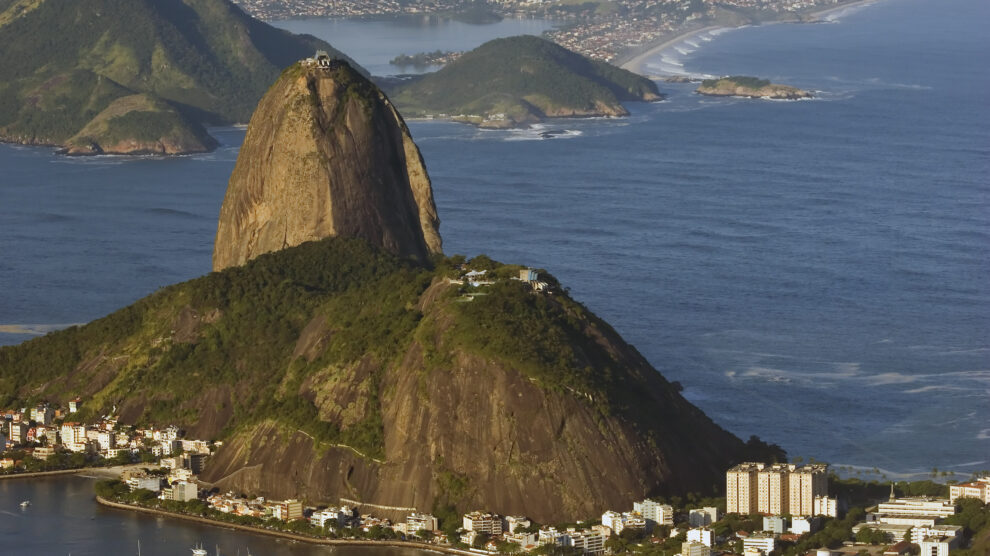
Photo: Dreamstime.