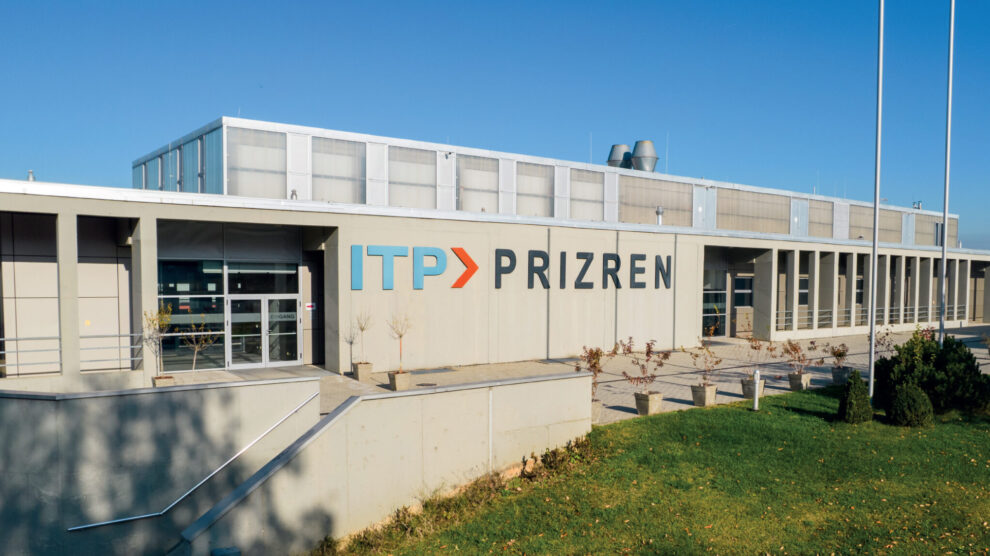
Kosovo’s tech industry barely exists outside of Prishtina, and a former Bundeswehr base is the best bet for changing that.
‘Swords to ploughshares’ is one of the oldest tropes in journalism (often used not entirely correctly, such as when describing the work of a de-mining charity, or a group of decommissioned officers who set up a bakery, or such like). This correspondent rarely shies away from using a good trope, however, not least when it is perfectly apt. And in the case of the Innovation and Training Park Prizren (better known as ITP Prizren), the trope has rarely been more apt.
In October, 2018 Thomas Silberhorn, a state secretary in Germany’s defence ministry, handed over what had hitherto been a Bundeswehr camp on the edge of Kosovo’s second largest city, after 19 years. Ramush Haradinaj, then Kosovo’s prime minister, said the German camp was passing “into an economic presence”.
The site had changed uniforms before. It was built by the Ottoman army and later used by the Yugoslav People’s Army, according to the Deutsche Gesellschaft für Internationale Zusammenarbeit (GIZ), Germany’s development agency. From June 1999 it housed the German contingent of NATO’s Kosovo Force (KFOR), and more than 100,000 German soldiers served in Kosovo over the years, most of them in Prizren. GIZ began converting the place on behalf of Germany’s development ministry in 2019. Lulëzon Jagxhiu, the Kosovan government’s chief technology officer, puts the cost at 16 million euros, split equally between the two governments. For that they got 40 hectares and about 50 buildings. Albin Kurti, by then Kosovo’s prime minister, and Jörn Rohde, Germany’s ambassador at the time, welcomed the first six tenants in 2021.
By then, there was talent in abundance to go around. The previous year, the Prizren campus of the University for Business and Technology (UBT), was moved to the site, and today around 2,000 students now study there. Enis Qafëleshi, who co-founded the Makerspace Innovation Centre in 2017, brought the centre, which serves as a community hub for students, entrepreneurs, and ICT enthusiasts focused on technology, education, and start-up growth, over to the park when it opened, and it has trained more than 3,000 young people since, with Qafëleshi saying that small firms “can grow much more easily” in the old army camp than elsewhere in Kosovo. Around them sits a looser crowd: Interstellar, a software house founded in Prizren in 2016; Eizek, which builds automation systems for the car industry; Penta Innovation (whose products include instant photo booths); RTK’s regional studio; and a factory turning out spices and sauces. There are currently around 60 residents.
One of the largest of these is Selise, a global IT delivery organisation specialising in the design, implementation, and operation of advanced technology solutions. At ITP Prizren it has been able to set up a fully secure area for work it carries out for clients who require tight security and high levels of confidentiality (indeed, it could be argued that a former military base is the ideal place for such operations).
Where work gets done
In recent years GIZ has stepped back, at the end of 2024 handing day-to-day running of the park to a Kosovan team led by Muhamed Rexhepi. He says that ITP Prizren, “brings businesses, start-ups, education and training together on one campus. For a technology company, the attraction goes beyond office space: it is access to talent, partnerships and support to grow, within a community that connects technology with other industries”. And as anyone who visits will immediately realise, ITP Prizren feels like a place where work is already being done, not one where bright new facilities are still waiting for tenants (a feature, if we can call it that, of several similar parks we have visited in the region).
Last month, the Kosovo ICT Association (STIKK) published its IT Barometer 2025, a survey of 102 information and communications technology (ICT) firms. It found 76 per cent of them in the capital. The sample is small, but the authors made a point of recommending a broadening of the Kosovo ICT sector beyond one city. Rexhapi acknowledges that this is one of his aims. “We see ITP as a catalyst for making Prizren a stronger second hub for Kosovo’s IT sector, complementing Prishtina and expanding opportunities beyond the capital,” he says. “Our role is to help companies establish and grow here, strengthen links between education and industry, and give young people more reasons to build their careers in Prizren. Success means more technology businesses, more skilled jobs and stronger connections to international markets.”
The same STIKK survey found that nine in ten firms had struggled to hire skilled staff in 2025, and that salaries had risen in every job category. That is an opportunity that ITP Prizren can exploit, offering as it does two universities on or beside the site. Prishtina airport is under 40 minutes away, Tirana’s just a little over two.
Photo: ITP Prizren.
