

The EU wants a rising price on flying to push passengers onto trains. That works between Paris, Brussels, and Amsterdam, less so in the East.
In the 1930s a traveller could board a sleeping car in Paris and step off, a few nights later, in Athens. The Simplon Orient Express and its sister trains carried through carriages to the Greek capital for decades; the last direct service from Paris to Athens was withdrawn in the 1970s.
Today no international passenger train leaves Greece at all. Greek railways first suspended cross-border services in 2011, at the height of the debt crisis; the few that returned have since stopped again, and the crossing into Bulgaria is made by bus. Travelling from Athens to Berlin without flying involves a train to Thessaloniki, a coach to Sofia and onward connections through Bucharest and Budapest: three days or more. Aegean flies the route in under three hours.
On this route the continent has gone backwards, just as the EU tightens the screws on aviation. Its transport policy rests on a simple bargain: make flying dearer, build fast trains and let passengers switch. In the dense western core of the Union, where capitals lie a few hundred kilometres apart and high-speed lines already link them, the bargain makes sense. For many cross-border journeys east of Berlin and Vienna, or beyond Copenhagen, no comparable service exists, and on Brussels’s own timetable none will until 2035 at the earliest, on most routes until 2040.
The stick and the timetable
The trains may be pencilled in for the 2040s, but the bill for flying is arriving now. Since January airlines no longer receive free emission allowances for flights within Europe; they buy them at auction or on the market. The free allocation that had cushioned the sector since it joined the EU carbon market in 2012 is gone, and in mid-November an allowance cost around 90 euros a tonne. That carbon price already applies to most flights within the European Economic Area, including those from Bucharest to Brussels. On July 17 the Commission proposed going further. From 2029 the carbon market would also cover flights leaving the EEA for airports within 5,000 km of Frankfurt, a radius that takes in Turkey and the Middle Eastern hubs. In June Poland and Czechia had joined France, Finland, Greece and Luxembourg in warning against unilateral measures on flights to third countries. The Commission went ahead regardless, and the Council and Parliament hope to agree by early next year.
Jet fuel remains unfinished business. The Commission’s 2021 proposal to end the tax exemption for jet fuel on flights within the EU has been stuck in the Council ever since, and the latest draft compromises would keep the exemption until at least 2035. Meanwhile the ReFuelEU regulation obliges suppliers to blend sustainable aviation fuel into kerosene: two per cent in 2025, six per cent in 2030 and 20 per cent in 2035.
Several governments in the western core have not waited for Brussels. France nearly tripled its ticket tax on economy flights within Europe in March 2025, from 2.63 euros to 7.40 euros. The Netherlands charges a flat 30.25 euros per departing passenger this year and will raise the rate for longer flights from January. Belgium is raising its levy again; in October Ryanair cut 20 routes from its Belgian network and blamed the increase. Not every government is heading the same way: Berlin moved this year to cut its ticket tax, and Sweden scrapped its own in 2025.
In November 2025 the Commission presented a plan to speed up rail links between EU capitals and other major cities by 2040, on lines built or upgraded for 200 km/h or more where possible. It puts the cost of completing the planned high-speed network at 345 billion euros. Its stated aim is to make rail an attractive alternative to short-haul flights. France has already written the idea into law, banning domestic flights where a train makes the same journey in two and a half hours or less. Three routes from Paris Orly met the test.
Geography is not a detail
The table compares capitals in the western core with capitals in the east and north of the Union: the straight-line distance between them and the fastest journey found by rail, or by rail and ferry, for departures on one ordinary weekday, Wednesday, December 9, 2026. Where the sea or a missing line gets in the way, the journey includes a ferry or a bus.
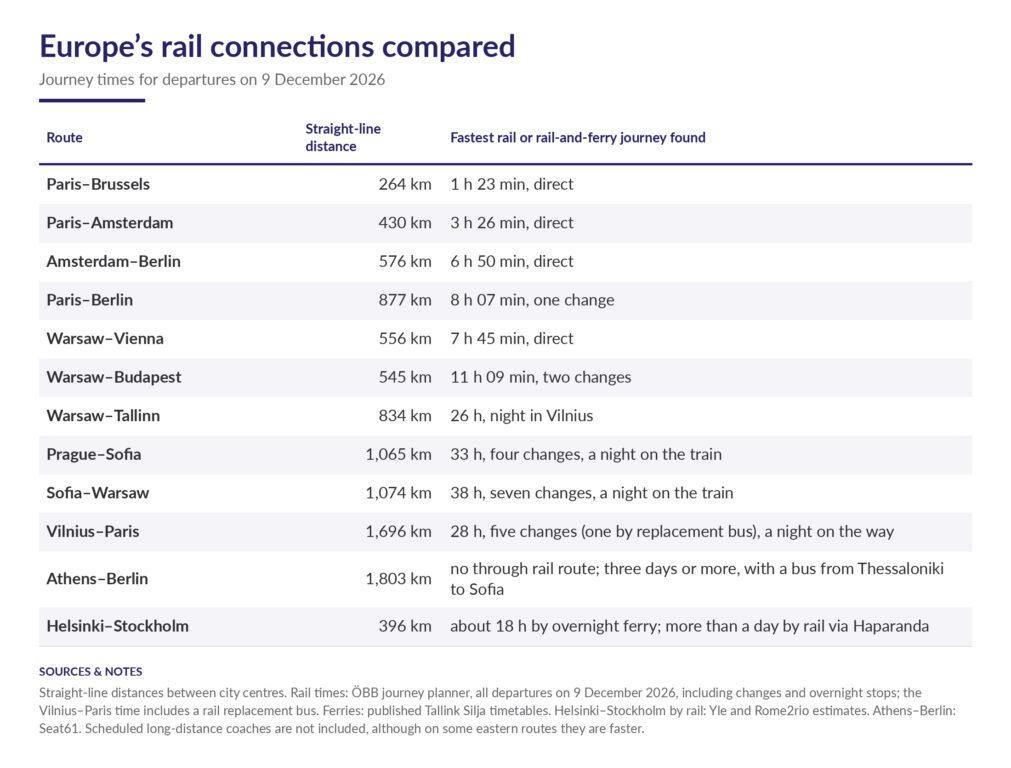
In the west the longest trip in the table, Paris to Berlin, covers 877 km in just over eight hours. In the east the fastest train from Warsaw to Vienna needs almost as long, seven hours 45 minutes, for just 556 km. Budapest is more than 11 hours from Warsaw. There is no same-day rail connection between Warsaw and Tallinn: the afternoon train reaches Vilnius just before midnight, the traveller sleeps there and arrives in Estonia 26 hours after leaving Warsaw. A coach does it in 14 to 18 hours, but it is the train that Brussels offers as the alternative to flying.
Measured as the crow flies, a rail passenger between Paris and Brussels moves at 191 km/h. Between Warsaw and Tallinn the average, night in a hotel included, is 32 km/h; between Sofia and Warsaw, with seven changes, it is 28 km/h.
The distances themselves are of a different order. Capitals in the western core sit between 260 and 880 km apart. Sofia is 1,070 km from Warsaw, Vilnius almost 1,700 km from Paris and Athens 1,800 km from Berlin. Apply France’s two-and-a-half-hour rule to the eastern and northern routes in the table and not one would qualify. Even at a steady 300 km/h along the straight line, Athens to Berlin would take six hours, before stops and changes.
The problem takes a different form in northern Europe. Helsinki and Stockholm are 396 km apart, closer than Paris and Amsterdam, yet the practical choice between them is an overnight ferry of almost 18 hours, an average of 22 km/h. Passenger trains resumed across the Finnish-Swedish border in August, after 38 years, but the line crosses at Haparanda, near the top of the Gulf of Bothnia, and a rail journey between the two capitals takes more than a day. Stockholm to Berlin takes 13 hours with three changes; Helsinki to Berlin, by ferry and train, about 38.
Timetables for the 2040s
The working tables published with the Commission’s rail plan (SWD(2025) 960) estimate Warsaw–Vienna at four hours 15 minutes and Warsaw–Tallinn, via Rail Baltica, at six hours 45 minutes by 2040; Sofia–Athens is to come down to six hours by 2035. These are indicative estimates, not a timetable. Helsinki appears in the 2040 tables only as “not connected”.
Rail Baltica was meant to open this year. In January the European Court of Auditors said that only a scaled-down first phase, single-track in places, is now envisaged for 2030, and that no firm completion date has been set for the full line, estimated at 23.8 billion euros. The head of the company building Latvia’s section has warned that even the first phase there may slip by three to five years. Poland’s first high-speed line, from Warsaw to Łódź via the new central airport, is due at the end of 2032; the contract for its first 13 km section is to be awarded next year. The Commission itself acknowledges that Europe’s high-speed lines are still concentrated in Spain, France, Italy and Germany.
A tax on distance
A price signal works when demand has somewhere to go. Raise the cost of flying from Paris to Brussels and passengers can take the Eurostar, which is what the policy intends. Raise the cost of flying from Riga to Brussels and there is no train to take. Passengers can still fly and pay more, endure a long overland journey, or not travel at all.
Airlines react faster than ministries, and they are not neutral witnesses: every carrier has an interest in blaming governments for its route cuts. After Hungary scrapped its windfall levy on air travel in January 2025, Ryanair’s traffic in the country rose by 17 per cent, which the airline credits to the tax cut; this winter it bases 12 aircraft in Budapest and adds eight routes, among them Warsaw, Kraków and Gdańsk. Since Slovakia began cutting air traffic control charges in 2025, Ryanair has doubled its Bratislava base from two aircraft to four, and a year ago forecast that its traffic there would grow by 70 per cent, to two million passengers in 2026. Wizz Air, the region’s largest carrier by seats, closed its Vienna base this spring while expanding from Bratislava and Budapest, and Ryanair blames Austria’s 12 euros ticket tax for its own cuts at Vienna. For a secondary airport, a few euros per ticket can decide whether a route exists at all.
The carbon price is not yet the heaviest item on the ticket. A passenger on a full, modern jet from Bucharest to Brussels accounts for roughly 90 kg of CO2. At around 90 euros a tonne, that represents a carbon cost of about eight euros per passenger. But it comes on top of national ticket taxes and the fuel mandate. In a January Reuters survey, analysts put the average allowance price for 2027 at about 107 euros a tonne, and a kerosene tax remains on the table for after 2035. The charge also grows with every kilometre. The eastern traveller pays more because the eastern traveller has farther to go, and has no train to take instead.
Counting per passenger
Supporters of the new levies note that kerosene pays no excise duty, that international tickets carry no VAT while motorists pay duty on every litre, and that aviation, by the Commission’s count, generates 13.9 per cent of the EU’s transport emissions, second only to road transport.
Measured in CO2 per passenger, however, a modern jet compares better than its image suggests. Wizz Air reported 49.7 grams of CO2 per passenger-kilometre in the 12 months to October 2026, at an average load factor of about 91 per cent. New petrol and diesel cars registered in Europe in 2024 emitted 169 grams per kilometre on the road, according to Transport & Environment’s analysis of EEA data, or about 106 grams per passenger with the 1.6 occupants the EEA assumes: more than twice the jet’s figure. Rail remains the lower-emission option. The difficulty for much of eastern Europe is that it is often not a practical one.
Cars, meanwhile, accounted for 69.2 per cent of passenger-kilometres travelled in the EU in 2024, and for more than 80 per cent in Lithuania. In the east the realistic alternative to the plane is a lengthy journey by car or coach, often on roads that are not yet motorways. In 2022, by Eurostat’s measure, the Netherlands had 82 km of motorway for every 1,000 km² of territory; Romania had four, Lithuania six, and Latvia, by the statistical definition, none.
Before the trains arrive
None of this is an argument against pricing carbon. It is an argument for pricing it with a map on the table. Brussels already accepts the principle. Flights between the Canaries or the Azores and their national mainland are exempt from the carbon market until 2030, and airports on small islands with no road or rail link can have the full price gap between kerosene and cleaner fuel covered. Where there is no practical alternative, carbon pricing may still push airlines to cut emissions, but it gives passengers little scope to change how they travel. Tallinn and Sofia are not islands, and their circumstances differ, but the underlying question is the same: how much choice does a passenger actually have?
A connectivity test would turn that question into a rule. Before a new levy reaches a route, ask whether a reasonable train exists. Where it does, as between Paris and Brussels, the charge can do its job. Where the train takes a day or more, a share of the carbon revenue should go back to the regions that have no such train, through cleaner fuel and newer aircraft. The Commission’s July proposal already points that way: it would reserve additional carbon-market allowances, worth an estimated 15 billion euros between 2029 and 2040, for cleaner fuels, electrification and curbing aviation’s non-CO2 effects.
Central and eastern European governments should make that test their condition. They cannot veto the carbon-market reform, but they can block an EU tax on jet fuel, and they set their own ticket taxes. Until high-speed trains actually leave from their capitals, they should vote for no new tax on flying, in Brussels or at home. Hungary has shown what happens when one is removed.
Europe once ran a train from Paris to Athens. The Commission now envisages a six-hour rail journey from Sofia to Athens by 2035. Until that train runs, the only Orient Express the region has leaves from the airport.
Photo: Dreamstime.