

Poland’s new hub is good for all of Central Europe.
Poland is building the largest transport project in its modern history, and the argument about it at home has narrowed to nine kilometres of track outside a city most foreign investors have never heard of. The argument matters well beyond Poland. It will decide whether Central Europe acquires logistics capacity of its own, for civilian and military use alike, or keeps renting it in Frankfurt, Amsterdam and Ramstein.
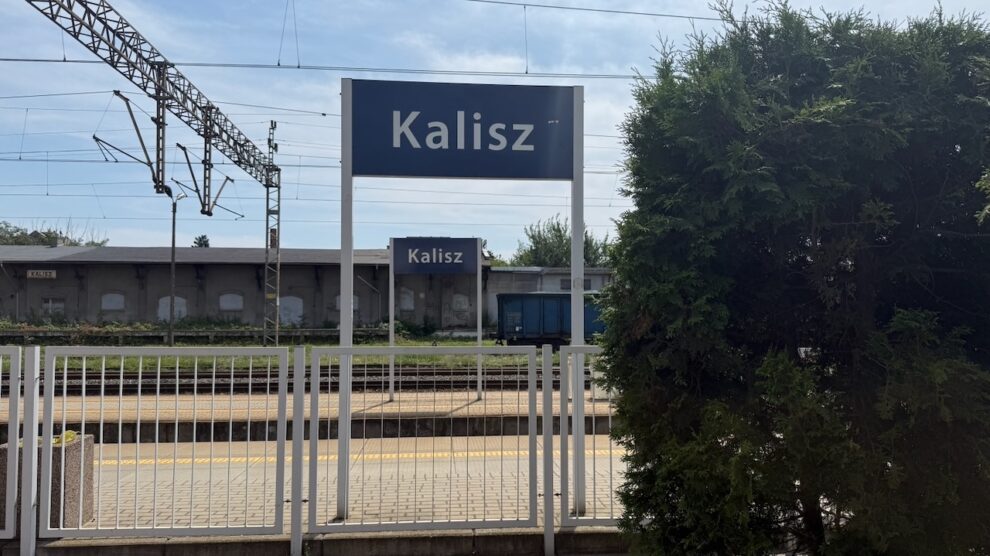
Start at a railway platform in Kalisz, in western Poland. To reach the second platform, passengers still walk across the tracks. The platform is narrow, low and unroofed, and it serves a city of 100,000 at the centre of a functional area approaching 400,000.
A century ago the same station was one of the significant rail gateways between the Russian Empire and Germany. The Warsaw–Kalisz railway opened on November 15, 1902, built to the Russian broad gauge of 1,524 millimetres. The cross-border section to Skalmierzyce, opened in October 1906, was laid with both broad and standard gauge, with customs chambers at Kalisz and Skalmierzyce and freight transhipped at Szczypiorno, just short of the border. Passengers walking through that building were not changing platforms. They were changing states, currencies and halves of the continent.
Poland’s planned high-speed line from Warsaw through Łódź and Kalisz to Poznań follows almost the same corridor. Port Polska, the state company running the programme formerly branded CPK, expects to open the Sieradz–Poznań section by the end of 2035, cutting Kalisz to Poznań from at least an hour and 28 minutes to about 35.
On March 6, 2026, the company applied for the environmental decision covering a nine-kilometre rail bypass of the city. It says the fastest trains will be able either to take the bypass or to call at the central station. Track, however, is laid once, and the timetable is rewritten every December.
‘Logistics win wars’
Nine kilometres is nothing in a programme this size. It still says something about what the hub is for.
Brussels set out its own answer in November 2025, when the European Commission presented its military mobility package. The aim is an EU-wide military mobility area by 2027, informally a “military Schengen”, with cross-border authorisation cut to a maximum of three days. Practice today varies widely; Kaja Kallas noted that some member states still require up to 45 days’ notice. The Commission identified four priority corridors and roughly 500 critical points: bridges, tunnels and terminals that cannot take heavy military loads. Fixing them would cost around €100 billion. Brussels has proposed 17.65 billion euros for military mobility under the Connecting Europe Facility for 2028–34. Andrius Kubilius, the defence and space commissioner, reached for the maxim attributed to General John Pershing: infantry wins battles, logistics wins wars.
Ukraine has already shown the scale involved. In 2025 about 220,000 tonnes of military assistance reached the country through NATO’s logistics structures, moved by 9,000 trucks, 1,800 railway wagons and close to 500 strategic airlift flights. Most of that flow passed through a single node: Rzeszów-Jasionka, 70 kilometres from the border, defended by American and German Patriot batteries and Norwegian NASAMS. In late 2025 and early 2026 the alliance stood up a second major hub in Romania, diversifying a system that had rested primarily on the Polish node.
Hub functions do not migrate towards the better-liked host. They migrate towards spare capacity.
Lieutenant General Bogusław Samol, quoted in the investor’s own materials, put the new airport’s wartime role plainly: if Poland or the Baltic states faced the threat of aggression, heavy transport aircraft could use it to bring troops and equipment from North America and Western Europe. The same materials note that the airport’s parameters, and those of the rail lines, have been consulted with the military since 2019. That also changes what the railway is for. Close to 2,000 kilometres of new line, in the original concept, is the system that would move people and freight into the region in a crisis. Ramstein remains the main American air logistics base in Europe, and nobody planned for the eastern flank to be supplied from Rhineland-Palatinate for thirty years.
Still shipping via Frankfurt
Central Europe is growing, and sending its goods to market through someone else’s airports. In 2025 Frankfurt handled about 1.99 million tonnes of cargo, Paris Charles de Gaulle 1.92 million and Amsterdam Schiphol 1.43 million. Warsaw Chopin, serving the region’s largest economy, handled around 137,000 tonnes. A substantial share of the value created in handling Central European cargo accrues at Western European hubs.
The passenger picture is similar. Chopin handled a record 24.1 million passengers in 2025 and is already operating close to the limits of its current infrastructure; the modernisation under way is meant to lift it above 30 million a year by 2029. Its location inside the city, surrounded by housing, all but rules out a third runway.
One can argue that Central Europe does not need a transfer hub of its own and can wait comfortably in the queue at Munich. Budapest, apparently, has not received the memo. It handled 426,519 tonnes last year, up 42.3 per cent, having doubled its volumes in five years, with Chinese e-commerce now accounting for close to half the tonnage it processes. Vienna posted a record 313,763 tonnes. Prague, up by almost half to 96,481 tonnes, is spending 16 billion Czech koruna (around 656 million euros) on a new terminal and logistics zone.
And then there is Warsaw
On August 7, 2025, the day after his inauguration, President Karol Nawrocki made his first domestic visit as head of state. He went to Kalisz, signed his first legislative proposal as president, a bill on the hub, and told the crowd that the city “cannot be run over by high-speed rail” and “must be part of this great, shared road”. He wanted the project to be “a real wheel, with every spoke leading to every region of Poland”.
The bill reached parliament in September 2025, where the governing coalition failed to throw it out after some of its own MPs broke ranks and voted with the president. Donald Tusk called that “a bad sign”. The bill has been sitting in the infrastructure committee ever since.
The government has a point. The presidential bill writes an operating speed of 250 km/h into law. The government’s infrastructure is being designed for 350 km/h, with trains expected to run at 320 km/h in normal service. On the company’s own arithmetic, the statutory limit would use roughly 70 per cent of what the new line can do. The bill also requires the airport to be completed by the end of 2031 and in operation by the end of 2032, civilian traffic at Chopin to cease by December 31, 2032, and at least 1,338 kilometres of new lines, financed by at least 66.18 billion złoty (15 billion euros) of Treasury securities.
It contains one provision both sides mention least. The network is to serve cities above 50,000 inhabitants, with Kalisz, Płock and Grudziądz named explicitly. So the president defends Kalisz at 250 km/h, the government defends 350 km/h and designs a bypass around Kalisz, and the committee has settled the dispute in the traditional way: it has not. The designers carry on.
The schedule, meanwhile, keeps moving. The symbolic start of main construction at Baranów was promised for September 2026 and did not happen. Preparatory works and test piling were under way on site, and contracts for foundations and drainage have been signed, but the company was still waiting for its building permit at the end of September, with work expected to begin in October or November. Piotr Rachwalski, its board member for rail, blamed administrative procedures and conceded that the offices and the system as a whole were not prepared for an investment of this scale. The 2026 procurement plan covers 87 tenders worth more than 54 billion złoty, of which 29, worth some 14 billion, had been launched by the end of July. The company still says the airport will open by the end of 2032.
None of this is only Polish. At InnoTrans in Berlin in September, Port Polska and Správa železnic, the Czech infrastructure manager, signed a cooperation agreement whose priority is a high-speed link from Katowice to Ostrava and a joint bid for EU money; a Wrocław–Prague connection was discussed and left for later, the Czech side having other priorities. On paper the corridors run Tallinn–Warsaw–Katowice–Budapest and Tallinn–Warsaw–Wrocław–Prague. Rail Baltica, which supplies the northern half of that geometry, has already missed its 2030 deadline: in September 2026 the three Baltic states said the line would be operational within the next EU budget period, to 2034, and asked for a further 10 billion euros from the Connecting Europe Facility, tying the request to military mobility and the cost of guarding the Union’s external border. Its scope has been trimmed as well. The line will bypass Riga, and parts of it will be single track.
Kalisz, on that scale, is a rounding error. The habit of cutting the network to fit the budget is not.
Four minutes
Routing the fastest trains around Kalisz rather than through it saves about four minutes on the Warsaw–Poznań journey. By the same company’s arithmetic, raising line speed from 250 to 320 km/h saves 15 minutes, and skipping the stop at the airport itself saves eight. The bypass is the smallest of the three gains and the only one that has to be built from scratch: nine kilometres of track, embankments, viaducts and a bridge over the Prosna, with no published cost estimate. The European Court of Auditors puts the average cost of the European high-speed lines it audited at around 25 million euros per kilometre outside tunnelled sections.
Four minutes is not much. The philosophy behind them matters more. Europe is now spending billions to make its transport networks harder to choke and easier to reinforce, after watching how much weight one node near Rzeszów has had to carry since Russia’s full-scale invasion of Ukraine. In Poland the largest infrastructure programme in the country’s history is still judged mainly on journey time between two metropolitan areas.
The strategic value of Port Polska will not come from a terminal in Baranów. It will come from the network that serves it: rail, road and logistics. The shield and the engine are the same infrastructure.
Alignments are decided once a century. In 1906 two empires thought Kalisz worth connecting to both their networks. Today passengers reach the second platform by walking over the rails.
Photo courtesy author.