
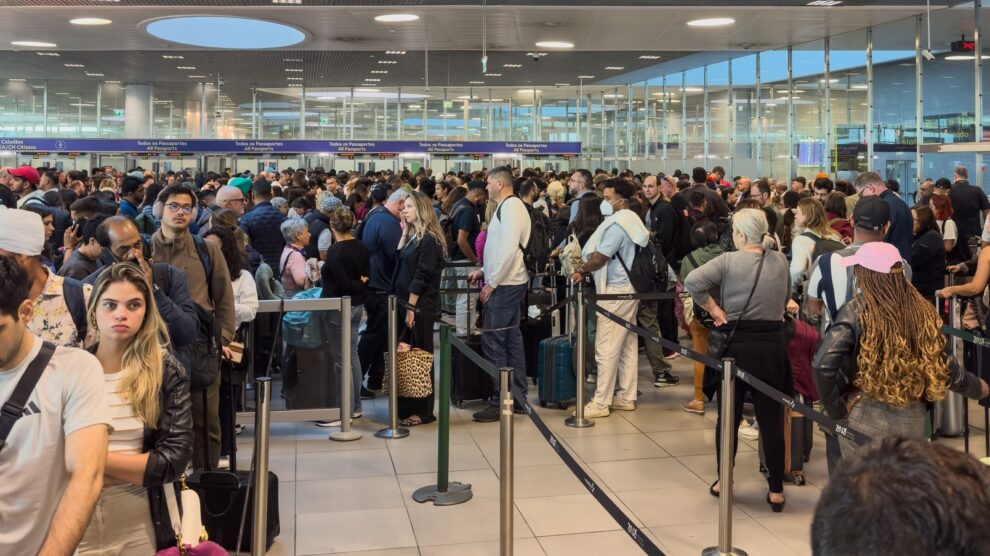
The EU’s biometric frontier is a total mess, and while Brexit hasn’t helped, it is only half the reason. Its implementation has been poor.
On the morning of April 11, border officers at Lisbon, Porto and Faro switched off the European Union’s new Entry/Exit System (EES), let the queues drain, and turned it back on after lunch. The system had been fully operational for one day. Michael O’Leary, Ryanair’s chief executive, had already dismissed the rollout; across the Schengen area, passengers waited up to three hours at passport control, and at one Italian airport 100 travellers missed their flight. At Paris Charles de Gaulle, non-EU arrivals were funnelled into manual lanes never built for the numbers.
Olivier Jankovec, director general of ACI Europe, the airports’ trade body, had seen it coming. In December he warned that EES, at that time only partially rolled-out, was already inflicting “significant discomfort” on travellers. By February he, Ourania Georgoutsakou of Airlines for Europe (A4E) and Thomas Reynaert of the International Air Transport Association (IATA) had written jointly to the European Commission, warning of four-hour queues by summer. Their objection was concrete. Biometric enrolment, which records fingerprints and a facial image from every non-EU visitor on first entry, had lengthened processing times by up to 70 per cent. The pre-registration app built by Frontex, the EU’s border agency, was meant to ease the load; travellers can currently use it in only a couple of countries.
O’Leary has since gone further, calling the EES “a shitshow and a shambles” and naming Seville, Alicante, Tenerife, and Faro as the airports most exposed. Nigel Farage and other Brexiteers have made a different case, casting EES as the bloc’s “revenge” for the 2016 Brexit vote. Simon Calder, The Independent’s travel correspondent, tells it differently still. He has noted that the UK itself negotiated third-country status after the referendum, which means British passport-holders gave up the fast lanes that membership had bought them.
The truth lies between the various camps. Brexit is indeed the root cause: British travellers would not touch the system (which, ironically, British officials had pushed for over several years prior to Brexit, concerned that the EU’s borders were weak) had the UK stayed in the EU. The execution, though, belongs to the Commission and the member states, and it has been poor. The rollout has been uneven from one country to the next. In France, e-gates still could not read British or American passports months after launch. The Spanish authorities staggered EES across their airports to spread the load. Geneva Airport recorded ski-season queues of five to six hours and drafted in extra staff. At many airports, notably Lisbon and Gran Canaria, the EES has crashed repeatedly and officers have fallen back on stamping passports by hand. Magnus Brunner, the European commissioner overseeing the system, has nevertheless rejected the charge that EES is problematic; one of his spokesmen called the rollout “smooth and well-managed”.
The European Commission built EES to do the opposite of what travellers met in April. Under its design, a visitor would give fingerprints and a facial image just once, to a central database run by eu-LISA, the EU’s technology agency, then clear the border on a quick facial scan for the next three years. The first crossing was meant to take three to seven minutes; every return inside that window, well under a minute at an automated gate. The Connexion, reporting from France in October, quoted the French and EU authorities promising registered travellers quicker, simpler trips.
ACI Europe had warned of exactly this gap in December, listing the unavailability of automated gates among its complaints. At many smaller airports the e-gates do not exist at all, so even an enrolled traveller meets an officer who checks one biometric and updates the file by hand, the encounter EES was meant to abolish. The Connexion found that only the biggest hubs ran both the kiosks and the gates. A returning visitor promised a one-minute scan often joins the same manual queue as the first-timer, three years running.
Half measures
Spain’s national statistics institute counted 19.1 million British visitors in 2025, more than from any other country and close to one in five of all foreign arrivals. On the Costa del Sol and the Greek islands, Britons are the clear majority of non-EU passengers. That points to an obvious remedy. Take British travellers out of EES and the worst queues would roughly halve, sparing Britons the queues and shortening them for everybody else. Nick Thomas-Symonds, the UK’s EU-relations minister, signed a reset deal in May 2025 that was meant to deliver something close to this, promising British holidaymakers wider use of e-gates. Third-country gates already operate at Amsterdam Schiphol and several Italian airports, but most have yet to open them to Britons.
The Commission has shown little appetite for special treatment. In May it told the Greek government it could not grant “blanket exemptions” to nationals of particular countries, and recalled the existing rules. Brunner’s officials have held the April deadline despite the airlines’ pleas. Georgoutsakou’s A4E called the first weekend a “systemic failure” rather than teething trouble and asked for the power to suspend the system over the summer; the Commission allowed only partial suspensions, and only into early July. ABTA, which represents British travel agents, had pressed the Commission to encourage contingency measures, with little to show for it.
The confusion reaches even those who live in the EU. British in Europe, a campaign group, had pressed the European Commission on the point well before launch, warning that its e-gates could not read both a passport and a residence card. EU residents are exempt from EES, their biometrics having been taken when they first applied to stay, yet at an automated gate they have no way to show it. The Commission promised an information campaign in each member state, but has yet to say if residents can breeze through EU lanes or must queue with non-EU visitors. Some countries (Poland, Romania, in this correspondent’s experience) appear to be happy enough to wave residents through, others less so.
The European Commission has a second system queued behind the first. It has confirmed that ETIAS, an online travel authorisation run by Frontex, will begin in the last quarter of 2026, and in March it raised the fee from seven euros to 20 euros. Unlike EES, travellers will buy it online before departure, so it should not lengthen the airport queues, though it is one more form to file and one more system that has to work. Britons will not strictly need one until the spring of 2027. ETIAS can only switch on once EES is judged to be running smoothly across the bloc; on the evidence so far, that day is not close.
Photo: Dreamstime.