
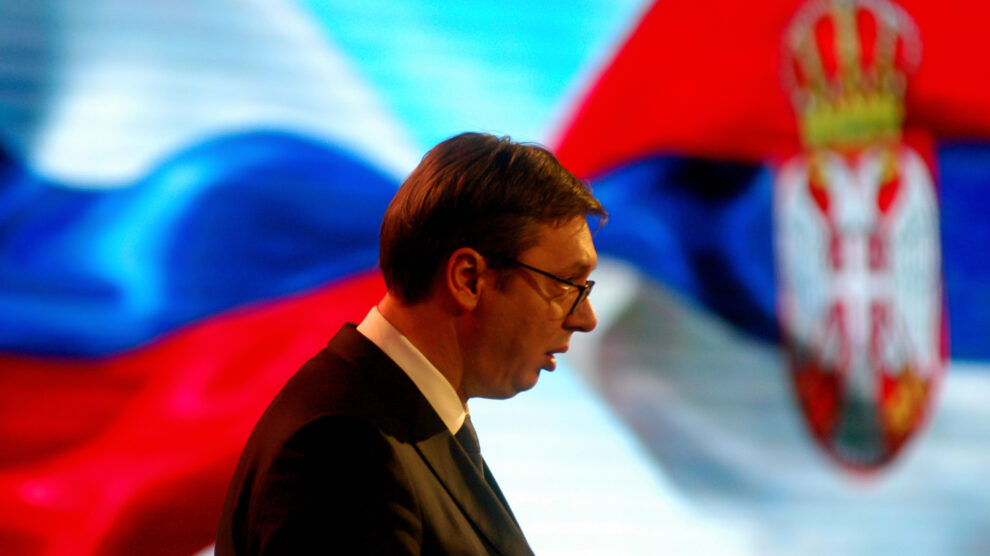
The students who toppled Aleksandar Vučić inherit a stalled EU bid, a leaky budget and a sanctioned oil company.
Unsurprisingly, a small army of right-wing influencers hastily imported from various parts of the world was not enough to convince Serbs that they should stick with Aleksandar Vučić, the country’s erstwhile president who resigned during the summer and called a snap parliamentary election in a bid to become prime minister. Instead, the election, held on October 25, was comprehensively won by a student-led movement that had spent two years protesting against Vučić, the former president himself conceding defeat shortly after polling stations closed. It will be a few days before the final results are known, but the student movement is likely to win at least 135 seats in Serbia’s 250-seat parliament, a healthy majority.
“We still do not have final results,” Vučić told supporters at his party headquarters in Belgrade. “But on the basis of a sample, it is clear that we have lost these elections, the Student List has won.” Increasingly authoritarian his 12 years as president may have been, but Vučić is no dictator, as some opponents have liked to label him. Dictators do not call snap elections, nor do they concede defeat.
By Monday morning the Republic Electoral Commission (RIK) had counted ballots from 96.8 per cent of polling stations, and the picture was, if anything, rosier for the students than the sample Vučić had leaned on: 53.3 per cent for the Student List (some 2.2 million votes) against 39.7 per cent for his United Serbia ticket. Turnout was close to 70 per cent, the highest since the break-up of Yugoslavia. By Vučić’s own reckoning no other national list made it into parliament, which means Ivica Dačić’s Socialists, junior partners in every government since 2012, are out.
None of this looked remotely possible two years ago. On November 1, 2024, the concrete canopy of Novi Sad’s freshly renovated railway station collapsed, killing 16 people, and the protests that followed grew into the largest since Slobodan Milošević was toppled in 2000. When the students decided to fight an election they did so on their own (rather peculiar) terms, with rules drawn up by faculty plenums barring students, opposition party officials, and anyone who had ever served in the ruling coalition from the list. The RIK registered it on September 15, after it handed in 69,099 notarised signatures, nearly seven times the legal minimum.
What the list does not have is a leader. Asked in early October whether he would be prime minister, Ilija Srdanović, who heads it, said only that it had “more than one candidate for every position”. Final results are due around October 29, after which the new assembly has 30 days to meet and a further 90 to elect a government. Ana Brnabić, the outgoing speaker and a Vučić loyalist, has been acting president since September 28, a job that passes to whoever becomes the new speaker, and a presidential election must be held by December 27 (Vučić, having served two terms, cannot stand). That means Serbs will be voting again before the year is out.
Ursula von der Leyen, the president of the European Commission, congratulated the students within hours of Vučić’s concession, offering to “work together to advance Serbia’s future in the European Union”.
Advancing it would make a change. Serbia last opened a negotiating cluster in December 2021. In July, after the commission recommended opening the next one for the sixth year running, eight member states blocked it at a meeting of EU ambassadors, with the Netherlands leading the objections. Nemanja Starović, the outgoing minister for European integration, grumbled in July that there was “evidently no real willingness for EU enlargement”. Marta Kos, the enlargement commissioner, had long insisted that Brussels was asking of Serbia exactly what the protesters were demanding, namely the rule of law and an end to graft. On those, at least, a Student List government should find common ground easily enough.
The ambassadors’ other complaint, Serbia’s refusal to join EU sanctions on Russia, is another matter entirely. In September the student movement published its foreign-policy platform, promising that Serbia would keep its “principled stance” against restrictive measures on Russia, citing the country’s own historical experience (the UN sanctions of the 1990s, presumably). At a televised debate on October 13 Aleksandar Baucal, one of the list’s better-known candidates, repeated the line but added that aligning with EU foreign policy was all a matter of negotiation, which Ana Brnabić promptly took as proof that sanctions were coming. Russia still supplies most of Serbia’s gas. Starović, for what it is worth, had said much the same last year: Serbia would back sanctions once membership was a few months away, and not before.
The economy the students inherit is in rather less robust shape than Vučić’s rallies suggested. The commission reckons growth slowed to two per cent in 2025 from 3.9 per cent the year before, while net foreign direct investment halved. In August the outgoing government rebalanced the budget, lifting the deficit target from three per cent of GDP to 3.5 per cent so that around one billion euros could be handed out to citizens (Nikola Altiparmakov of the Fiscal Council, an independent state body, argued that it should at least have gone to the households that needed it). The same council puts the cost of Expo 2027 and its attendant projects at around 3.4 billion euros. Official figures for September will not be published until after the election; Radar, a weekly, reported that spending that month was two-thirds higher than a year earlier.
Then there is NIS, the oil company that owns Serbia’s only refinery, at Pančevo, and which has been under American sanctions since October 2025 because its majority owner is Gazprom Neft. In January MOL, a Hungarian energy group, agreed to buy Gazprom Neft’s 56.15 per cent stake. Saša Ranđelović of Belgrade’s Faculty of Economics had warned the previous month that NIS was the single biggest risk to growth this year. At the start of October Forbes Serbia reported that the talks had all but collapsed, with Gazprom playing for time. MOL’s licence from the US Treasury to keep negotiating expires on Friday, October 30. Like many students late with assignments, Serbia’s students will be hoping for an extension.
Photo: Dreamstime.