
A wave of costly failures has humbled vertical farming. Its next chapter is now being written underground, and it looks far more affordable.
In July Jacob Nickles and his colleagues lowered themselves 1.1 kilometres beneath England’s North Yorkshire moors, past the dark-matter detectors, and planted a crop. Their farm, in a working polyhalite mine near Whitby, is now the deepest in the world. Nickles, who co-leads the controlled-environment group at the University of Sheffield’s Institute for Sustainable Food, reckons the pit’s steady temperature and ready-made ventilation could strip out the energy costs that have sunk flashier rivals. Lord Vallance, the science minister, backed the 12-month trial as a hedge against Britain’s fickle weather. The pitch is old mine shafts reborn as food hubs in some of the UK’s poorer corners.
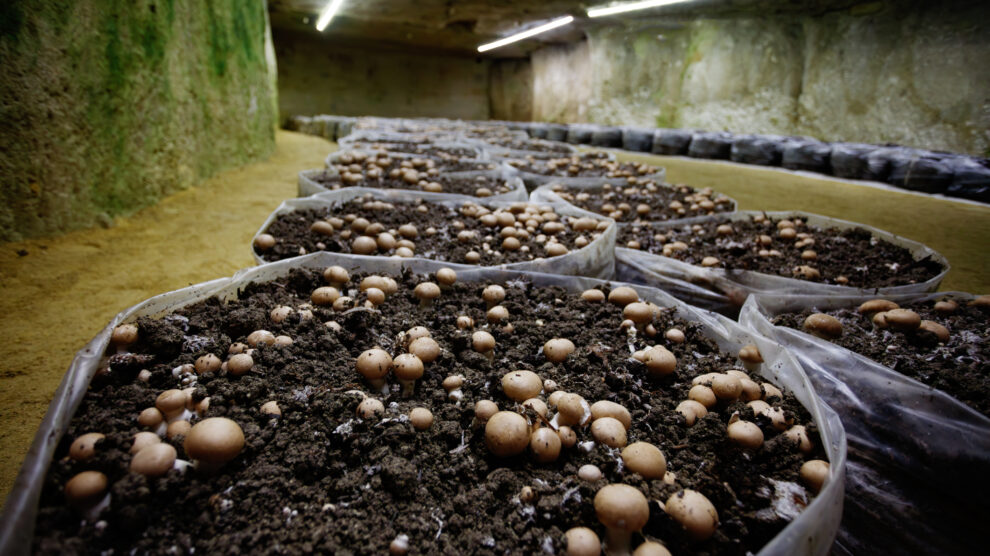
Graham Yost turned the notion into television in 2023. In Silo, his Apple adaptation of Hugh Howey’s novels, 10,000 survivors farm the middle levels of a mile-deep bunker while the poisoned surface of the Earth festers overhead. Real subterranean farming is older and a good deal less cinematic. Parisians grew mushrooms in the quarries beneath their city from the early 1800s, until the metro’s tunnels drove them out.
The Hollywood connection doesn’t end with the science fiction of Silo. Backers as famous as Natalie Portman and Justin Timberlake once queued to fund indoor farms. By 2025 they were nursing heavy losses. Plenty Unlimited, which had raised 940 million dollars from investors including SoftBank, filed for Chapter 11 in March that year, its valuation down more than 99 per cent from a peak near two billion. Bowery Farming, backed by Portman and Timberlake and once worth 2.3 billion US dollars, shut down late in 2024 and began auctioning off its lighting rigs. AeroFarms and AppHarvest had already filed for bankruptcy in 2023; the first restructured, the second did not survive. By one count, 14 controlled-environment firms folded during 2025 alone.
Tisha Livingston, who has kept 80 Acres Farms solvent, blames the arithmetic of light. Stacking lettuce under LEDs in a chilled shed can cost 100 times more per acre than a field, and the lamps never rest. She has said her own firm came through by staying “extremely cautious” with cash while rivals spent freely.
Down in the dark
Sean Paling has run dark-matter experiments a kilometre below the surface for years, and his Boulby laboratory now hosts the Sheffield trial. The rock holds a steady temperature for nothing, he points out, and blocks the cosmic rays and hard frosts that trouble the surface. The lamps, and their bills, follow the crops underground all the same.
In 2017 Jean-Noël Gertz and Théo Champagnat began growing mushrooms in a disused Paris car park. Trading as Cycloponics, the pair filled several thousand square metres of concrete in the 18th arrondissement with oyster and shiitake, chicory and microgreens, and later added sites in Strasbourg and Bordeaux. La Caverne had been built for cars that Parisians stopped buying; it now aims for about 50 tonnes of produce a year. Its crops want little light, and each day’s harvest goes out across the city by bicycle.
Steven Dring and Richard Ballard opened Growing Underground beneath Clapham in south London in 2015. Their farm lies 33 metres down in a wartime air-raid shelter that once held 8,000 people during the Blitz and later housed arrivals from the Empire Windrush. The business, now Zero Carbon Farms, took B Corp status in 2021 and supplies Marks and Spencer with microgreens and salad leaves grown on 70 per cent less water than a field. Olivia O’Brien, its business-development director, said in February that the tunnels run the year round on renewable power.
Nickles has given himself a year to see which crops can stand the ambient salt and the heat thrown off by the mine’s machinery. Farm Urban, his commercial partner, has already planted the first trays a kilometre down.
Thousands of disused pits lie across Europe, many in towns and cities that lost most, in some cases all, of their industry decades ago. Underground farming could be one way of beginning their revival. Many people will be watching closely when Farm Urban releases the first results of its experiment next summer.
Photo: Dreamstime.