
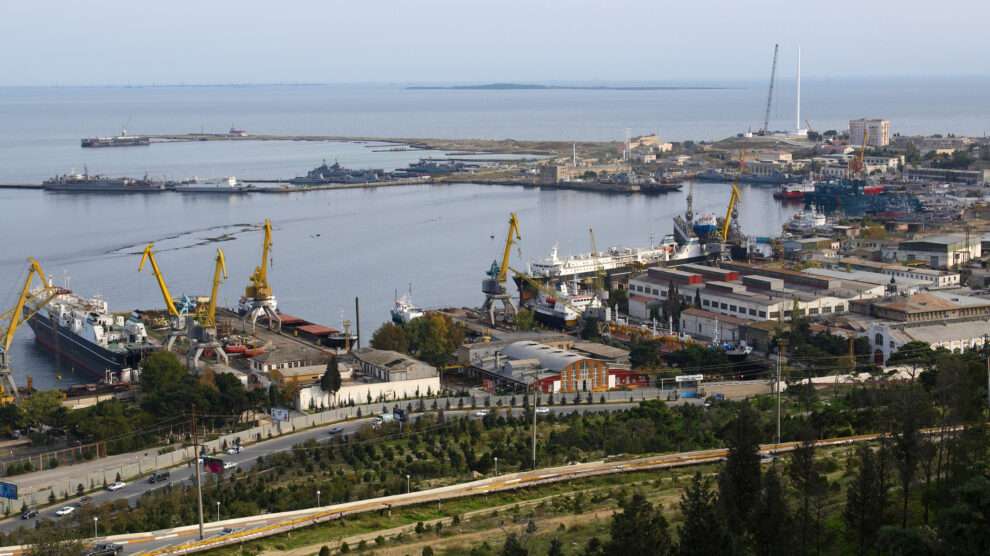
Trans-Caspian Transport Corridor investments could spur growth and create millions of jobs Across Europe and Central Asia.
Countries in Europe and Central Asia could unlock faster growth, more jobs, and stronger private investment by upgrading and better integrating a critical trade route linking East Asia, Central Asia, the South Caucasus, Türkiye, and the rest of Europe, according to a new World Bank Group report.
The report, titled Integration: World-Class Trade Logistics Along the Trans-Caspian Transport Corridor, finds that strategic investments in the emerging Trans-Caspian Transport Corridor (TCTC), also known as the Middle Corridor, could more than triple trade volumes along the route, halve travel times, boost GDP by 3.3 per cent, and create two million more jobs by 2040. The report further finds that if countries pair infrastructure investments with reforms that improve trade and transport efficiency, corridor volumes could quadruple and travel times could fall by two-thirds by 2040.
According to the report, these gains would come from easing transport bottlenecks, improving supply chain reliability, and widening market access in the nine countries along the corridor–Armenia, Azerbaijan, Georgia, Kazakhstan, Kyrgyzstan, Tajikistan, Türkiye, Turkmenistan, and Uzbekistan. For the nearly 200 million people living in these countries, that also means better access to markets and other opportunities.
Supply chain disruptions, and risks related to floods, droughts, and other weather shocks are increasing the value of faster, more reliable trade routes. For TCTC countries, many of which are major producers of energy, critical minerals, raw materials, and food products, the corridor offers a chance to reduce vulnerability to external shocks while turning transit demand into domestic investment, business growth, and jobs. The recent surge in regional trade, especially among developing economies, is an added impetus for TCTC countries to develop this strategic transport artery.
The report shows how trade corridors can lower logistics costs, attract investment, raise productivity, and support job creation. It assesses the TCTC’s economic potential, identifies the barriers holding back performance, and offers practical recommendations to turn the corridor into a stronger engine of regional growth.
“The Trans-Caspian Transport Corridor can become a powerful driver for faster growth, economic diversification, poverty reduction, and expanded private investment for the countries along the corridor,” said Antonella Bassani, World Bank Vice President for Europe and Central Asia. “It has the potential to transform from a transport corridor that simply moves goods and people to a regional platform that actively generates business, jobs, and local industrial growth along it. This will require investment in physical infrastructure as well as complementary enabling investments in service delivery and new approaches to trade facilitation, transport operations, and cross-border collaboration to build a more seamless regional market.”
Where investment is needed
The report estimates that more than 25 billion US dollars in physical infrastructure investments will be needed through 2040, particularly on rail networks, maritime ports, and feeder roads. Many of the most critical investments are already underway or in advanced stages of preparation across the corridor countries. However, sustained gains in competitiveness, freight volumes, and economic impact will also require stronger corridor performance, more efficient services, and institutional reforms across countries.
In addition, an estimated 30 billion US dollars will be needed for ‘enabling’ investments, such as connecting road and rail links that tie the corridor into local economies, logistics hubs and inland terminals that help goods move faster, and logistics equipment, including rolling stock, such as locomotives and railcars, cargo-handling gear, and digital systems that allow the entire network to function smoothly.
The corridor’s success will ultimately depend on how well countries and operators work together to reduce border delays, simplify documentation, coordinate hubs, and deliver reliable services. Stronger partnerships among governments, transport operators, and the private sector can improve reliability, attract investment, and help turn the route into a wider platform for growth.
The report highlights four priority actions to improve how the corridor is governed and operated: adopt a single digital corridor system to replace fragmented paperwork with one entry point for transport, transit, and trade data; empower or create an integrated, market-oriented, joint-venture rail freight and trans-Caspian shipping operator to connect containerised rail and maritime services end to end; strengthen corridor-wide coordination to monitor performance, resolve bottlenecks, and support joint decisions; and modernise corridor operators by improving governance, financial sustainability, and regulation so that state-owned rail, port, and shipping companies can operate more commercially.
“Realising the corridor’s full potential will depend on practical improvements that make freight movement faster, more predictable, and easier to manage across borders. Better-connected railways, ports, logistics hubs, and digital systems—combined with stronger coordination among countries and operators—can help turn the Trans-Caspian Transport Corridor into a more competitive route for businesses and a stronger platform for regional development,” said Charles Cormier, World Bank Regional Director of Infrastructure, Europe and Central Asia.
Photo: Dreamstime.