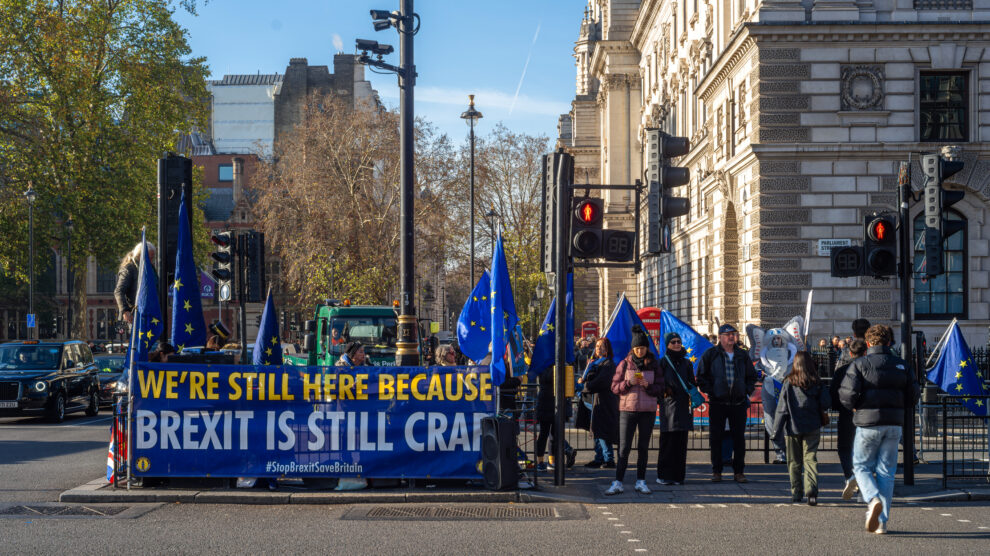
Britain spent two decades holding the EU’s door open for CEE, and the region now has every reason to hold it open in return.
British Euroscepticism existed long before 1988 (there was an attempt to pull Britain out of what was then the Common Market, which it had only just joined, back in 1975), but it is Margaret Thatcher’s speech in Bruges in September 1988 that in many ways founded what we might call modern British Euroscepticism. Nevertheless, much of that speech has been forgotten, lost amid her warnings of Brussels wanting to create a federal European superstate. Thatcher was, in fact, a lot warmer to Europe than is broadly remembered, not least the Single Market, of which she was a partial architect and staunch advocate. She also in Bruges (more than a year before the Iron Curtain came down) promised that Britain would “always look on Warsaw, Prague and Budapest as great European cities”. She meant every word of it, too, although not, it must be said, for altruistic reasons, nor for the reasons the people of those cities might have thought. Her (and British) enthusiasm for an ever-wider EU was, as James Ker-Lindsay of the London School of Economics has written, more down to the fact that in a union of 25 or more members would be much harder to turn into federation than one of just 12 members.
Nearly forty years later, Warsaw, Prague and Budapest all have good cause to return the favour. On September 30, Andy Burnham, who became the UK’s prime minister in July following the resignation of Keir Starmer, said for the first time (in public at least) that rejoining the European Union was among the options his government would look at (going “all the way”, as he put it), making him the first sitting prime minister to entertain the idea since the Brexit referendum 2016. It took less than 24 hours before there came a mainly positive reaction from across the Channel, with Radosław Sikorski, Poland’s foreign minister, saying that Poland would welcome a British application, adding that it would mean a decade of analysis in London had found membership to be the best way of being in the single market after all. From Prague, Andrej Babiš, the Czech prime minister and never one to mince his words, offered a somewhat cheekier answer at an EU summit in October: “Yes, of course [we want the UK to return]. We need more money,” (saying the quiet bit out loud, some British Eurosceptics were quick to retort).
Rejoining the EU is not (yet) official UK policy of course, although half of Britons now appear to be in favour of a return. Burnham has gone on to say that now is not the moment to rerun the referendum, and Wes Streeting, his defence secretary, told reporters in Brussels on November 2 that Britain was not yet ready to open talks (Kaja Kallas, the EU’s foreign-policy chief, standing next to him, agreed that “we are not there yet”). But the conversation has at least begun, the omerta around Brexit broken, and Central and Eastern Europe really ought to be the loudest voices cheering the UK on, louder even than the French and the Spanish, who have so far arguably been the keenest to see Bre-entry happen.
When ten countries joined the EU on May 1, 2004 (almost all of them from CEE), only three of the existing member states (Britain, Ireland, and Sweden) opened their labour markets to the new arrivals on day one. In contrast, Germany and Austria kept workers from the new members out for the full seven years they were allowed to do so. The UK Home Office had expected somewhere between 5,000 and 13,000 workers arriving from CEE each year. By the end of 2007 more than 765,000 workers from the new members had registered, two-thirds of them Polish, and they sent home money, skills, a decent command of English and (eventually, in many cases) themselves. Poles alone made more than 1.2 million applications to stay on in the UK after Brexit.
It should be said, however, that Britain’s love for CEE did have a few limits. It was a British prime minister, David Cameron, who in 2013 fought for (and won) the first ever cut to the EU’s budget, the same budget that was being used (amongst much else) to finance the construction of motorways across the CEE member states, and it was Cameron again who, in his ultimately futile renegotiation of 2016, went after the child benefit paid to Polish workers whose children lived back in Poland. Rumen Radev, Bulgaria’s prime minister, said in October that while Britain would indeed be welcome to return, “this time, the UK must learn its lesson.”
Even so, the region has had nearly seven years to find out what the EU is like without its most reliable (whatever the reason) big-country ally. Britain could usually be counted on to side with the central and eastern members in rows about free trade, about Russia, about the United States, and about whether the next round of enlargement should even happen at all. The UK remained the strongest supporter of further expansion until it left the bloc, a role which now (arguably) is held by Germany (but which is nothing like as keen). With Ukraine and Moldova in the queue, and some parts of the Western Balkans waiting more than 20 years, a heavyweight that openly advocates for a wider union would be no bad thing.
Britain needs a unified CEE
Then, of course, there’s the question of security, where ties are already a little closer than might be imagined. In May, Starmer and Polish counterpart Donald Tusk signed the Northolt treaty (so-called in honour of Polish pilots who flew from an airbase of that name in 1940), which committed the two countries to build a new air-defence missile together. British troops, meanwhile, already lead NATO’s battlegroup in Estonia. However, talks on British participation in the EU’s 150 billion euros Security Action for Europe (SAFE) fund remain stalled after Brussels asked for an entry fee reported at up to 6.5 billion euros, with Paris, by most accounts, the keenest on keeping British defence firms at arm’s length.
What the UK arguably could do with most of all right now is a unified CEE making Britain’s case in Brussels (much as the UK did all those years ago). Should Westminster pursue a new kind of arrangement with the EU (be it full membership, Single Market, Customs Union) there will be many awkward negotiations (such as the UK’s rebate, the euro, Schengen membership) and these are precisely the negotiations where having the governments in the EU’s east onside and unanimous, could do the most good.
Alas, when Burnham meets Ursula von der Leyen and António Costa, the presidents of the European Commission and the European Council, in Brussels next week for the much-touted UK-EU reset summit, no prime minister from Warsaw, Prague or Budapest will be present.
Photo: Dreamstime.