
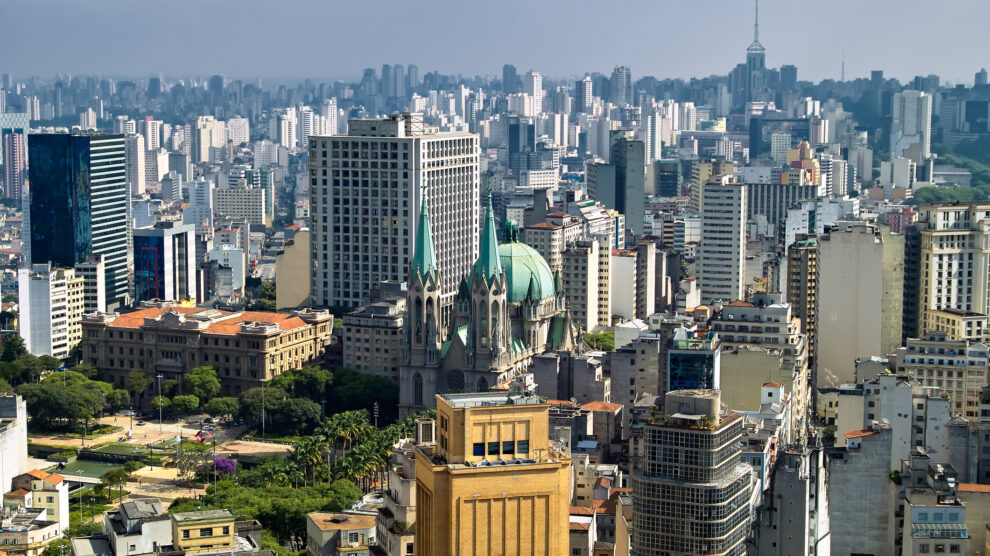
The city that abolished outdoor advertising is having second thoughts. Two decades on, the admen it banished have found their way back in.
Walking around São Paulo for the first time, very little looks out of place. Certainly, there are few signs that the city has, for the past two decades, been the site of one of the world’s most ambitious experiments in urban renewal. As soon as somebody tells you the subject of the experiment, however, the city immediately looks different to just about every other metropolis on earth outside of North Korea and, perhaps, Turkmenistan. There’s something missing: adverts.
Gilberto Kassab, then the city’s mayor, signed the Lei Cidade Limpa (Portuguese for Clean City Law) on December 26, 2006, and the law took effect on New Year’s Day 2007. Businesses were given a year to remove all outdoor advertising, comprising around 15,000 billboards and 300,000 shopfront signs, along with advertising on buses and taxis. Kassab, who called the ads visual pollution, staked his reputation on ensuring that the law was enforced thoroughly (in stark contrast to many Brazilian laws, which are often applied a lot more loosely). Dalton Silvano, an advertising executive and the only city councillor to vote against the law, warned that the city would grow lonelier without its ads. Clear Channel Outdoor, one of the world’s largest outdoor firms, sued São Paulo on constitutional grounds, but lost. Business groups forecast losses of 133 million US dollars and 20,000 jobs. A survey taken a few years later, in 2011, found that 70 per cent of residents continued to approve of the ban.
Vinicius Galvão, a reporter at Folha de S.Paulo, told American radio that his old landmark had been a Panasonic billboard and was now the art deco building it had covered, giving the city a new identity. The removals also exposed favelas and workshops that the hoardings had hidden. Works of art were impacted too. City workers whitewashed murals, among them a 680-metre work by Os Gêmeos (the artistic name of twin brothers Otavio and Gustavo Pandolfo), which was painted over in 2008 while the pair were the subject of an exhibition at Tate Modern in London. The subsequent public outcry forced the city to change the law in order to protect street art, which since 2012 has again been permitted, although only in locations designated by the council.
The admen adapt
JCDecaux, the world’s biggest outdoor-advertising company, won a 25-year concession in October 2012 to run 1,000 digital clocks carrying advertising, hiring the paulistano architects Ruy Ohtake and Carlos Bratke to design them and slipping paid messaging back in through the street furniture the law still allowed. Other brands found other, often highly creative ways to advertise their wares. General Electric commissioned muralists to paint its logo onto three tower blocks, a campaign that Marcello Serpa of the agency Almap BBDO described as a way to subtly talk about its products. Converse meanwhile turned pedestrians’ shadows into sponsored street art. Most of the city’s ad spend, however, moved indoors and online. Eletromidia, a São Paulo firm that Globo bought in 2024, now runs some 66,000 digital panels in malls and metro stations, and the five largest operators control about 63 per cent of Brazilian out-of-home sales. Social-media advertising in Brazil is forecast to climb from 3.1 billion US dollars in 2025 to 4.6 billion by 2029.
Notably, perhaps, few other cities have followed the São Paulo example, at least in full. A few in the emerging Europe region (Bucharest, notably, where outdoor advertising is particularly aggressive, and where a mesh might cover an entire facade) could learn from some of the limitations that have been introduced. Only Poland, so far, has taken any real action, passing in 2015 a Landscape Act which gives municipalities the power to introduce local laws to restrict, or totally ban intrusive outdoor signs. Only a handful of cities have so far made use of it, however. Other cities have gone further, without going full São Paulo. Éric Piolle, then the Green mayor of Grenoble, refused in 2014 to renew his city’s contract with JCDecaux, and by mid-2015 workers had taken down 326 hoardings, 64 of them billboards, replacing many with trees. Nantes pulled more than 110 electronic billboards in 2023, Chennai banned new hoardings in 2009, Tehran covered its 1,500 billboards with art for 10 days in 2015; and Amsterdam has barred adverts for petrol cars and flights. Anne Hidalgo, the mayor of Paris, paused a plan for new digital boards after lobbying by Résistance à l’Agression Publicitaire, whose Khaled Gaiji likened advertising to an iceberg. Laurence Ruffin, who succeeded Piolle in 2026, has turned to shop signage.
There has also been a partial softening of the law in São Paulo. The Commission to Protect the Urban Landscape, the municipal body that polices the law, approved the Boulevard São João project earlier this year, clearing four buildings at the junction of Avenidas São João and Ipiranga to be wrapped in LED panels in the manner of Times Square or Piccadilly Circus. A separate proposal to soften the Clean City Law had already passed a first council vote in 2025. Ricardo Nunes, mayor since 2021 and re-elected in 2024, has backed the change. Fernando Augusto Pacheco, writing in Monocle, urged him to turn out its lights. “When advertising is allowed to overshadow a city’s essence and character, the results are invariably ugly and confusing,” he wrote.
Indeed, defenders of the São Paulo law point to the new life given to the city by the absence of advertising. Buildings, not least its rich collection of Art Deco masterpieces, can breathe and shine when not hidden behind aggressive hoardings and billboards. Advertising, they argue, is ubiquitous both on television and online. Walking down the street should offer consumers a break. São Paulo, for now, provides them with that break, and furthermore, the city’s advertising industry survived, simply reinventing itself to make the most of channels that remained open to it. The free market detests outright bans of anything, but there’s no greater spur towards reinvention.
Photo: Dreamstime.