
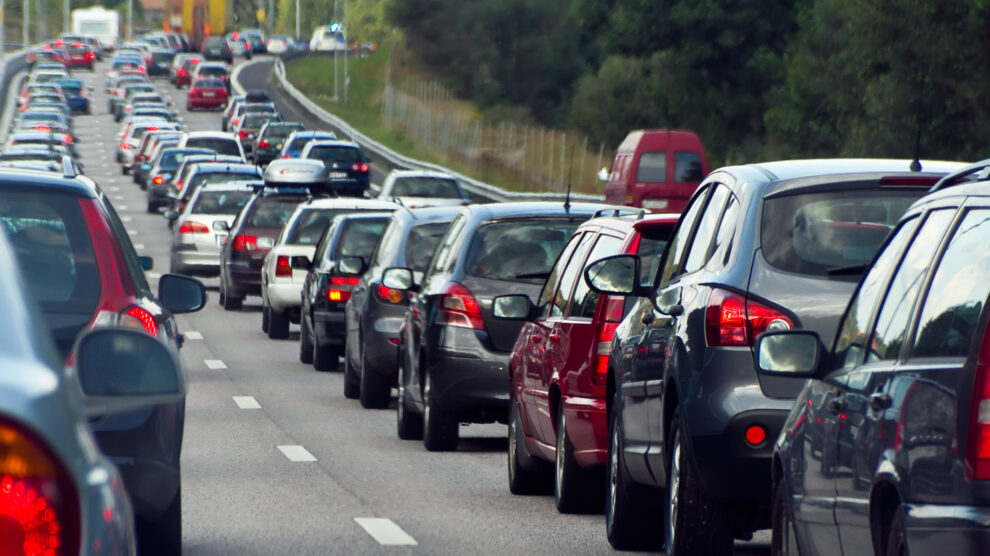
No, one more lane will not make any difference: widening roads remains a fool’s errand. Cities that price driving honestly get fewer cars.
Byron Hebert, the city administrator for Katy, Texas, told Community Impact in September 2025 that getting his fast-growing suburb moving meant widening every north-south road within reach. A few weeks earlier, Governor Greg Abbott had committed 146 billion US dollars in new spending to the Texas Department of Transportation over the next decade. The Katy Freeway, the stretch of Interstate 10 connecting Houston to its western suburbs, was last widened in 2011 at a cost of 2.8 billion US dollars, ending with 23 lanes and the ‘world’s widest highway’ title. By 2014 evening commute times along it had climbed 55 per cent. The Texas A&M Transportation Institute ranked the same segment the most congested in the state in its 2024 study. “One more lane, bro, just one more lane, I promise” has become a meme for an obvious reason.
Gilles Duranton and Matthew Turner published the canonical paper on this in the American Economic Review in October 2011. The two economists, then at the University of Toronto and Brown, set the elasticity of vehicle-miles to road capacity at close to one: lay down 10 per cent more lane-kilometres in an American city and motorists, old and new, will drive about 10 per cent more miles. Wenhua Hsu and Hongliang Zhang replicated the result on Japanese expressways three years later. The arithmetic has aged unhelpfully for the lane-builders.
The Pearland Economic Development Corporation, south of Houston, has been busy marketing the planned widening of State Highway 35 as a commercial-development opportunity under its ‘Pearland 20/20‘ plan. Wider lanes invite developers, developers invite fleets, and the fleets refill the lanes. Houston TranStar’s figures this year had drivers on the Katy stretch spending longer in rush hour than they did in 2024.
Anne Hidalgo, then the socialist mayor of Paris, asked her city to vote on something else entirely in February 2024. Parisians backed her proposal to triple parking fees on cars heavier than 1.6 tonnes by 54.55 per cent, taking the hourly rate for an SUV to 18 euros in the centre and 12 euros further out. David Belliard, her transport deputy, said the take would reach 35 million euros a year. Lyon brought in its own three-tier scheme that June. The revenue was a side-benefit. The message was the point: the heavier the car, the higher the bill, and no apology offered for it.
Lee Waters, then Welsh deputy minister for climate change, told the Senedd in February 2023 that nine major road-building projects would be cancelled. Out went the third Menai crossing, Flintshire’s Red Route and the A483 improvements in Wrexham. Dr Lynn Sloman, who chaired the review panel that had spent 18 months going through 55 schemes, set the rationale in unembellished terms: the bypass demanded to relieve congestion produces extra traffic, which produces demands for further lanes, which produces a recurring bill the taxpayer cannot afford.
Charge sheet
Jonas Eliasson, the transport economist who later became director of Stockholm’s city transport administration, helped design the congestion charges his city introduced as a seven-month trial in January 2006. Traffic into the inner cordon fell about 20 per cent in the first weeks and stayed down. Stockholmers voted to keep the system by referendum the following September, having begun the experiment as the country’s most-loathed reform. Eliasson and Maria Börjesson, of Sweden’s KTH Royal Institute of Technology, published a fresh review of the long-run data in January 2025: the elasticity of driving to its price is reliably higher than the elasticity of public transport use to fares. Making the car expensive shifts more journeys than making the bus free.
Kathy Hochul switched on the nine US dollars congestion charge for vehicles entering Manhattan south of 60th Street at 12.01am on January 5, 2025. Janno Lieber, the Metropolitan Transportation Authority (MTA) chair, reported the following September that 17.6 million fewer vehicles had entered the zone since launch. Sarah Kaufman, director of the Rudin Center for Transportation at New York University, told Bloomberg in December that she saw the programme as a clear success on traffic, public safety, air quality and transit funding. Timothy Fraser and Yeonkyeong Gina Park, of Cornell, published a paper in npj Clean Air in December finding fine-particulate concentrations in the zone down 22 per cent. The MTA banked 578 million US dollars in the first year and tied it to capital upgrades on the subway, buses and commuter rail.
Christophe Béchu, then France’s environment minister, called the Paris surcharge ‘punitive environmentalism‘ on RTL the morning after the vote. Yves Carra of the drivers’ lobby Mobilité Club France dismissed the SUV classification as marketing wrapping. The grievance underneath each is the same, in that nobody likes to be charged for what used to be free. But kerb-space at peak hour was never free. The costs were paid by the people on the slower bus and the people breathing the fumes. Pricing those costs properly funds the buses, the cycle lanes and the trams.
Photo: Dreamstime.