
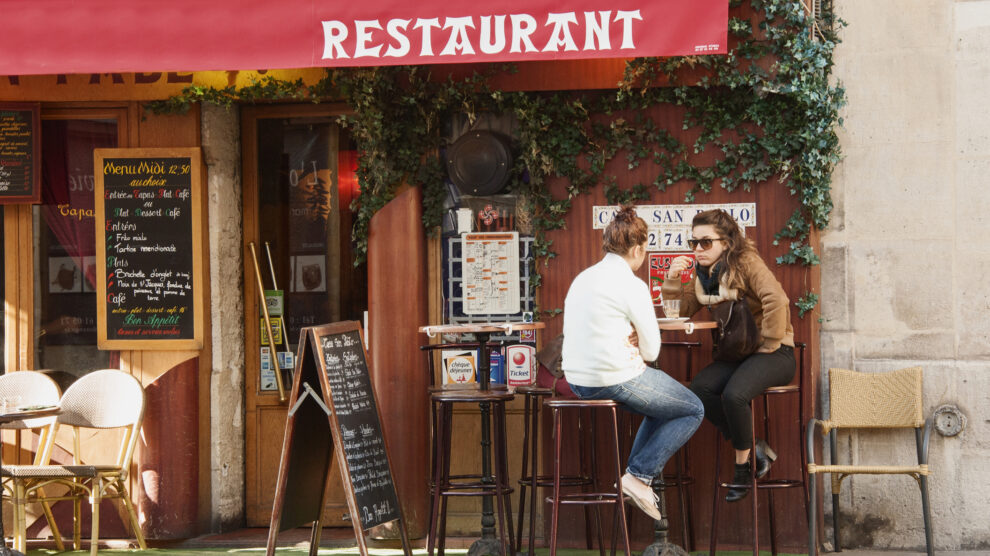
Fewer Europeans are eating out and margins are thin. Their way back runs through theatre, delivery and a smaller, cheaper table than before.
Guido Zöllick got his tax cut on the first day of January. The president of DEHOGA, Germany’s hotel and restaurant federation, had lobbied for years, and the government finally lowered value-added tax on restaurant meals to seven per cent from 19. German gastronomy turnover had fallen 5.1 per cent in real terms the year before, and Zöllick had warned the trade was nearing “the limit of burden capacity”. The cut let operators hold their prices rather than raise them again.
Jochen Pinsker, who tracks European foodservice for Circana, laid out the wider picture in September last year. Restaurant visits in France were still nine per cent below their 2019 level by the middle of last year, with Italy and Spain each down four per cent; solo diners had grown to 15.6 per cent of full-service visits, up from 9.4 per cent in 2016. Marie Audren, director-general of HOTREC, Europe’s association of hotels, restaurants and cafés, told the organisation’s annual assembly in Cork in April that energy bills and geopolitical shocks were still grinding down small operators. Pinsker called the whole thing “a reset”.
Victor Lugger and Tigrane Seydoux made the opposite bet. The pair opened their first Parisian trattoria in 2015 and now run 35 restaurants across nine countries under the Big Mamma banner, all red lighting, homemade pasta and pavement queues; turnover jumped 27 per cent last year. McWin, a private-equity house, bought a majority stake, and Seydoux moved his family to Florida late in 2026 to open the group’s first American room himself. Ephemera Group, founded by three graduates of Lyon’s Institut Lyfe, has pushed the theatre harder still, opening its seventh projection-mapped restaurant, Under The Sea, in Montpellier in February. It took 10,000 bookings in the first 72 hours.
Miki Kuusi resigned as chief executive of Wolt in October to take charge of its sister firm Deliveroo. DoorDash had bought the Finnish delivery platform in 2022 and owns both companies. Wolt runs in 27 countries and sold one billion euros of groceries last year on top of its restaurant orders. In February DoorDash closed Wolt in Japan and Uzbekistan, and Deliveroo in Qatar and Singapore. Circana recorded record European delivery volumes over the same months, much of it cooked in kitchens that seated no one.
Anton Soulier closed Taster’s own kitchens and turned the French group into a licensing business. Its delivery-only brands are now cooked by other operators in more than 400 online restaurants across 80 European cities, and the company raised 30 million euros to widen the model. Clément Benoit took Not So Dark down the same route in 2021, raising 83 million euros to let restaurateurs run its brands. Coherent Market Insights values Europe’s dark-kitchen market at 7.4 billion US dollars in 2026 and expects it to pass 25 billion by 2033, led by Germany and Britain.
Short menus for solo diners
Mirko Silz has moved L’Osteria into the space Vapiano left when it fell into insolvency in 2020. The Italian-food chain opened its 200th restaurant in Hamburg in February 2025 and committed 60 million euros to enter France, Poland and Spain, using a mix of franchised and company-owned sites. Silz has said the plan will create “up to 10,000 new jobs”. Smaller operators are going the other way, fitting out counters and short menus for solo diners, who on Pinsker’s count now take one full-service seat in every six.
Circana expects Germany to lead the recovery, with visits up 1.6 per cent in 2026, and Spain to trail at 0.2 per cent. Zöllick has said he still expects a sixth straight loss-making year despite the lower tax. Visits across the big European markets remain below their 2019 levels. Big Mamma opens its first Florida restaurant later this year.
Back in Germany, not everyone is happy. Monika Schnitzer, the head of Germany’s Council of Economic Experts, wants the reduced VAT rate abolished. She arguses that the tax benefit does not mainly support small traditional restaurants, but is also used by large international fast-food chains. This raises questions about whether the measure is the best use of public money. The scheme reportedly costs German taxpayers 3.4 billion euros per year.
Photo: Dreamstime.