
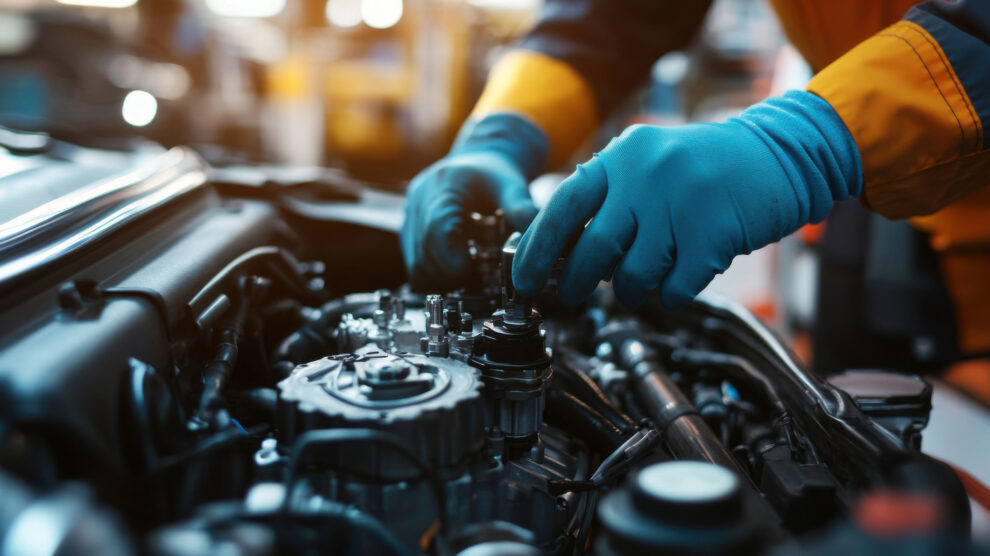

Competition from China and the switch to electric vehicles is transforming Europe’s auto parts industry.
When we think of Europe’s car industry, robotic arms and gleaming production lines come to mind. But behind the headlines lies another story: the ‘aftermarket’ auto parts sector—a 240 billion euros industry employing over four million people—is navigating significant change. This sector services over 195 million vehicles across Europe, making automotive parts the third-largest spending category for consumers after housing and food. Independent providers alone account for over 60 per cent of this market, serving drivers who rely on competitive pricing and choice.
Chinese cars are reshaping the market. Even with EU tariffs of up to 38 per cent, Chinese EVs cost 20-30 per cent less than European equivalents—and consumers are noticing. Germany, traditionally Europe’s automotive powerhouse, has seen Chinese brands climb from negligible market share to serious contenders in just five years, undoubtedly triggering concern amongst domestic manufacturers.
For parts suppliers like Armtek, this raises practical questions. Chinese manufacturers typically keep their parts catalogues in-house, controlling the repair market directly. BYD, for instance, manufactures 75-85 per cent of its components internally—from batteries to semiconductors. It’s a vertically integrated model quite different from European carmakers, who traditionally rely on extensive supplier networks. We must learn to work alongside this new reality.
The EV transition brings its own dynamics. European EV sales grew 147 per cent in the last three years. A petrol engine has around 2,000 moving parts; an electric motor has roughly 20. Less routine maintenance, yes—but new opportunities emerge. Battery replacements, for example, cost between 4,500 and 15,000 euros depending on the vehicle—a significant service opportunity. Thermal management systems, charging components, and software diagnostics represent growing segments and opportunity.
European ingenuity
At Armtek, we see this as a signal to evolve. EU legislation is moving towards EVs, with most member states planning to phase out new petrol and diesel car sales by 2035. Despite some voices of concern, this actually provides welcome clarity on where to invest. The transition period—where petrol, hybrid, and electric vehicles coexist—requires us to serve all three markets simultaneously.
The wider stakes matter: hundreds of thousands of European jobs depend on the auto parts industry adapting well. Independent garages, which service the majority of vehicles once warranties expire, rely on access to quality parts at competitive prices. AI-driven inventory management, smarter supply chains, and real-time market intelligence are proving valuable tools in staying competitive.
What about trade policy? EU tariffs on cars (typically 10 per cent) exceed those on parts (zero-two per cent). Some industry voices call for higher barriers to protect European manufacturers, but it would be wise to exercise caution on this front.
Tariffs have limits. Chinese cars are gaining market share despite a 38 per cent levy—consumers vote with their wallets. Europe’s real strength has always been innovation, engineering excellence, and quality. That’s where our focus should remain. Trying to simply price Chinese producers out of the market is unlikely to succeed.
Demand patterns are shifting too. New car sales remain around 20 per cent below pre-pandemic levels, recovering gradually from the 2022 low. But there’s good news: Europeans are keeping cars longer—the average vehicle age is now 12 years, up more than a year from a decade ago. Older vehicles need more maintenance and more replacement parts, which sustains healthy demand across our industry.
Change is never easy, but it brings opportunity. The European aftermarket has grown steadily at around two per cent annually since 2011, proving its resilience through economic cycles and technological shifts. Companies that embrace new technologies, rethink their product lines, and stay close to customers will thrive. The road ahead requires adaptation, investment, and fresh thinking—but European ingenuity has navigated transformations before and will do so again.
Photo: Dreamstime.