Europe throws billions at its defence sector. Ukraine’s kitchen-table innovators are already cashing in.
Great news for Ukrainian housewives. The European Commission this week approved a 1.5 billion euros work programme under its European Defence Industry Programme (EDIP), and 260 million euros of it is earmarked for rebuilding Ukraine’s defence-industrial base. That should buy a lot of 3D printers.
Perhaps best not to tell Armin Papperger, boss of Rheinmetall, Germany’s largest arms manufacturer, who told The Atlantic magazine last week that Ukrainian drone-makers were little more than “housewives” with “3D printers in the kitchen”. Making drones, he said, was “like playing with Lego”.
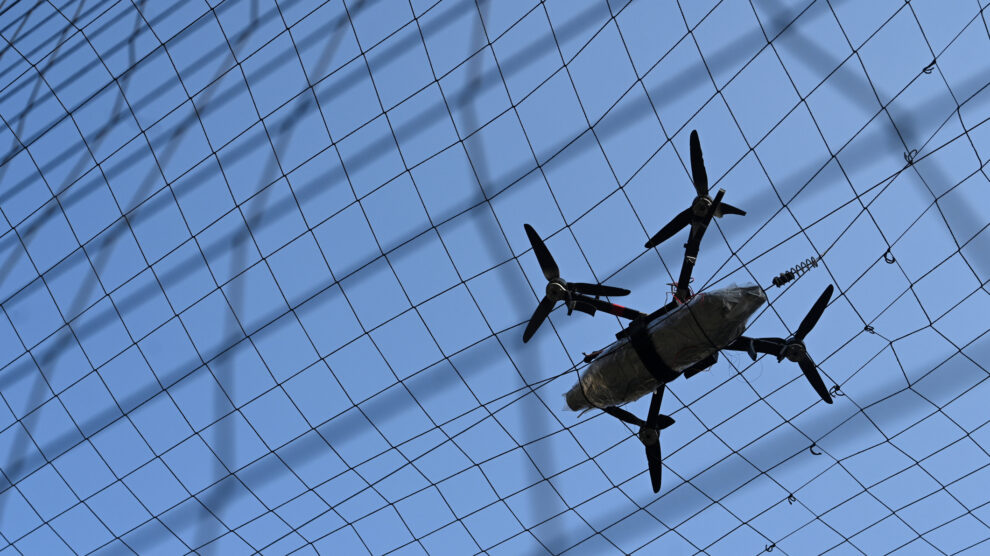
The timing could hardly have been worse. As Papperger was dismissing Ukrainian ingenuity, President Volodymyr Zelensky was criss-crossing the Gulf, signing ten-year defence partnerships with Saudi Arabia, Qatar and the United Arab Emirates worth billions of dollars. The commodity on offer? Precisely the scrappy, battlefield-tested drone expertise that the Rheinmetall boss finds so unimpressive. Ukraine has deployed more than 200 anti-drone specialists to the Middle East, where Gulf states are scrambling to counter Iranian Shahed attacks. Each Patriot missile fired at one of these drones costs close to four million US dollars. A Ukrainian interceptor drone does the same job for roughly 2,000 US dollars.
The hashtag #MadeByHousewives duly swept Ukrainian social media over the weekend. Zelensky himself weighed in on Monday, observing drily that if every Ukrainian housewife could produce drones, every Ukrainian housewife could also run Rheinmetall. Oleksandr Kamyshin, a Zelenskyy adviser, pointed out that the women working in Ukraine’s drone factories “deserve respect”. Rheinmetall scrambled to issue a grovelling statement on X, professing its “utmost respect” for Ukraine’s defence efforts.
Scaling up defence start-ups
Papperger’s gaffe matters beyond the memes because it exposes a tension at the heart of European defence policy. Brussels is throwing money at making Europe’s bloated, fragmented arms industry fit for purpose. The EDIP programme, adopted by the EU in December 2025, channels grants towards ramping up production of counter-drone systems, missiles and ammunition. Some 325 million euros goes to European Defence Projects of Common Interest. Another 240 million euros will fund joint procurement of defence equipment. A 100 million euros equity pot (branded, inevitably, with an acronym: FAST) is supposed to help defence start-ups scale up.
Andrius Kubilius, the Lithuanian commissioner who runs the EU’s defence and space portfolio, insisted that EDIP had been translated into “immediate opportunities” for member states, Norway, and (for the first time in an EU defence-industrial programme) Ukraine. The BraveTech EU initiative sets aside a further 35.3 million euros to support Ukrainian and EU start-ups working on urgent battlefield challenges. Calls for proposals open on this week.
All perfectly worthy. But the sums don’t always match the ambition. Europe’s defence-industrial base remains a patchwork of national champions and overlapping programmes, hobbled by decades of underinvestment and an allergy to joint procurement. The EU has spent four billion euros through its European Defence Fund since 2021, spread across 224 projects. Russia’s economy, meanwhile, has been on a full war footing for years, with Vladimir Putin spending more than a third of the state budget on the military.
Ukraine, forced to innovate under fire, took a rather different path. Hundreds of Russian drones are launched at its cities in a single night (one recent attack involved 948 in 24 hours). The response was not a white paper or a multi-year procurement cycle but a furious, bottom-up innovation race. Private firms, start-ups and, yes, small workshops developed interceptor drones, electronic-warfare tools and layered air-defence systems in something closer to real time. Ihor Fedirko, who runs the Ukrainian Council of Defence Industry, reckons the country could export around two billion dollars’ worth of weapons this year, not counting joint production ventures.
Everything but the kitchen sink
The Gulf deals are the payoff. Saudi Arabia, Qatar and the UAE all signed framework agreements for co-production, technology transfer and the creation of factories in both Ukraine and the partner countries. It is a model that looks nothing like the traditional Western arms trade (where enormous defence contractors sell enormously expensive kit to governments after enormously long procurement processes) and a good deal more like the agile, distributed manufacturing that Papperger so casually dismissed.
The EU, to its credit, seems to recognise this. Last week the Commission also unveiled AGILE, a separate programme worth 115 million euros aimed at getting defence start-ups and SMEs to market faster. Kubilius said the goal was to nurture 20 to 30 European firms into becoming the next Helsing SE or Frankenburg Technologies. Whether Brussels can incubate the kind of lethal improvisation that a live battlefield demands is another question entirely.
Papperger, whose company posted 29 per cent sales growth last year and projects a further 45 per cent this year, can afford to be sanguine. Rheinmetall makes tanks and artillery, not interceptor drones that cost less than a second-hand car. But the economics of modern warfare are shifting under his feet. The Gulf states are not buying Ukrainian expertise out of charity. They are buying it because it works, and because it is cheap. A CEO who cannot see that may have spent too long looking at spreadsheets and not enough time in the kitchen.
Photo: Dreamstime.