
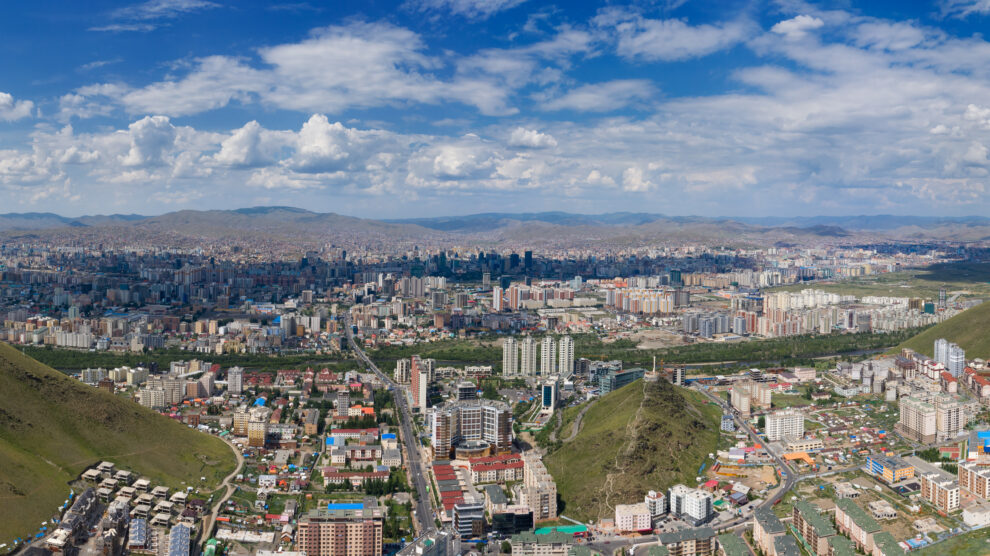
In the first of a short series of articles looking at the economy of Mongolia, we take a look at where the country has made good progress.
When Moody’s and S&P upgraded Mongolia’s sovereign credit rating in the second half of 2025 (the former to B1, the latter to BB-), it barely made headlines outside Ulaanbaatar. It should have. A decade ago, Mongolia was a byword for commodity-driven boom and bust, its finances so stretched that it needed an IMF bailout in 2017. Now it is posting fiscal surpluses for the fourth year running, public debt is falling, and GDP grew by 6.9 per cent in 2025. S&P’s upgrade marked a shift from ‘highly speculative’ to merely ‘speculative’. Which, by sovereign bond standards, counts as progress.
The growth story comes with an asterisk, though. Two things drove it: a spectacular rebound in agriculture after back-to-back dzud winters (brutal freezes that wiped out nearly a fifth of Mongolia’s national livestock herd by 2024), and a surge in copper production at Oyu Tolgoi, the giant underground mine in the South Gobi run jointly by the government and Rio Tinto. Agricultural output expanded by 33.2 per cent as herds rebuilt and calving rates recovered; mining output rose by 10.6 per cent, with copper concentrate production up nearly 60 per cent. Together, these sectors accounted for the overwhelming bulk of last year’s growth. Strip those two effects out, and the picture is rather more modest. Services and trade, the parts of the economy that might sustain a middle-income country over the long run, barely stirred.
Copper’s moment
Oyu Tolgoi is now fully operational underground, and its expansion has transformed Mongolia’s commodity mix at an opportune moment. Global copper prices surged more than 30 per cent across 2025, reaching near-record levels on the London Metal Exchange, propelled by supply constraints and the clean energy transition’s appetite for the metal. Mongolia’s copper exports were up 76 per cent in value terms. Gold output embedded in Oyu Tolgoi’s copper concentrate more than doubled.
Coal, Mongolia’s other big earner, went in the opposite direction. Prices fell by 38 per cent as China’s power sector shifted toward renewables and domestic production caught up. China’s coal imports dropped by roughly 10 per cent across the year. For a country where coal-related revenues have historically accounted for around a third of corporate income tax receipts, this was a painful squeeze. Total budget revenues fell from a record 39.2 per cent of GDP in 2024 to 35.3 per cent in 2025. The government cut spending hard in response, finishing the year with a surplus of 1.5 per cent of GDP and public debt down to 40.2 per cent from 42.8 per cent a year earlier.
That is fiscal discipline of a kind that has historically eluded Ulaanbaatar. Bond investors noticed: the Development Bank of Mongolia refinanced its external debt at spreads roughly 2.5 percentage points tighter than on its previous issuance.
The other Mongolia
Away from the spreadsheets, the picture is more complicated. Inflation averaged 8.6 per cent in 2025, well above the Bank of Mongolia’s target band, driven by meat prices (booming livestock exports are squeezing domestic supply) and the lingering effects of an electricity tariff increase in late 2024. The central bank raised its policy rate by 200 basis points in March 2025 and repeatedly tightened limits on consumer lending. Households felt the pinch. Private consumption grew by 9.2 per cent but lost momentum through the year as real incomes stagnated.
Then there is the Ulaanbaatar problem, which tends to get less attention than the copper mine but matters rather a lot. Close to half of Mongolia’s population now lives in the capital, which accounts for roughly two-thirds of national GDP. The city has grown at extraordinary speed for two decades and its infrastructure has not kept up. Average commute times in the six central districts rose by about ten minutes between 2011 and 2023 (a 20 per cent increase) as vehicles proliferated far faster than road capacity. Average traffic speeds on main roads have slumped from 30-40 km/h in the late 1990s to roughly 13 km/h today, and as low as nine km/h during the rush hour.
A new World Bank analysis, published as part of its April 2026 economic update, finds evidence of “over-agglomeration”: concentration of industry in the capital has begun to reduce rather than boost firm-level productivity as congestion and rising costs outweigh the advantages of proximity. Manufacturing shows the effect most clearly.
China’s shadow
Underlying all of this is a dependency that no amount of fiscal discipline resolves quickly. Mineral exports (coal, copper, and gold) account for around 95 per cent of Mongolia’s export revenues. China buys almost all of it. A sustained slowdown in Chinese industrial activity, or an acceleration of Beijing’s clean energy transition away from coal, would hit Ulaanbaatar harder than almost any other capital. The coal price slide of 2025 was a preview.
The good news is that Ulaanbaatar has been paying attention. A new critical minerals roadmap, adopted alongside 2026 minerals law amendments, prioritises 11 strategic materials including lithium, cobalt, and graphite for accelerated exploration. Mongolia is geologically promising but substantially underexplored for these minerals, and royalty reforms are beginning to address the tax structures that have deterred smaller explorers. In a separate signal of changing times, a Mongolian national became chief executive of Oyu Tolgoi in early 2026 for the first time in the mine’s history.
For now, the story is one of genuine resilience built on narrow foundations. The copper boom has bought time; the pastoral rebound repaired rural balance sheets. Whether the government uses the fiscal breathing room to build something more durable is another question: one we will address in the next article in this series looking at Mongolia
Photo: Dreamstime.