
A 50 billion euros data centre in a Croatian backwater is exactly the kind of project that the Three Seas Initiative was created to deliver.
Topusko is not where you would expect to find 50 billion euros. The town in central Croatia, tucked between Zagreb and the Bosnian border, has 945 inhabitants. Its main attractions are a hot-spring spa, the ruined arches of a 13th-century Cistercian abbey, and the dubious distinction of being classified by the Croatian government as a First Category Area of Special State Concern (a polite way of saying it never quite recovered from the 1990s wars that turned this stretch of the old Krajina into rubble).
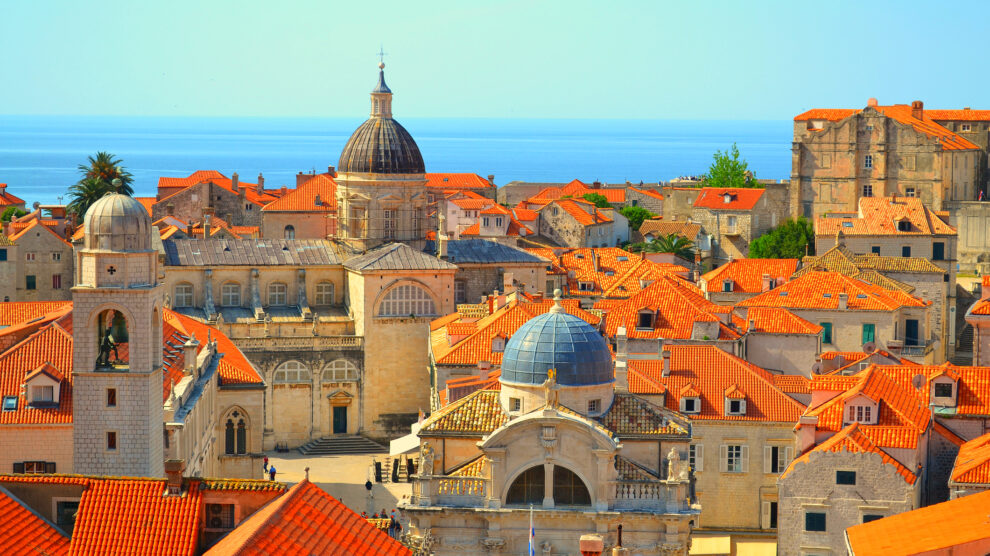
On April 28, in front of 13 prime ministers and presidents gathered for the Three Seas Initiative (3SI) summit in Dubrovnik, an American-led consortium announced that Topusko will become the site of Pantheon AI, a hyperscale data-centre campus. The numbers are beyond anything Croatia has seen before. Pantheon Atlas, the investment vehicle, will spend 12 billion euros building the campus itself, with total deployment expected to top 50 billion euros once hyperscale tenants install their equipment. That makes it the largest foreign investment in Croatian history (the country’s annual FDI inflows have averaged around three billion euros over the past decade) and among the largest American private investments anywhere in Europe.
The 310-acre site will deliver one gigawatt of capacity, with 800 MW of usable IT load, built to NVIDIA’s GW-scale AI factory standard. A behind-the-meter 500 MW solar plant with 8 GWh of battery storage, supplied by Greenvolt (majority-owned by KKR), will power it. Four independent 400 kV transmission lines, designed by Croatia’s Končar, will allow up to 5.2 GW of additional renewable capacity onto the national grid. Construction begins in early 2027 and the campus should be operational by the first quarter of 2029. It promises 3,000 construction jobs and 1,500 permanent ones, in a county where unemployment runs roughly double the Croatian average.
Why Topusko, of all places? Because Frankfurt, London, Amsterdam, Paris and Dublin (the so-called FLAP-D markets that anchor European data) are full. Vacancy across them fell to 6.3 per cent by end-2025, according to JLL, a property consultancy, with 83 per cent of the construction pipeline already pre-let. Grid connections in Frankfurt can take a decade. AI workloads, on JLL’s reckoning, will account for half of all data-centre demand by 2030. Hyperscalers need power, land and political stability. Croatia, an EU and NATO member with cheap rural acreage, available capacity and decent connectivity, ticks each box.
All of which raises an awkward question for the 13 leaders in Dubrovnik. Pantheon AI is precisely the sort of investment the 3SI was created to deliver. But it wasn’t delivered by the 3SI.
Talking shop
The initiative, launched in the same coastal city in 2016 by the presidents of Poland and Croatia, brings together 13 EU member states stretching from the Baltic to the Black to the Adriatic seas. Together they cover 120 million people and roughly three trillion euros of GDP, growing at about twice the EU average. The Atlantic Council, an American think-tank, estimates the region needs between 600 billion and one trillion of infrastructure investment to catch up with western Europe. Plugging that gap was meant to be the 3SI’s main job.
The Three Seas Initiative Investment Fund, set up in Luxembourg in 2019 with seed capital from nine member-state development banks, was supposed to do the heavy lifting. Its target was three-five billion euros. By mid-2024 it had raised about €900m and committed roughly 800 million euros across nine countries. America’s Development Finance Corporation chipped in 300 million US dollars. Returns have been respectable (around 15 per cent annually, by Atlantic Council estimates), but the fund is close to using up its capital, and the private investors it was meant to attract have largely failed to materialise.
The institutional picture is thinner still. There is no permanent secretariat. The 3SI has functioned, as Ian Brzezinski of the Atlantic Council put it last week, as a “stop-and-go undertaking”, with political energy peaking around the annual summit and dissipating for nine months afterwards. Croatia’s coordinator, Ambassador Romana Vlahutin, has been pressing for reform. So have the Poles. The Czechs and Austrians, never enthusiastic, are less keen.
The deeper confusion is over what the 3SI actually is. Andrzej Duda, then Poland’s president, framed it in 2016 as a geopolitical project to bind central Europe more tightly to America and reduce dependence on Berlin and Moscow. Zoran Milanović, his more euro-Atlantic Croatian counterpart, said in 2020 the initiative risked the precise resentment it was meant to avoid. The Trump administration, which pledged $one billion US dollars to the fund in 2017 and disbursed less than a third of that, treats the 3SI as a vehicle for American commercial diplomacy: LNG exports, civil nuclear, and now AI infrastructure. Brussels watches warily, suspicious of any ‘mini-EU’ that might splinter the bloc’s coherence.
Pantheon AI sharpens the dilemma. The project is heavily American (Pantheon Atlas is a US-led vehicle; Eastdil Secured is advising; Latham & Watkins is counsel). It was unveiled in Dubrovnik by Joshua Volz, US special envoy for global energy integration, alongside Andrej Plenković, Croatia’s prime minister, and 12 of his counterparts. None of this required the 3SI. But all of it would have looked rather better being claimed by it.
That is what a permanent secretariat (now formally on the Dubrovnik agenda) is meant to fix. Brzezinski wants a small office of fewer than a dozen staff to act as marketing arm, project repository and convening agency between summits. The cost is trivial. The political consensus is not. The proposal needs unanimous backing from all 13 members, and Vienna in particular still prefers to treat the 3SI as a discussion club rather than an institution.
Capital of Pantheon’s scale is now arriving in central Europe under its own steam, drawn by the same mix of cheap power, EU stability and political alignment with Washington that the 3SI has been advertising for a decade. Dubrovnik’s leaders can build the architecture to channel those flows, or watch them happen and claim the credit afterwards. Topusko, long used to being overlooked, may yet find its hot springs heating something stranger than rheumatic Hungarians.
Photo: Dreamstime.