
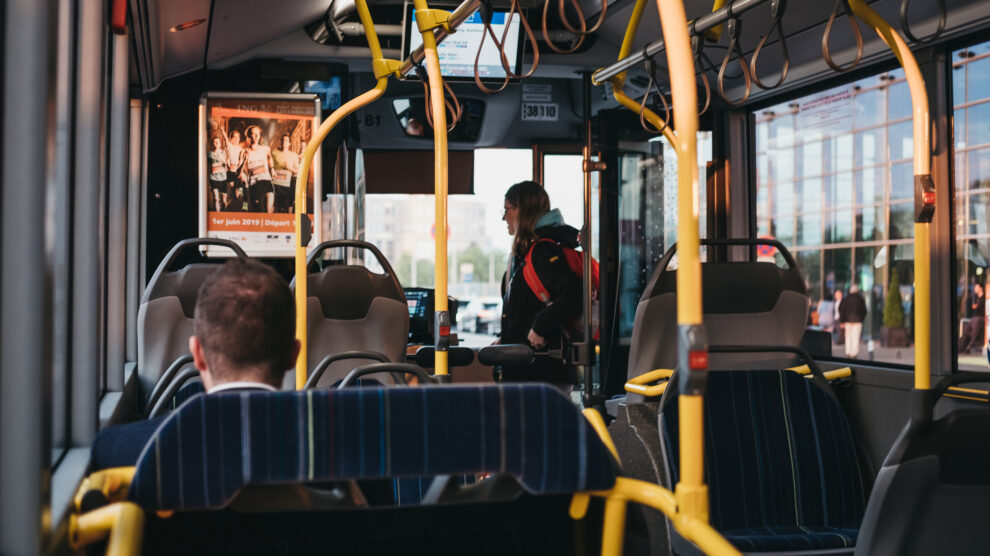
Half of Europeans never use public transport. Freebies are an easy answer, but as some countries have found out, they don’t ease congestion.
Eurostat published a transport snapshot in March showing that just over half of EU adults (50.6 per cent) did not use public transport at all in 2024. Only 10.7 per cent used it every day, and 11.6 per cent every week. The non-users were not evenly spread. Cyprus stood at 85 per cent, followed by Italy at 68 per cent, Portugal at 67.8 per cent, France at 65.1 per cent, Slovenia at 61.6 per cent and Greece at 61.3 per cent. At the opposite pole sat Luxembourg, where 15.7 per cent of adults never boarded a bus, train or tram, alongside Estonia at 26.6 per cent and Sweden at 26.7 per cent.
The correlation looks tidy. Luxembourg abolished fares across its national network in February 2020; the Estonian capital, Tallinn, did the same for residents in 2013. Both governments have spent the years since pointing at modal-share charts as proof that scrapping the ticket window works. Reinvantage’s free bus problem in February argued otherwise. Luxembourg’s congestion sits at pre-pandemic levels, with car journeys still over 75 per cent of the total; Tallinn’s transit share of trips slid from above 40 per cent to below 30 per cent across the decade after fares went, while car commuting climbed from 40 per cent to 50 per cent.
Wiener Linien is the operator most often cited by free-transport enthusiasts. In May 2012 it cut its annual ticket price for the Vienna core zone to 365 euros, the famed euro-a-day. By 2019 some 852,000 residents held one, against 363,000 in 2011, and there have been more annual passes than registered vehicles in the city since 2015. Modal share at 36 per cent by public transport is the highest in any European capital. The price rose to 467 euros in January 2026.
A study by Civity, a German management consultancy, found a less flattering picture. Passenger numbers in Vienna rose nine per cent in the six years after the price cut. That was below the city’s population growth and below the average rate before the change. The modal split barely budged. The pass had not pulled drivers from cars; it had reorganised the wallets of people who already used the system.
Wheels and sticks
Vienna paired its cheap pass with a transit network denser than any of the German cities trying to copy it, settlement patterns built around the tram and metro since the 1970s, and parking management that has tightened relentlessly. The Verkehrsverbund Ost-Region pools tickets across operators so a single fare carries a passenger from S-Bahn to tram to bus without further thought.
Zurich offers a starker version. About 65 per cent of journeys within the city are made by public transport and only 17 per cent by car, according to the city’s quadrennial modal-split survey. Central trams arrive every 45 seconds at peak. Not a single transport referendum has been defeated by Zurich’s voters since 1973. Oded Cats at the KTH Royal Institute of Technology in Stockholm has found that the cross-elasticity of transit demand to petrol prices is reliably higher than the elasticity to fares: making driving expensive shifts more journeys than making transit cheap.
Ken Livingstone tested that proposition in central London in 2003 by introducing a five UK pounds daily congestion charge. Traffic inside the zone fell 15 per cent in the first year and the night-day speed differential, the standard measure of congestion, by 30 per cent. Bus ridership inside the zone is up 33 per cent over the two decades since, on figures from Centre for Cities. The charge stands at 15 pounds today, with net revenue ringfenced for sustainable transport investment. In November 2025 the Greater London Authority began consulting on raising it in line with Tube fares so the gap between driving and riding does not erode.
Germany has run the natural experiment at scale. The 49 euros Deutschlandticket, launched in May 2023 and now 58 euros, has been bought in the millions and gives unlimited travel across regional and local networks. Researchers at the Technical University of Munich found that only one in five new ticket-holders cut their car use. Most of the rest had already been commuting by transit, or had shifted from cycling and walking. Cheap fares without faster, denser services made the trains popular without making the roads quieter.
The countries at the wrong end of Eurostat’s table share a problem free fares would not fix. Cyprus’s only urban networks (in Nicosia, Limassol and Larnaca) run on bus frequencies that struggle to compete with the car. Italian buses outside Milan and Rome are notoriously slow, and ticketing is fragmented across hundreds of operators. France’s Cour des comptes found in September 2025 that scrapping fares in larger cities cost a fortune in lost revenue while shifting trips mostly from walking and cycling rather than from cars. Slovenia and Greece have municipal systems that thin out as soon as the suburbs begin.
The fix is unglamorous. Bus lanes that cars cannot drift into. Signal priority that lets a tram clear an intersection before the next bonnet creeps forward. Real-time information that puts a number on the next arrival. Ticketing that crosses operator borders without the passenger learning the politics behind them. Parking metres that bite harder than the fare ever did. The Verkehrsverbund model (pioneered in Hamburg in 1965 and copied across Germany, Austria and Switzerland) has delivered ridership gains in member cities ranging from 12 per cent over the long run to several multiples of starting levels, by combining all of the above.
Free rides are easy to announce, but full buses are harder to deliver. The countries near the bottom of Eurostat’s chart will not lift their numbers by waving away tickets. They will lift them by making the bus arrive before the next song ends, the route end somewhere worth going, and the parking metre bite harder than the fare ever did.
Photo: Dreamstime.