
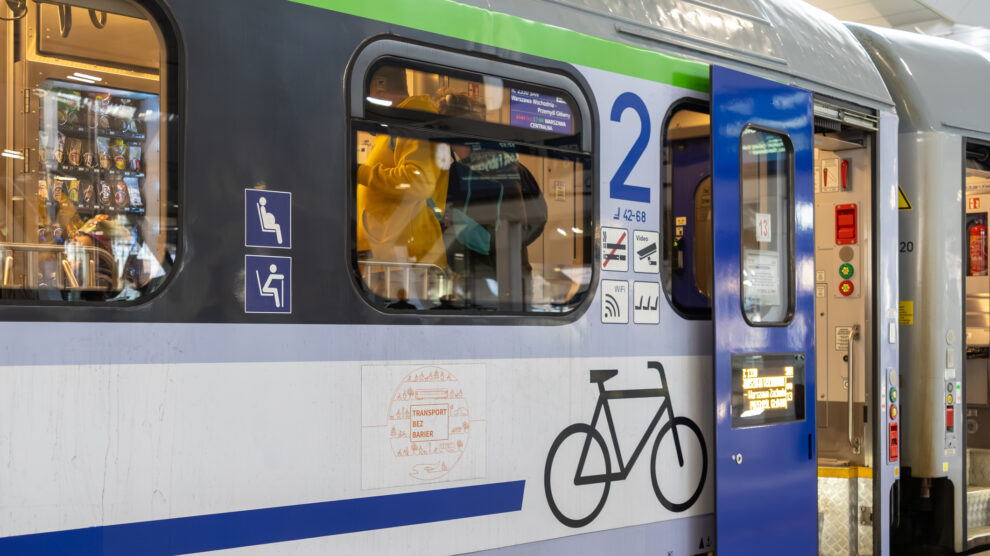
A partnership between bikes and trains ought to be one of transport’s natural pairings. In many parts of Europe that is no longer the case.
A prominent railway campaigner known to this writer has a small travelling ritual. Before boarding some trains, he needs to fold his bicycle, zip it into a black bag and carry it aboard much like a suitcase. Folded bikes count as ordinary luggage on most of Europe’s railways, so no one charges him for it and no one turns him away. Indeed, there is no reason to believe that the bag contains a bike at all. He resorts to the bag because the partnership between bikes and trains, which ought to be one of transport’s natural pairings, is under strain.
The European Parliament and the Council appeared to settle matters in 2021 with Regulation 2021/782 on rail passengers’ rights. The European Cyclists’ Federation, the umbrella lobby behind the EuroVelo network of long-distance routes, had pushed hard for it. From June 2023 the rules obliged operators to carry bicycles and, on new or rebuilt trains, to fit a minimum number of cycle spaces. The drafters also left escape hatches, allowing operators to refuse bikes on grounds of safety, capacity or the timetable. Those clauses have done most of the work since.
Deutsche Bahn set out its own terms in September 2025, when DB Regio and DB Fernverkehr published a bicycle carriage plan, a document German law now demands of every railway. It records where bikes may travel and how many fit each type of train. It also notes, in the usual small print, that carriage cannot be guaranteed: on a crowded regional service the conductor may send the cyclist back to the platform. Prams and wheelchairs come first, as they should. The bicycle sits at the bottom of the queue.
Bavaria’s transport authority had trimmed its offer earlier, at the end of 2022, when it withdrew the free carriage of smaller bikes that riders in the state had long taken for granted. Deutsche Bahn had banned cargo bikes from its trains in August 2019. The flat-fare Deutschlandticket fits the same pattern. The Verband Deutscher Verkehrsunternehmen (VDV), the operators’ association, counted 14.6 million holders of the pass at the end of 2025, and the price rose to 63 euros in January 2026, but the ticket still carries no bicycle. In most states the cyclist pays a second fare. Those fares differ from one state and transport association to the next, and change by the hour: in Baden-Württemberg a bike rides free before six in the morning and after nine, yet costs six euros in between. Bernadette Felsch of the ADFC’s Bavarian branch has urged members to print the rules and show them to staff, because even conductors lose track.
A marriage of convenience
Christian Tänzler of the ADFC, Germany’s main cycling federation, put the commercial case at the ITB travel fair in Berlin in March 2025. He asked for a single nationwide rule for bikes on trains, built along the lines of the Deutschlandticket, and noted that cycle tourists spend about 117 euros a day, much of it in rural districts that attract little other trade. The federation, which claims more than 240,000 members, has pressed the same case for years. Its 2025 position paper called for premium national cycle routes and barrier-free stations, and its travel survey shows rising numbers of cyclists arriving by train despite the shortage of spaces.
The Federal Ministry for Transport measured that appetite in its Fahrradmonitor survey of 2023, which found that 56 per cent of cyclists rated taking a bike on local and regional trains as important. DB Regio, the regional arm, bars bikes from the Munich and Nuremberg S-Bahn through the morning peak, school holidays excepted. Deutsche Bahn promised more space in its September 2025 plan, as new ICE 3neo trains, running since December 2022, take over more long-distance routes. The regional fleet, where most cyclists travel, gained no such pledge.
Caroline Lodemann, the ADFC’s federal manager, returned to the question in late May 2026 at a rail-access conference that Deutsche Bahn had convened. She said the combination of bike and train fails people on the journeys they care about most, the daily commute and the summer holiday. Her federation reckons the country is short of roughly a million bike-parking spaces and about a thousand secure cycle stores at its busier stations.
BikeRadar, a cycling magazine, reported in February 2026 that Eurostar will carry a full bicycle only once it has been dismantled, bagged and handed to a luggage desk, with the train manager free to refuse anything larger. TGV-Lyria had dropped assembled bikes altogether back in December 2017. SNCF still carries them free on French regional trains, though it keeps them off the Paris commuter lines at peak times.
Other countries remain more committed to ensuring that trains and bikes have a symbiotic relationship. NS, the Dutch operator, runs an Amsterdam-to-Berlin Intercity with room for 16 bikes, reservation required, at 14.10 euros. Belgium’s SNCB carries folding bikes free and takes a full one on local trains for a few euros. Norway’s Go-Ahead Nordic accepts bikes on every train with room to spare, reservations included on the Oslo-to-Stavanger line.
Photo: Dreamstime.