
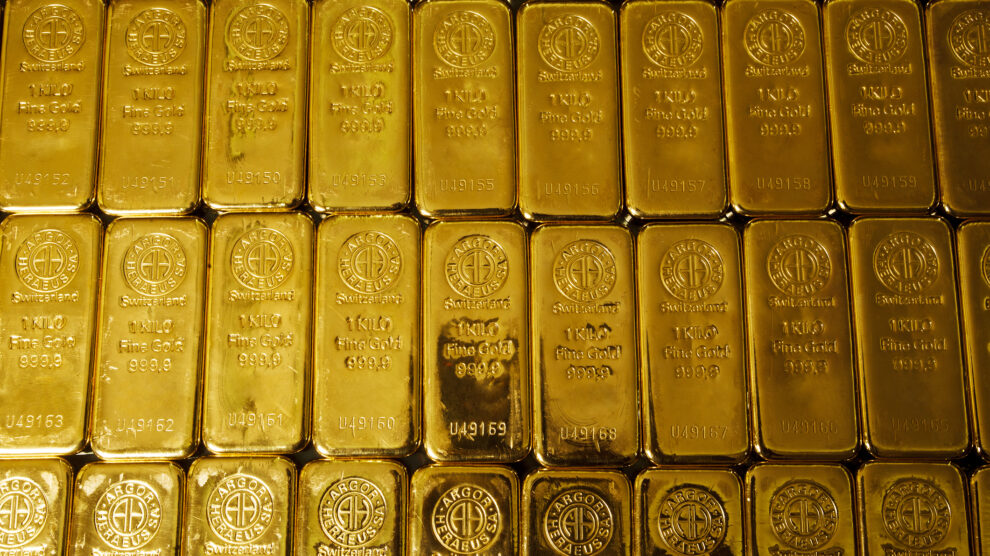
Warsaw is buying more gold than any central bank on earth, through every price dip. The reasoning holds; copying it is harder than it looks.
Adam Glapiński was in a buying mood. On July 9 the governor of the National Bank of Poland (NBP) told reporters that his bank had picked up 82 tonnes of gold since January, snapping up bullion each time the price slipped. The World Gold Council, which counts the numbers reported to the IMF, puts the haul lower, at 64 tonnes. Either way it dwarfs the field. Uzbekistan, the next keenest buyer, has managed 33 tonnes this year; China, 25.
The spree is not new. Glapiński launched it in April 2023, while Mateusz Morawiecki’s Law and Justice (PiS) government still ran the country. Since then the bank has added 385 tonnes, lifting its stock to 613.85 tonnes, worth about 71.77 billion euros. That is more gold than the European Central Bank keeps (around 508 tonnes), and enough to seat Poland among the world’s 10 largest holders.
Donald Tusk once wanted want the governor gone. In March 2024 the Polish prime minister, who had beaten PiS the previous autumn’s election, moved to bring Glapiński before the State Tribunal, accusing him of surrendering the bank’s independence to his old party. Glapiński stayed put. His term runs to 2028, the NBP answers to no minister, and the shipments keep coming. The buying has not paused for the change of government.
Safe as vaults
Central bankers took a lesson from February 2022, when Western governments froze around 300 billion US dollars of Russia’s reserves within days of the country’s invasion of Ukraine. Bullion sitting in a vault in Warsaw cannot be frozen, seized or sanctioned by anyone abroad. It earns no interest, but it carries no counterparty either, and for a country on NATO’s eastern flank that trade looks worth making.
In November 2019 Glapiński flew 100 tonnes home from the Bank of England, 8,000 bars across eight flights, declaring that gold “symbolises the strength of the country”. About 100 tonnes of Poland’s stock now sits in NBP treasuries rather than in London. Uzbekistan’s central bank keeps 87 per cent of its reserves in bullion.
The People’s Bank of China added 14.93 tonnes in June, its 20th straight month of buying, taking its holdings to 2,346 tonnes. India and Kazakhstan have been quieter, but no less steady. The Reserve Bank of India bought 18 tonnes in February to reach 822 tonnes, and the National Bank of Kazakhstan added 12 tonnes over the first quarter. None has sold.
Aleš Michl has bought for a different reason. Since 2022 the governor has lifted the Czech National Bank’s gold from about 12 tonnes toward a target of 100 tonnes by 2028, on the calculation that the larger holding steadies its annual profits. Marissa Salim of the World Gold Council reported in July that a record share of the banks it surveyed mean to add more within the year, and that three-quarters expect the dollar to shrink as a slice of world reserves within five years. Gold may indeed pay no interest and cost money to store, and for two decades that was reason enough to leave it be. That logic no longer appears to hold.
Not every wager on gold has paid off. In May 1999 Gordon Brown, then Britain’s chancellor, announced the sale of 401 tonnes of the country’s reserves, and the Bank of England auctioned them by March 2002 at an average of 275 US dollars an ounce. The sale, later nicknamed ‘Brown’s Bottom’, raised about 3.5 billion US dollars. By 2010 the price had tripled, and it has climbed a good deal further since.
In 2024 Tusk failed to prise Glapiński from the bank, and with his term running to 2028 the buying has stayed clear of party politics. The banks buying hardest sit on or near Russia’s border, among them Poland, Kazakhstan and Uzbekistan. The United States, whose dollar the rest are quietly shedding, has not added an ounce in decades. In January the NBP’s board approved another 150 tonnes. Glapiński means to reach 700.
Photo: Dreamstime.