
The rush to colonise the heavens says more about the urge to flee Earth than to save it. Its real worth may lie a good deal closer to home.
In April four astronauts flew around the Moon and came home, the first humans to travel that far since 1972. While Artemis II did not land, instead looping around the far side, taking some amazing photographs and then splashing down in the Pacific, the mission thrilled hundreds of millions of people who followed its every move, from launch to reentry, with an interest not seen, at least in this correspondent’s experience, since the Space Shuttle first flew in 1981 (when my entire primary school gathered in the library to watch it on television).
Back then, of course, the United States and Soviet Union remained locked in a space race. The Soviet shuttle, Buran, flew only once, in 1988. The Space Shuttle programme ran for 30 years and often gets hailed as a huge success, even though it was a massive failure in terms of achieving its stated original goal of providing cheap, safe access to space (two shuttles were lost in catastrophic accidents).
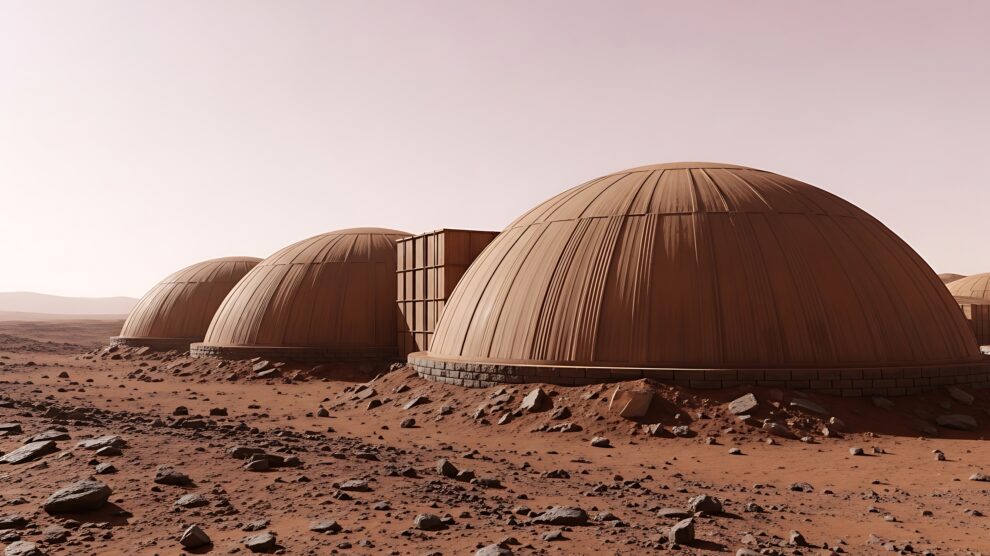
While Artemis II was a NASA mission, many of humanity’s recent ventures into space have been financed by private enterprise, whose ambitions go beyond the Moon. Back in 2018, Elon Musk, the founder of SpaceX, made clear that he believed humans must prioritise the colonisation of Mars so the species can be conserved in the event of a third world war. More recently he has stated that the Moon is a “distraction”.
Be it war or ecological disaster, Musk is not alone in making the argument for Mars. Earth is fragile, the argument runs, and a species with all its eggs on one planet sits one asteroid or one war away from oblivion. Mars is the insurance policy, and its colonisation cannot come quickly enough.
Plenty of others, of course, disagree entirely. Lord Martin Rees, Britain’s Astronomer Royal and co-founder of Cambridge’s Centre for the Study of Existential Risk, calls the dream of mass migration to Mars a “dangerous delusion”, his objection a purely practical one. Mars is colder and deadlier than Antarctica, and no amount of terrestrial ruin makes it less so. Better to send robots, which need neither air nor a return ticket. Neil deGrasse Tyson makes a similar point with a slightly different angle, one that has been thrown at space exploration from the very beginning, namely that mending a damaged Earth is far easier (and cheaper) than trying to transplant life onto a dead world.
What perhaps unites Mars sceptics more than anything else is the question of what happens to those left behind. Daniel Deudney, a political scientist at Johns Hopkins, argues in Dark Skies that pushing into space is a danger in its own right rather than a refuge from one, and that the honest purpose of rockets is what he calls “space for Earth”. Kelly and Zach Weinersmith set out to write a cheerful manual for settling the cosmos and ended up with A City on Mars, a book that concludes that nobody has actually thought such a policy through. Readers of the book tend to close it far more grateful for the planet they are already standing on than before they started.
For Earth’s sake
The complaint that space is a waste of resources better spent on Earth is somewhat overplayed, however. NASA currently costs the US around 25 billion US dollars a year, under half of one per cent of all federal spending. The choice between Mars and the poor is, for large part, a false dichotomy.
There is a positive, human case for going to Mars, perhaps best put by Robert Zubrin, president of the Mars Society, who has argued for Mars settlement for three decades. “If you’re not pushing, you’re not growing,” he says. A civilisation without a frontier, he warns, curls in on itself. One need not swallow the frontier myth whole to feel the pull of it. People have always walked towards the horizon without quite knowing why, and the walking has usually repaid them, albeit often at great cost.
These arguments justify very different ventures, though, and the present excitement runs them together. There is more to space exploration than settling Mars. Firing a probe at Europa or parking a telescope at the edge of time is relatively cheap and wildly productive. Watching Earth from orbit has already rewritten what we know about our planet’s climate. Deflecting an asteroid may one day save more lives than a health service. There is no vanity in any of that, and it ranks among the best-value science we do.
Settling humans on the Moon or Mars is another matter though. As adventure it can be defended, and as a way of learning what bodies and machines endure it has real worth. As salvation it collapses, and dressing it up as salvation spoils the case for everything else. To reach Mars would be a magnificent achievement. It would also prove very little beyond confirming to ourselves that we can do it.
Which returns the whole business to the ground. The most valuable thing the space age ever made was not a moon rock or a satellite but a photograph, taken by people who had gone far enough to look back and see Earth. Going just far enough to be able to view ourselves is partly how we learn to look after home. Grasp that, and there is no reason the exploring should ever stop. Mistake a flag on Mars for a future, though, and it is we who could end up lost in space.
Photo: Dreamstime.