
Two-fifths of the world’s land is degrading. The COP charged with halting it sits in Mongolia this month, starved of money and of attention.
Think COP, think climate change, climate catastrophe, and the largely talking shop that is the annual United Nations summit where nearly 200 countries gather (often in some of the most fossil fuel dependent countries on Earth) to (ostensibly) negotiate global climate action, set emission-reduction goals, and review progress under the UN Framework Convention on Climate Change (UNFCCC). The 31st edition, COP31, will be held in Turkey in November.
Less well known are the other COPs, for there are several. ‘COP’ stands simply for Conference of the Parties and is not just one single event, but a title used by different international treaties for their governing bodies that meet regularly, such as the UN Biodiversity COP (CBD), with a focus on protecting nature, animals, plants, and stopping the loss of ecosystems, and UN Desertification COP (UNCCD), with its focus on fixing damaged land, stopping deserts from growing, and managing droughts.
The latter, the UNCCD, is currently taking place in Mongolia, number 17 in this particular cohort of COPs. Operating under the theme, Restoring Land, Restoring Hope, the summit marks the first time an East and Central Asian country has hosted a UNCCD COP.
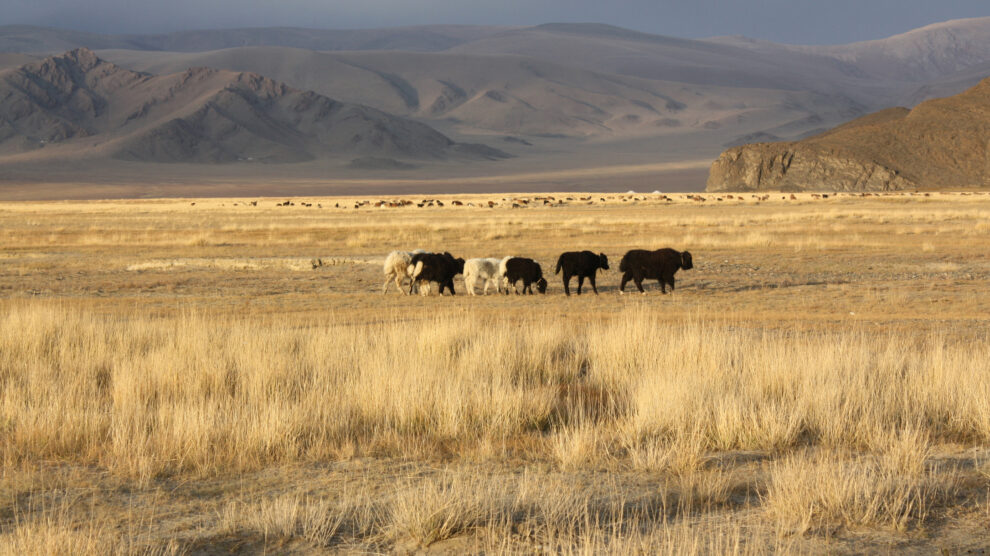
Mongolia knows a thing or two about desertification. The country is one of the top ten nations most impacted by climate change, with an average temperature increase of 2.26°C over the past 80 years and a significant decrease in annual precipitation. Increasingly vulnerable to desertification, as of 2020, over 76.9 per cent of Mongolia’s land area is affected by degradation, according to the United Nations Development Programme (UNDP), and many of the regions worst hit by desertification are also home to Mongolia’s nomadic herders, who rely on the land for their livelihood. The livestock sector accounts for around a quarter of the country’s employment and more than 10 per cent of its gross domestic product. In 2023 and 2024, Mongolian farmers lost more than seven million livestock due to severe summer droughts followed by extremely cold winters.
“For Mongolia, land is inseparable from our people, our livelihoods and our future. We know that the health of our land has direct consequences for people’s lives,” said Mongolia’s Minister for Foreign Affairs Battsetseg Batmunkh at the opening of UNCCD COP17.
Failure to deliver
Governments agreed to a desertification convention at first, 1992 Rio Earth Summit, alongside its better known climate and biodiversity treaties, and it remains the only one of the three that is legally binding on land. Yet whereas the UNFCCC COP receives global attention every year, the UNCCD version goes largely unnoticed. In December 2024, Barron Orr, its chief scientist, blamed this low profile on a lack of“iconic” images. While funding for land restoration rose from 37 billion to 66 billion US dollars between 2016 and 2022, this is still well short of the 355 billion US dollars the UNCCD says it needs each year, while the world loses roughly 100 million hectares of land annually. The UN says that public resources alone are unlikely to close the gap, and despite depending heavily on reliable land and water supplies, the private sector provides only around six per cent of global land restoration and drought resilience funding. Organisers of COP17 conference are therefore hoping to strengthen collaboration between governments, development banks, businesses and investors.
Previous events have been only partially successful. The convention’s members adopted land degradation neutrality as a goal back in 2015, and the Great Green Wall, an African-led plan to restore 100 million hectares across the Sahel, drew fresh money at Riyadh in December 2024, including 11 million euros from Italy and 3.6 million euros from Austria. These sums, however, are small, when set next to what is needed. Jes Weigelt of TMG Research, a think-tank, warned afterwards that the summit had suffered the same fate as that year’s climate and biodiversity COPs and had “failed to deliver”. Countries have since pledged to restore about one billion hectares, against the 1.5 billion to two billion believed to be degraded.
The United States has been particularly obstinate. At COP16 in Saudi Arabia, the largest desertification summit yet, the African Group pushed for a legally binding drought protocol, but the US pushed back, its delegation arguing that “droughts have local causes and as such do not require collective action”. The only real firm outcome was the Riyadh Global Drought Resilience Partnership, which brought together 12.15 billion US dollars in pledges for 80 vulnerable countries, 10 billion US dollars of that from the Arab Coordination Group.
The US has been no more cooperative in Ulaanbaatar, blocking (along with Russia) several key agenda items on the opening day. The postponed discussions include gender-responsive approaches, migration, drought, rangelands, civil society engagement, and cooperation among the three Rio Conventions. That a dispute over inclusion should overshadow the event bodes ill for its ability to bring about any meaningful change. In that respect, it differs little from its better known counterpart.
Photo: Dreamstime.