

Methodology this year favours reinvention: a response to the limits, increasingly visible, of traditional investment promotion practices.
We have once again ranked the performance of 31 investment promotion agencies (IPAs) across Central and Eastern Europe, the Balkans, Baltics, Caucasus, and Central Asia (the ninth time it has done so), and Estonia, a regular winner in the early years of the ranking, has returned to first place, dethroning Latvia, the highest ranked country of the past two years. Latvia fell to joint third (with Czechia and Lithuania), behind Moldova, which claimed second place. While comparisons with previous years are not entirely relevant given changes in the methodology used in the latest ranking, the fact that the three Baltic states all continue to take positions in the first five countries is evidence that as a whole, the region remains a leader in investment promotion.
The main goal of the research is to identify best practices that can be shared and contribute to the region’s social and economic development and help attract more foreign direct investment. To achieve that, researchers have developed a series of metrics to analyse the digital channels the 31 national IPAs use. Based on that, they assign points across seven categories, all reinvention capacities: Foresight, Identity, Choice, Reallocation, Adaptability, Execution Momentum, and Reinvention Culture. This emphasis on reinvention marks the biggest shift in the ranking’s methodology since it was introduced in 2018.
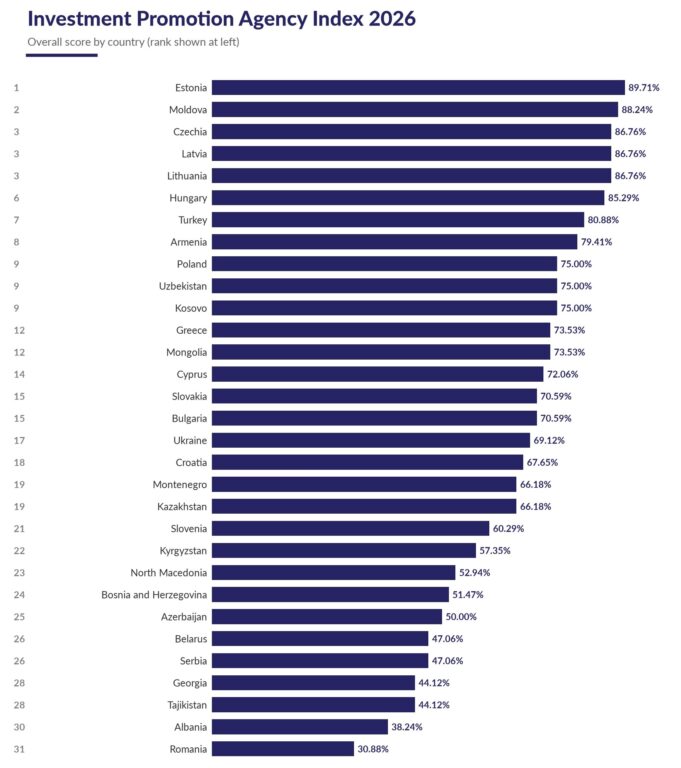
Estonia’s first place was, it should be noted, marginal. It scored 89.71 per cent, fewer than 1.5 percentage points more than Moldova (88.24 per cent). The three third-placed IPAs (Czechia, Latvia, Lithuania) all scored 86.76 per cent. At the foot of the ranking, Romania’s IPA scored lowest, just 30.88 per cent, well behind Albania (38.24 per cent), and Tajikistan (last year’s wooden spoon winner) which improved to joint 28th place, and 44.12 per cent.
Weighting this year’s methodology heavily in favour of reinvention comes as a response to the limits, increasingly visible, of traditional investment promotion practices and is intended to highlight the importance of adopting new ways of thinking across the investment promotion space. For far too long, IPAs have used location, talent, cost, and incentives as their primary means of promotion, all things which can admittedly bring about short-term, positive results but which in fact do little to differentiate one country from another.
The limits of ‘talent, location, cost, incentives’
The key question that IPAs should be asking themselves (and all good reinvention begins with organisations asking themselves the right questions) is: What would investors miss most if my country disappeared from the map? The answer is highly unlikely to include any of the classic four tools of investment promotion (incentives, cost, location, talent), all of which can easily be found elsewhere. Our new ranking, and methodology, has rewarded those countries which already appear (through their digital channels) to be asking and answering that question.
This is not to say that incentives, location, and talent will become irrelevant entirely. Estonia, it must be said, is itself not above offering incentives. Invest Estonia’s record 2025, in which it supported investment decisions worth 431 million euros, owed a good deal to a new scheme of large-scale investment grants, the threshold for which has since been lowered to 70 million euros. What foreign firms really appreciate in the country, however, is minimal bureaucracy and a digital state (which Estonia has been selling to the world for the best part of two decades but which is still hard to find elsewhere). The country is also quick to implement changes that can boost investment. In May, a committee of the Riigikogu, Estonia’s parliament, backed a bill creating an express lane for strategic investments, after business leaders complained that planning takes too long. This suggests joined-up-thinking between business, the IPA, and government (something which, again, is not found in too many other places). This ability to read signals from investors about their needs and quickly adapt is a key part of IPA reinvention.
Moldova’s second place will surprise some, but a closer look at the activity of Invest Moldova, its IPA, reveals why it scores so highly this year. Its pitch includes a whole section devoted to reconstruction in Ukraine, where it sees itself as a key staging ground in the years to come. Moldovan wages (still relatively low) can be matched in plenty of places, but its ability to tap into funds for Ukraine’s reconstruction while the country itself edges towards EU membership is somewhat more difficult to replicate.
Past success is no longer enough
Ultimately, IPAs that want to succeed in the future will need to be less greedy about the investment that they chase. They would pick two or three sectors (and be brave enough to tell the ministries lobbying for the other dozen that they are not on the list) and move their resources accordingly, spending less on expensive stands at trade fairs and brochures promising a skilled, multilingual workforce in the heart of Europe (a heart which, as we continually point out, seems to beat in an improbable number of places), and more on the firms already in the country. More than 30 per cent of the decisions Invest Estonia supported last year, for example, were reinvestments by foreign-owned companies already there.
A reinvented IPA would also look forward. Most agencies still report what they won last year, and few say where they think capital will be heading in five years, or why their country will be ready for it. A reinvented agency would publish that thinking, be prepared to be wrong in public, and change course when it needs to. Its website (where many investors still form a first impression, like it or not) would state what the country’s key value is front and centre. None of the 31 agencies we rank is there yet, but a few do at least appear to have realised that past success and what for too long has been assumed as best practice are no longer enough.
Photo: Dreamstime.