

Estonia wins again, but further down the table some of the strongest numbers rest on talent that arrived by accident and could leave the same way.
Make that four years in a row. Just as night follows day, it comes as no surprise that Estonia once again tops the Future of IT Index, comfortably ahead of Cyprus in second place. The index, which for almost a decade now has ranked the IT sectors of Central and Eastern Europe, the Western Balkans, the Baltics, Caucasus, and parts of Central Asia and the Mediterranean, looks at performance across five distinct pillars—talent, infrastructure, economic impact, business environment, and future technologies. Estonia leads in three of the five pillars and in future technologies (arguably the most revealing metric) it leads by a remarkably wide margin. The country’s well-earned reputation as an innovator and leader of digital transformation shows little sign of erosion just yet. Indeed, in October, the cybersecurity company Blackwall (formerly known as BotGuard) became the country’s latest unicorn, achieving a valuation of 2.2 billion euros following a 100 million euros Series C funding round led by AVP. Blackwall brings the number of Estonian unicorns to 12, some going for a country of 1.4 million people.
Behind the top two the margins were a good deal tighter. Lithuania, up one place from last year to third, came top for business environment, while Slovenia (down in ninth as recently as 2023) climbed two places to fourth, finishing a mere 0.07 points behind Lithuania and leading the infrastructure pillar, where it edged out Estonia. Latvia, fifth again, did not come first in any one pillar, but as usual it was solid (if never spectacular) across the board, which in an index built like this one counts for rather a lot.
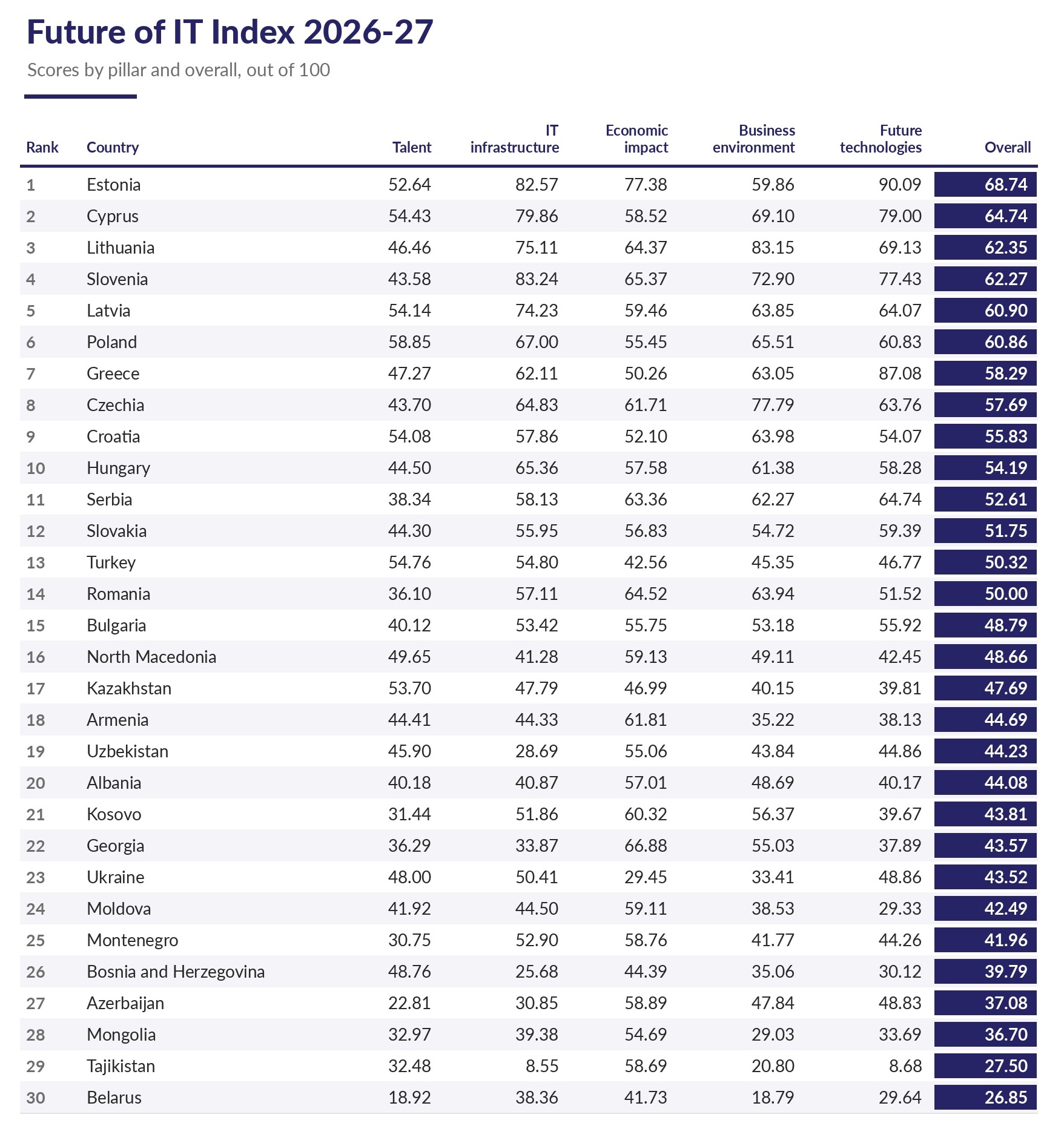
Poland is a more complicated case. It tops the talent pillar, which carries 40 per cent of the overall weighting (no other pillar accounts for more than 15 per cent), mainly because of the large number of students and graduates in ICT. And yet it slipped from third to sixth, four hundredths of a point behind Latvia, dragged down by a lowly 21st place for economic impact. Turkey, second for talent, is 13th overall. Cyprus, meanwhile, is third on talent and Estonia seventh, and neither produces ICT graduates in anything like Polish (or Turkish) quantities.
The real surprise is in economic impact, where second place goes not to one of the EU’s digital overachievers but to Georgia, which is only 22nd overall. The explanation is not hard to find. After Russia’s full-scale invasion of Ukraine in 2022, IT specialists from Russia (and to a lesser extent Belarus and Ukraine) arrived in Tbilisi in their thousands, many bringing their employers with them. Armenia, seventh for economic impact, tells a similar story. On future technologies, however (the pillar that looks at AI skills, AI policy and the like), Georgia ranks 25th and Armenia 24th, and Georgia’s talent score (23rd) suggests local universities are not producing replacements in any great number should the newcomers decide to move on, which, having moved once, they presumably could. The sector employed more than 50,000 people last year; Georgia’s 21 universities had around 12,000 IT students between them. Serbia, which also took in plenty of Russians, is the exception, sixth for future technologies and the only non-EU country in the top ten. Greece meanwhile is much like Georgia but in reverse. It ranks 25th for economic impact but second for future technologies, and climbed three places to seventh overall.
Further down the table, Albania and Kosovo each climbed seven places, to 20th and 21st respectively. Kosovo’s rise is more of a recovery than a breakthrough (it was as high as 11th in both 2023 and 2024 before tumbling to 28th last year).
At the bottom, Mongolia, Tajikistan and Belarus bring up the rear, with Belarus last of all, not helped by the fact that it does not publish reliable data on ICT students and graduates. Egypt and Jordan, included in the index last time out, were left out altogether for the same reason.
Then there is Ukraine, down six places to 23rd and bottom of all 30 countries for economic impact, its scores hit by the emigration of IT specialists as Russia’s ongoing war on the country continues to take its toll.
Photo: Dreamstime.