The EBRD’s annual gathering in Riga next month shows that there is a great deal of life left in what critics often dismiss as talking shops.
Tomas Kairys, the European Bank for Reconstruction and Development’s head of the Baltic states, told reporters in February that the Bank had invested a record 654 million euros across the three Baltic countries in 2025. Latvia took 160 million euros of that, spread over 13 projects, the highest annual figure the EBRD has ever put into the country. The timing was not accidental. From June 5 to 7, Riga will host the EBRD’s 35th Annual Meeting and Business Forum, with more than 2,000 delegates expected on the banks of the Daugava.
Arvils Ašeradens, Latvia’s finance minister signed the host-country memorandum with the Bank’s secretary general, Kazuhiko Koguchi, in May 2025. The Bank’s recent rotation tells its own story: Marrakech in 2022, Samarkand in 2023, Yerevan in 2024 (where Odile Renaud-Basso was re-elected to a second term as president), London in 2025 for the 35th anniversary meeting, and now the Baltics. Across all its regions, the EBRD put a record 16.8 billion euros to work in 2025, of which 9.4 billion euros supported the green transition and 75 per cent went to the private sector.
These are the numbers that explain why the meetings still happen at all. Annual gatherings of multilateral lenders are where governors approve country strategies, donor pledges are renewed, capital increases are ratified, and successor presidents are elected. Renaud-Basso said in February that the EBRD had deployed a record 2.9 billion euros in Ukraine in 2025, taking the total since February 2022 to 9.1 billion euros. That figure rests on a four billion euros paid-in capital increase that governors approved in May 2023 at the Samarkand meeting. Without the meeting, there is no vote, and without the vote, there is no money.
Crowded calendar
Scott Bessent, America’s treasury secretary, used a speech last April to the Institute of International Finance, held alongside the International Monetary Fund and World Bank Spring Meetings, to accuse both institutions of “mission creep” and of having been “knocked off course”. He came back to the theme in October at the IMF-World Bank annual gathering in Washington, telling reporters that the IMF should sell a Maryland golf course it owns and stop “dalliance in these climate policies or social engineering”. The IMF and World Bank did not push back hard in public. Kristalina Georgieva, the IMF’s managing director, used her townhall to announce a review of civil-society engagement; civil-society groups noted afterwards that the room had included delegates from JPMorgan and Coca-Cola.
Donald Trump delivered a special address to a packed Davos Congress Hall in January, after Air Force One briefly turned back from its outbound leg. He spoke about wanting a “strong Europe” and softened his earlier stance on Greenland. The Danish government, which had been invited, chose not to send representatives over the Greenland dispute. Mark Carney, Canada’s prime minister, used his own Davos speech to deliver what the World Economic Forum’s own write-up called a “stark assessment” of the rules-based international order. The WEF reported close to 3,000 cross-sector leaders and 400 political leaders in attendance, a record on its own count.
Ajay Banga, the World Bank president, called for a “new culture of transparency” in sovereign debt restructuring at a press conference last October, the closing day of the Washington meetings. Georgieva described uncertainty as “the new normal” in her own curtain-raiser. Both spoke against a backdrop of widening sovereign distress: the IMF projected global public debt would top 100 per cent of GDP by 2029. The World Bank’s 189 shareholders have not approved a quota realignment since 2010. The forums still draw the cameras. What they draw less of, on the evidence of the last two years, is binding agreement.
Renaud-Basso approved a 500 million euros loan to Naftogaz in August 2025 to replenish gas reserves before winter, the largest single loan the Bank has ever extended to Ukraine. A separate 270 million euros loan to the same company followed in April. Energy security took 1.2 billion euros of the Bank’s 2025 financing in Ukraine and nearly 3.3 billion euros since the war began. The four billion euros capital increase that backs all of this was, again, ratified at an annual meeting. Country strategy decisions for Türkiye, the Bank’s largest country of operations, will be debated in Riga in June.
Destination Riga
Vilnis Ķirsis, then Riga’s mayor, told reporters at the MIPIM property forum in Cannes last March that the city had been named in the Financial Times’ European Cities and Regions of the Future list for the third consecutive year. Foreign direct investment in the city reached 10.2 billion euros by late 2025, with Riga start-ups attracting 60 million euros in 2025, up from 21.8 million euros the year before. The European Investment Bank opened its first Latvia office in 2025 and channelled a record 381 million euros into the country, equivalent to 0.9 per cent of GDP. Smaller capitals trade on those introductions for years afterwards.
Renaud-Basso confirmed in February that the Bank had mobilised 60 million euros from France, the European Union and the United Kingdom to restore the New Safe Confinement structure at Chornobyl, damaged in a Russian drone strike on 14 February 2025. The donor mix, the loan terms and the next tranche of country strategies all sit on the Riga agenda in June. Critics often call gatherings such as these talking shops. They are clearly anything but.
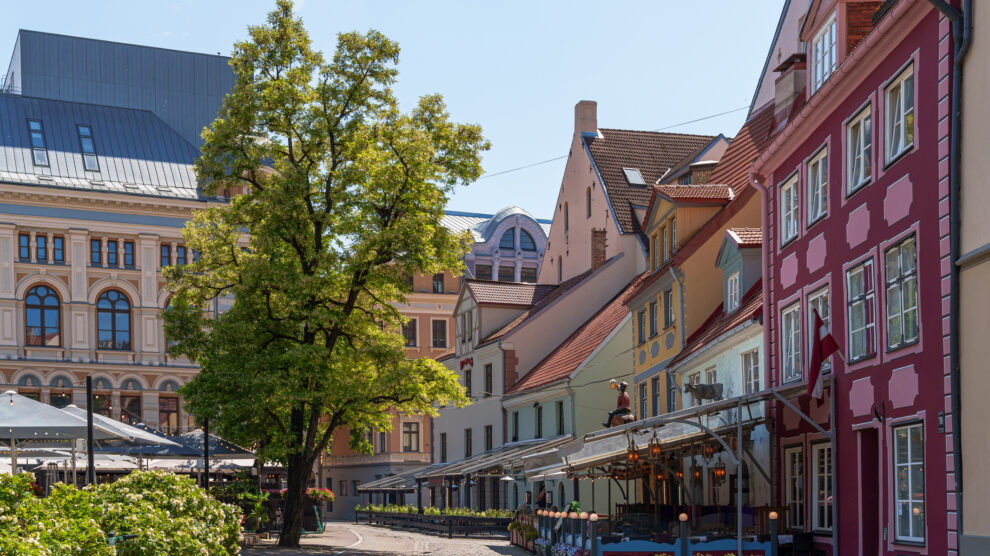
Photo: Dreamstime.