
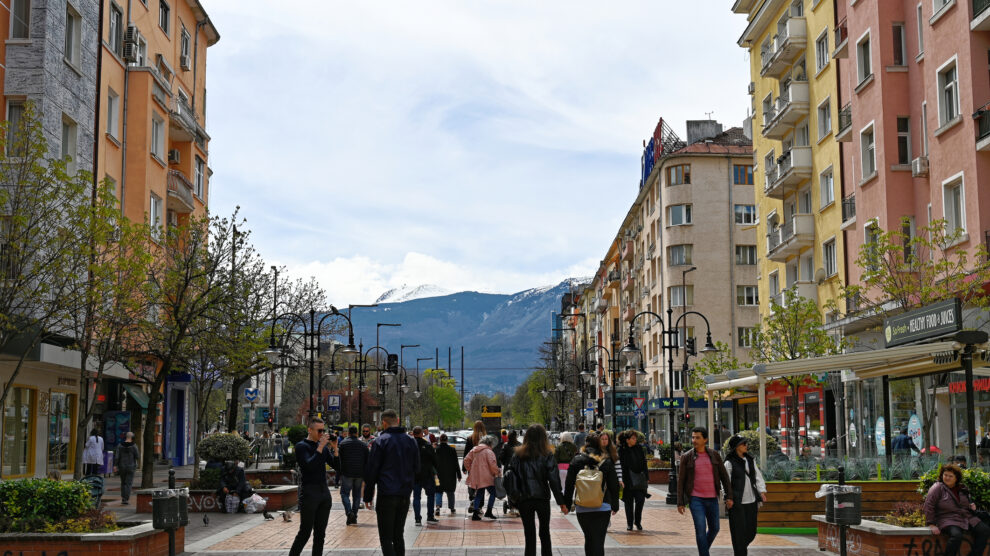
Across the Baltics and the Balkans, shrinking countries are betting everything on one major city. Entire regions risk being left in limbo.
Adrian Nikolov of the Institute for Market Economics, a Sofia think-tank, published his annual regional analysis in February. Bulgaria’s capital, he reported, generated 46 billion euros in 2024, or 44 per cent of national GDP. Only one other region, Stara Zagora, sat above the country’s average GDP per capita. The gap between Sofia and the rest, slightly under threefold in 2000, has since widened to more than fivefold. Most of the 25-year increase in regional inequality, Nikolov noted, can be put down to a single city pulling away.
Bulgaria’s National Statistical Institute released its end-of-year population figures in April. The country had 6,423,207 residents at the end of 2025, down 14,153 in a year, with deaths nearly double births. Five regions out of 28 grew at all; only the south-west, which contains Sofia, grew at the national level. The north-west, Bulgaria’s poorest corner, now holds just 10.1 per cent of the population. Sofia city alone holds 20.3 per cent.
Riga has run a similar trick on a smaller stage. Latvia’s Central Statistical Bureau reported in August 2025 that the population had fallen to 1.83 million by mid-year, down 26,500 in six months. The capital still holds about 605,000 of those people, around a third of the total, and produces 46.3 per cent of national GDP. Latgale, the easternmost region, has a per-capita GDP of 11,536 euros, less than a third of Riga’s. Some Latgale parishes now record fewer than seven people per square kilometre.
Žygimantas Mauricas, chief economist at Luminor Bank, calculated last May that Vilnius had become the first Baltic capital to exceed the European Union average for GDP per capita. The city generated 36 billion euros in 2024, outpacing Riga (26 billion euros) and Tallinn (24 billion euros). A decade earlier, Tallinn was a quarter richer; Riga, level. Lithuania’s national population has fallen below 2.7 million, a 0.9 per cent decline in 2024. Lithuania, Latvia and Bulgaria are three of the four fastest-shrinking countries in the European Union. All three have capitals that are growing.
City limits
The Latvian counties of Strenci, Baltinava, Viļaka, Krāslava and Ērgļi (spread across northeast, central and eastern Latvia) will lose all their residents to emigration or mortality, by the mid-2049 if current rates of departure hold, according to demographic modelling by the University of Latvia cited last year by the Jamestown Foundation. Several smaller parishes in Latgale have already passed the point at which a working settlement can be sustained. Schools have closed, doctors’ surgeries have consolidated and the bus services that once linked villages to a regional centre have been thinned out or scrapped.
Sofia recorded house-price growth of 16.3 per cent year-on-year in the second quarter of 2025, the fastest in the European Union. Apartment prices have doubled since 2020. Valdas Benkunskas, mayor of Vilnius, told the public broadcaster LRT in 2024 that the city’s planners are studying whether to absorb surrounding municipalities. Riga has tried something similar over two decades.
Pieriga, the area surrounding Riga, was the only Latvian region beyond the capital itself to grow its population last year, according to the CSB. It did so by absorbing people who commute into Riga every morning. Vilnius region accounts for 72 per cent of Lithuania’s foreign direct investment. Sofia city attracts half of Bulgaria’s. Rural schools, hospitals and old-age pensions are funded from national budgets. Those budgets rest on tax bases produced in three capital cities.
Juris Pūce, then Latvia’s environment and regional development minister, pushed through the country’s administrative reform in June 2020. It came into force the following July, cutting the number of local government units from 119 to 42, and was intended to make rural government cheaper to run. Daugavpils, the largest city in Latgale, recorded 78,126 residents at the start of 2025, down from around 85,000 a decade earlier. Lithuania’s ‘green corridor’ tax incentives, extended in 2025 to defence manufacturers, have steered Rheinmetall’s planned 155mm shell plant to Baisogala, in the centre of the country. The company’s Lithuanian headquarters sit in Vilnius.
Rumen Radev resigned the Bulgarian presidency in January 2026, founded Progressive Bulgaria on March 2, and won a snap election in April with 131 of 240 seats, the country’s first absolute parliamentary majority since 1997. The budget that brought down his predecessor following massive protests in Sofia had proposed an increase in transfers to lagging regions. It was withdrawn before it could be voted on. Galab Donev, sworn in as Bulgaria’s new finance minister on May 8, has so far spoken about corruption and cutting the country’s deficit. The regions have not featured.
Photo: Dreamstime.