
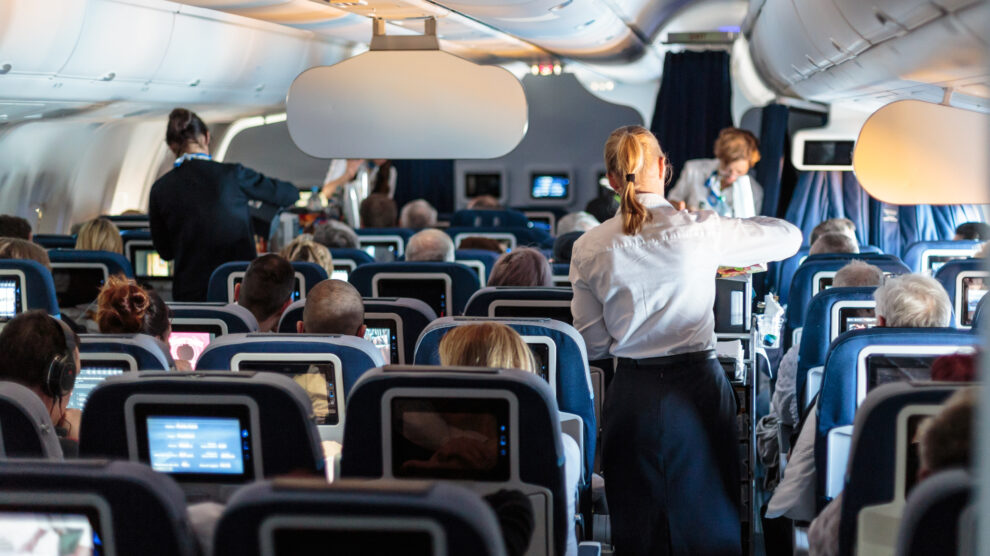
Airlines are dividing their cabins into an increasingly wide array of often confusing options. Do you fly Business Light or Premium Economy?
It used to be so simple. Aeroplane cabins were divided into economy and business class, with an additional first class section on some routes. There was often not a great deal of difference between an economy and business class seat, the higher price of the business class ticket instead being justified by its extraordinary flexibility (change your plans at the last minute and you could almost always take an earlier, or later, plane at no extra cost).
On legacy carriers, cabins look a lot different today. If low-cost airlines have almost all gone down the route of uniformity, where one size of seat and one level of service fits all, flag carriers have gone in the entirely opposite direction, coming up with myriad classes of ticket, seat, and service, all designed to ensure that those willing to pay for an extra level of comfort can do so.
Taiwan’s EVA Air is widely credited with introducing the world’s first true premium economy product when it debuted what it called Economy Deluxe Class in 1992. It currently offers four different classes of travel, known as Royal Laurel, Premium Laurel, Premium Economy and good old Economy. It’s not the champion of class differentiation, however. That title is (currently) held by Singapore Airlines, which offers Suite, First, Business, Premium Economy, and Economy class tickets. Others still offer tickets which incorporate some elements of different classes, such as Business Light (or Lite, on some airlines) which usually offer the comfort of a modern, business class seat but without the traditional flexibility of a business class ticket. The choice is often endless.
Delta Air Lines has put a number on why carriers keep chopping up the cabin in ever more bits. In January the US-based airline reported that in the last three months of 2025 its premium cabins brought in 5.7 billion US dollars, edging past the 5.62 billion taken by the main cabin. It was the first time in Delta’s history that the seats at the front had outsold those at the back. Premium ticket revenue rose nine per cent over the quarter while main-cabin revenue fell by seven per cent. Ed Bastian, Delta’s chief executive, told reporters that almost none of the airline’s seat growth in 2026 would go into economy. Virtually all of it, he said, would be premium.
Real estate, extremely limited on any aeroplane, no matter big they might get, is the main driver of much of the chop and charge mentality. A business-class seat can take up the same amount of floor space as three or even four economy seats, the trade off being that it generally earns the airline a lot more than three or four economy fares. On Delta’s route between New York and Los Angeles, for example, four economy seats fit into the space of a single Delta One seat; the four together fetch around 616 US dollars, the one lie-flat seat a whopping 1,599 US dollars. Premium economy, the middle tier that airlines unsurprisingly now love, is even more profitable still. Lufthansa says it generates up to a third more revenue per square foot than ordinary economy, for seats that are not all that much roomier. American Airlines says that premium economy is the most profitable use of space on its wide-bodied aircraft. United says its Premium Plus cabin increases its revenue per seat-mile by as much as four to six per cent.
Pauper class
For those of us on limited budgets who will almost always, alas, be consigned to the back of the plane, it does rather beg the question as to what we will be left with. Is premium economy simply what economy itself once was? Measurements overwhelmingly suggest that it is, given that the average pitch in a long-haul economy cabin has been significantly reduced from around 34 inches (83.36cm) in the 1980s to just 30 or 31 today (that’s not much bigger than the low-cost operators which generally offer around 29 inches). Premium economy averages about 38 inches. It does rather look as though premium economy, however it is named, branded, or sold, is offering not a great deal more bog-standard economy once did.
Airlines argue that it does, citing entertainment and meal offerings, as well as pointing out that such changes are ultimately the difference between profit and loss, and keeping their planes in the air. They have learnt to sell comfort to the people who are least likely to downgrade their seats when money is tight. Delta’s Bastian said last September that over 95 per cent of its revenue comes from households earning 100,000 US dollars a year or more. The margins (much like economy class seats, those of us at the back of the plane might argue) are thinner than they first appear. McKinsey meanwhile has calculated that even a booming transatlantic route turns a profit of only around 12 per cent.
There is, arguably, a much cheaper way to make flying more bearable that requires no new class at all. Lufthansa’s premium economy seat has a fixed shell, so a passenger wanting to recline their seat no longer falls into the lap of the unfortunate person sitting directly behind them. It’s all rather telling, however, that airlines have worked out how to end the war over reclining, even if it’s only for those willing to pay for it.
Perhaps one thing that all airlines could do to increase comfort (both reducing friction between passengers and reducing costs) is to follow the lead of the low-cost carriers and do away with reclining seats in economy entirely. Nobody wants the back of somebody else’s seat in their lap, and, furthermore, non-reclining seats are both lighter and cheaper to maintain.
Photo: Dreamstime.