Russia’s election fools nobody, which is rather the point. It also hands Putin a stick with which to beat a Ukraine that cannot vote at all.
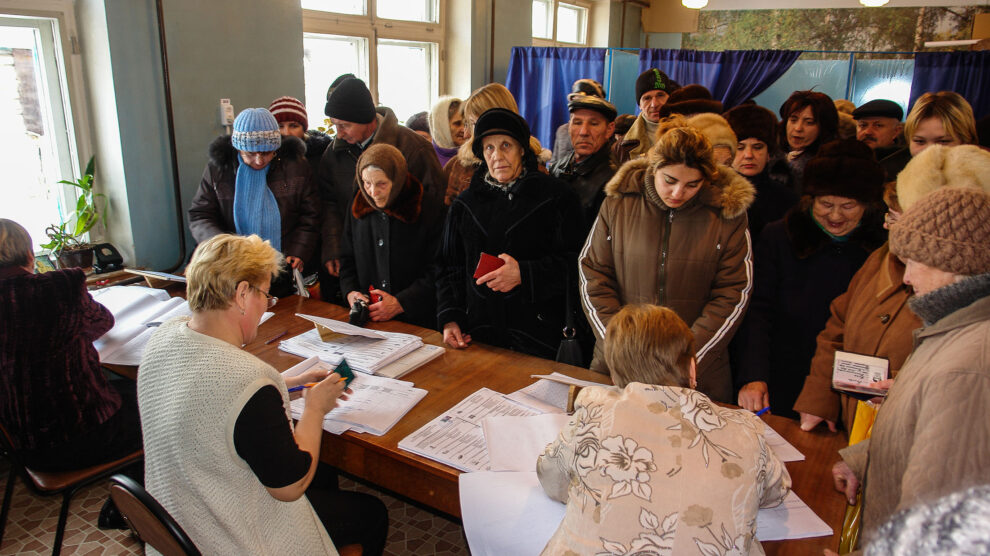
Oh the suspense. Russia will hold a parliamentary election in less than a month’s time, but the only political party in the country that openly opposes Moscow’s war on Ukraine, Yabloko, will not be taking part. Earlier this month, Russia’s Supreme Court upheld Yabloko’s removal from the September vote, while just a few hours previous, another court sentenced Yabloko’s deputy leader, Lev Shlosberg, to more than 11 years in a penal colony for calling for a ceasefire. However you might define a free, fair, and democratic election, Russian ballots do not fit the description. United Russia, the party closest to Vladimir Putin, will win a clear victory, with the Communists, the ultra-nationalist (if called otherwise) Liberal Democrats, and conservative Just Russia parties all likely to win some seats. For voters, it’s not much of a choice. Turnout will probably tell observers more than the results themselves. That 51 per cent of voters bothered to vote in the last election, in 2021, was hailed as a victory for Vladimir Putin given that it was an improvement on the 47 per cent of 2016.
When so little is at stake, why do countries such as Russia bother with elections at all? Nobody falls for the pretence, and yet elections are held (usually with great fanfare) anyway. Other countries go even further than Russia. In March, North Korea held elections for its Supreme People’s Assembly, with the Workers’ party of Korea winning all 687 seats. No real surprise, given that it was the only party on the ballot. Voters were simply offered the choice of approving or rejecting the sole candidate put forward by the party. All candidates were approved, on a turnout of 99 per cent. Putin, not surprisingly, was amongst the first to offer his congratulations to North Korea’s leader, Kim Jong Un, saying that the result, “clearly demonstrates unanimous public support”. Kim will no doubt be just as effusive in his praise when Putin’s United Russia strolls to victory next month.
Political scientists have given a name to the farce of uncompetitive elections, electoral authoritarianism. Andreas Schedler of the Central European University, who has done more than most to popularise the term, argues that countries such as Russia go through the motions of holding elections not necessarily to decide who governs, but to manage those who might make governing awkward for others. An election, albeit a foregone conclusion, lets a leader such as Putin co-opt rivals, reward the faithful, and take the measure of his own officials. Two other academics, Jennifer Gandhi and Adam Przeworski, studying dictatorships across decades, found that pliant parliaments help autocrats buy off opponents with seats, jobs, salaries, and patronage, dividing any semblance of opposition before it can properly take root. Holding a rigged election is cheaper (both in terms of cost and external optics) than more violent forms of oppression, but it serves much the same purpose.
‘Because I can’
There’s also another factor that makes authoritarian leaders brazenly rig elections they have little chance of losing, which is signalling to both internal and external audiences that they can. The cheating is, in and of itself, the message, and a crushing win broadcasts strength no matter how visibly engineered. This is why turnout usually matters far more than the final result.
A convincing landslide, dressed in democratic clothes, can also buy the perception of legitimacy abroad. In January, United Russia said that it was forming a network of “professional international observers…to counter attempts at external interference in the electoral process”. Andrei Klimov, a member of the party’s Supreme Council and the Council on Foreign and Defence Policy, told the Russian news agency TASS that, “We are training professional, objective, and reliable observers who will observe, not interfere. This is to avoid turning to obviously provocative organisations, such as the unelected OSCE/ODIHR, shady groups from the Council of Europe, and other shady entities.” Quite.
Having gone to the trouble of holding elections, Putin will not waste the opportunity to point across the border at Ukraine, which has held no vote of any sort since Russia invaded the country in February 2022. Kyiv imposed martial law that same month, and its constitution bars elections while it stands. That has not stopped the Kremlin from branding Volodymyr Zelensky illegitimate, a charge Zelensky’s opponents of all stripes reach for whenever it serves their purpose, and it’s one that even US President Donald Trump didn’t hesitate to use in February 2025 when he called the Ukrainian president a “dictator without elections”. Zelensky hason a number of occasions offered to hold an election within 90 days of a ceasefire, provided his allies can guarantee its safety.
Putin and his allies will therefore spend much of the autumn rebuking Zelensky for not holding any elections, once his own charade is done and dusted. The results of those elections will mean little. Central Election Commission Chair Ella Pamfilova said in June that internet disruptions could occur during the elections. She urged people “not to complain”. As if they’d dare. Given the lack of choice on the ballot sheet, not turning up is probably the only way they might be able to do so.
Photo: Dreamstime.