
The EU’s recorded music market generates six billion euros a year, yet its artists struggle to find audiences in neighbouring countries. For a few weeks a year, Eurovision shows what happens when European pop actually crosses borders.
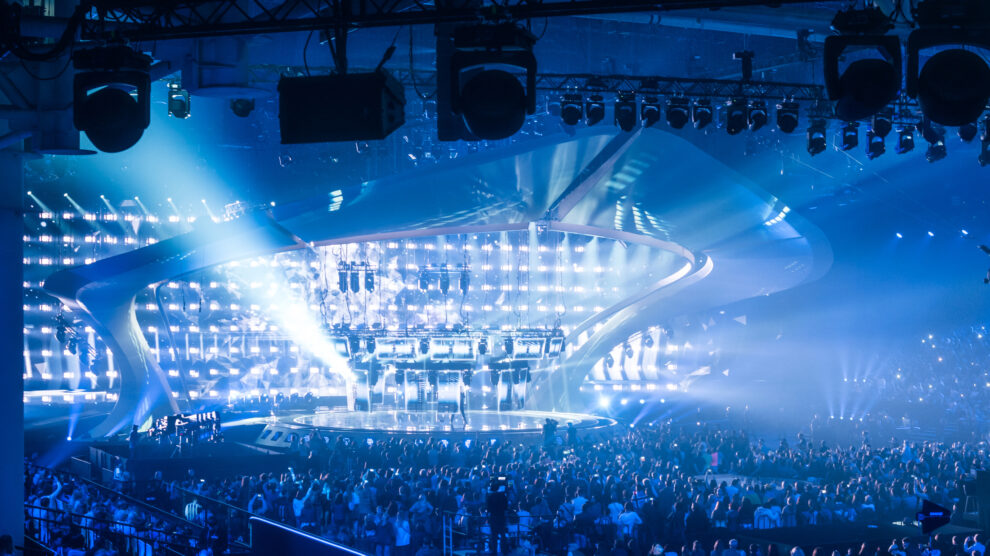
On November 14, DARA appeared as a special guest at the inaugural Eurovision Song Contest Asia in Bangkok. Six months earlier, in Vienna, her Bangaranga had given Bulgaria its first Eurovision victory, topping both the jury vote and the televote with 516 points. Two weeks before Bangkok she released her follow-up single, Bad Idea.
Outside Bulgaria, Vienna was remembered mostly for a boycott: five broadcasters stayed away in protest at Israel’s participation, leaving only 35 countries in the contest, the smallest field since semi-finals were introduced in 2004.
One night in Vienna
Eurovision is not an EU programme. It is run by the EBU, an alliance of public broadcasters that stretches from Ireland to Azerbaijan, and public broadcasters and host cities foot most of the bill. The canton of Basel-Stadt alone spent a net CHF 33.3 million, about 35.8 million euros, on hosting the 2025 contest. Vienna set aside up to 22.6 million euros this year, and a study published on November 17 by the Austrian Institute of Economic Research (WIFO), commissioned by the city, estimates that the contest brought Austria up to 77.2 million euros in gross value added.
The contest also gives artists an international audience. Viewers in 148 countries and territories voted this year. The day after the final, Bangaranga was the 12th most-streamed song in the world on Spotify and number one on its daily charts in 11 countries, and it became the first Eurovision song in 14 years to top the German singles chart. By October it had passed 60 million streams on Spotify. The EBU says 85 per cent of the streams of Eurovision songs happen outside the three weeks around the contest.
Eurovision has produced global stars, from ABBA and Céline Dion to Måneskin, the Italian band that won in 2021 and was later nominated for a Grammy as best new artist. Few winners, however, have built careers on that scale. Whether DARA can turn Vienna and Bangkok into a lasting audience abroad will say more about Europe’s music business than “Bangaranga” did.
Twenty-seven charts
EU recorded music revenues reached six billion euros in 2025, 21.3 per cent of the world total, according to IFPI, the recording industry’s international federation, and nine of the world’s 20 largest recorded music markets are in the EU.
Far less music travels between those markets. By IFPI’s count, 53.5 per cent of the tracks in an EU country’s year-end top ten in 2025 were by domestic artists, on average, and 5.2 per cent by artists from other EU countries. A study completed for the European Commission this year, examining streaming charts from 2017 to 2023, found a similar pattern: domestic artists accounted for 24 per cent of chart entries, artists from other member states for 14 per cent and the rest of the world for 62 per cent. American repertoire is the most streamed of all, according to the consultancy KEA.
There are no tariffs on songs and no border checks on Spotify. Yet listening habits stop at the border. The barriers that remain are less visible: rights are still administered largely by national collecting societies, radio quotas in countries such as France and Poland favour songs in the national language, and recommendation algorithms, the Commission’s study notes, tend to reward what is already popular. In 2024 the year-end top tens of Finland, Hungary and Italy were entirely domestic, and much of the space between the national chart and the global one is taken by artists from Los Angeles and London.
Strong home markets are not a failure in themselves. Dawid Podsiadło, who sings in Polish, was the first Polish artist to sell out Warsaw’s National Stadium on his own. Around 80,000 people saw his concert there in 2023, then a record for the stadium, and this summer he played sold-out stadium shows in Warsaw, Poznań and Gdańsk, including two nights in the capital. For many artists, however, success at home brings little recognition abroad.
When Warsaw sang in English
Some of Poland’s biggest pop stars of the 1990s had ambitions well beyond the domestic market. In 1994 Poland made its Eurovision debut in Dublin, and Edyta Górniak finished second with To nie ja!, still the country’s best result. By the mid-1990s she had signed an international recording deal with EMI. Her English-language album, released in 1997, was sold across Europe and issued in Japan as Kiss Me, Feel Me. One of the biggest hits on Wilki’s 1992 debut, an album that sold more than 220,000 copies, was in English: Son of the Blue Sky. Polish pop in the 1990s looked abroad, even when abroad did not look back.
English is no longer the obvious route to a wider audience. This year 20 of the 35 Eurovision entries included a language other than English, and 22 languages were heard in Vienna, a record; in 2016 only three songs had no English at all. Singing in one’s own language is a perfectly good artistic choice, and listeners reward it: six of the ten most-streamed songs from Vienna were not in English.
There are also commercial reasons to concentrate on the domestic market. Recorded music revenues in the region are growing fast: in 2024 they rose by 26.9 per cent in Romania, 23.9 per cent in Hungary and 22.3 per cent in Poland, against 9.1 per cent for the EU as a whole, according to IFPI. Fast-growing home markets can make expansion abroad a less urgent priority. Yet a deliberate international strategy can make a difference. Romania showed it more than a decade ago: Inna’s Hot, written and produced by the Constanța trio Play & Win, reached number six on the UK singles chart in 2010, part of a wave of Romanian dance-pop that sold across Europe. More recently Sara James, a Polish singer who came second at Junior Eurovision in 2021, promoted her debut album across Europe, with showcases in Germany and a collaboration with the Czech artist Ben Cristovao. When IFPI profiled her last year, nearly half of the consumption of her music came from outside Poland.
Jurassic Park in Seoul
South Korea offers a different model. In 1994 a widely cited comparison presented to South Korean policymakers held that Steven Spielberg’s Jurassic Park had earned as much as Hyundai would by exporting 1.5 million cars; Hyundai had exported about 640,000 in 1993. Korean governments have since treated culture as an industry to be built, with laws, agencies and public money.
Korea has about 52 million people, and its recorded music market is the world’s seventh-largest, smaller than Germany’s or France’s. Yet preliminary government figures put its wider content exports, games included, at a record 14.9 billion euros in 2025, and customs data show that exports of K-pop albums alone passed 300 million US dollars for the first time. The culture ministry, which also covers sport and tourism, has a 2026 budget of 7.85 trillion won, about 5.35 billion US dollars, including 2.67 trillion won for culture and the arts. The figure is not directly comparable with EU spending, since member states run their own culture budgets, but it shows how seriously Seoul takes culture as an industry.
Part of K-pop is written in Europe. STIM, Sweden’s music rights society, says Swedish songwriters have worked with BTS and NewJeans and that Swedish royalty income from K-pop has grown tenfold since 2018. According to research commissioned by STIM, Sweden is the EU’s only net exporter of music measured by songwriting royalty flows, and one of four in the world, with the United States, Britain and South Korea. Bangaranga itself was written by a Bulgarian, a Norwegian, a Romanian and a Greek.
Beyond the home market
EU money for music is modest. Creative Europe, the Union’s programme for the cultural and creative sectors, has 2.44 billion euros for 2021–2027, of which about 806 million euros goes to its Culture strand. The Commission says more than €140 million went to music in 2021–2025, 26 per cent of what the Culture strand spent in that period, mostly through cooperation projects, networks and platforms for emerging artists. That is roughly 28 million euros a year, shared between the EU and the non-member countries in the programme, and less than Basel-Stadt spent on a single Eurovision.
In July 2025 the Commission proposed folding Creative Europe into a new programme, AgoraEU, worth 8.6 billion euros for 2028–2034, including 1.8 billion euros for culture. On 19 November the European Parliament’s culture and civil liberties committees backed 10.72 billion euros and targeted support for music, though without a separate music strand. The Irish presidency of the Council had proposed cutting AgoraEU to about six billion euros, and the revised budget proposal that European Council President António Costa presented on November 21 keeps the cuts, according to Culture Action Europe. EU leaders meet this week to discuss the next long-term budget.
Whatever the final budget, Europe needs to think differently about how it supports its music. The problem has been diagnosed before: a European music export strategy was drawn up for the Commission in 2020, a follow-up study on putting it into practice appeared in 2023, and national export offices already cooperate through the European Music Exporters Exchange. Those institutions should be judged by how well they help artists find audiences abroad. More of the money should follow artists across borders, through tour support for acts playing in other member states and export grants tied to verified audience growth and ticket sales outside an artist’s home market. For a Polish band, touring Prague, Berlin and Lisbon should be routine business, not a financial gamble.
Bangaranga was written by four Europeans and topped Spotify’s charts in 11 countries. Europe already knows how to write a hit together. It has yet to build the business that sells one.
Photo: Dreamstime.