What Italian espresso bars and their cheap coffee can teach businesses about keeping things simple: Do just one thing, and do it very well.
Bardonecchia, an hour and a half on the train from Turin, just a few hundred metres from the French border, is a fairly standard Italian ski resort. Not as big as the huge ski areas across the Alps in France, it nevertheless offers plenty of decent terrain over two mountains and one of the best value lift passes in Europe (not least as there’s a hefty discount for anyone who arrives by train). Prices in the resort’s restaurants are also relatively budget-friendly, reflecting perhaps that this is very much an Italian-first destination. There are some foreign visitors (indeed, at UK half-term time it can feel as though half of Britain’s schoolchildren have turned up), but outside that one week Italian is likely to be the only language you will hear.
It would be easy to explain this Italian-first approach as the reason behind the resort’s cheap coffee, too. Even at the top of the mountain an espresso costs just 1.50 euros, a cappuccino two euros. But then this is Italy, where cheap coffee is in many regards considered a human right.
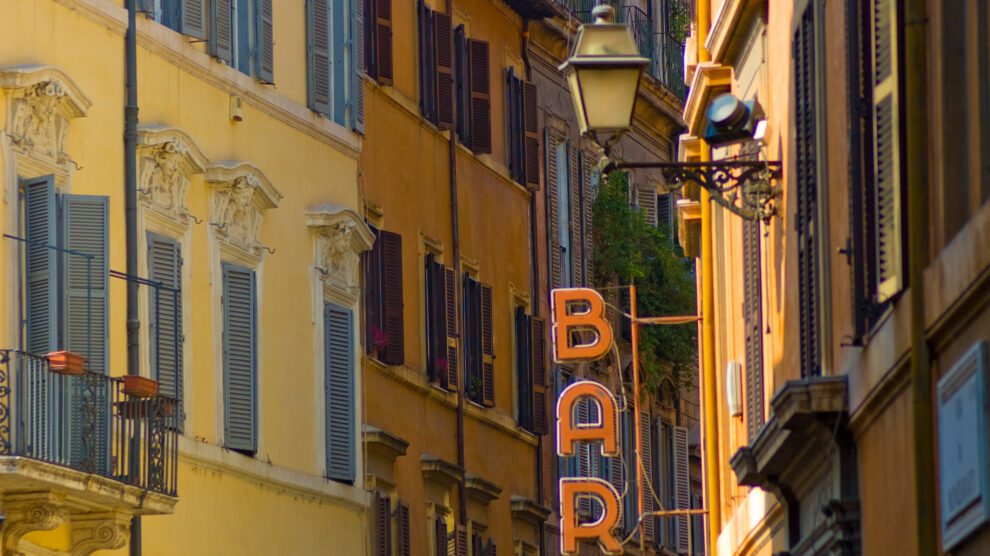
Walk into almost any bar/cafe in Italy (and there are roughly 132,000 of them) and the ritual is the same. You step up to the counter, you ask for un caffè. The barista pulls a shot. You drink it in three gulps, pay your 1.50 euros (in some parts of the country it’s even cheaper), and walk out. The whole thing takes no more than a couple of minutes. There is no queue of people waiting for a caffeine-free oat-milk latte with an extra shot of vanilla. Nobody asks your name or misspells it on a cardboard cup. The menu is espresso, cappuccino (never ordered after midday, of course) and perhaps a macchiato. And the prices are almost set in stone (unless you find yourself in a tourist hotspot in Venice, Florence, or Rome, and make the mistake of sitting down and purveying table service. Then the price will triple, or worse).
Coffee in Italy is the notion of ‘keeping it simple’ raised to an art form. Italian coffee bars are not flogging infinite choice, but instead selling good espresso, fast, at a price that makes it part of daily life rather than a luxury. Some 97 per cent of Italian adults drink coffee every day. Around six billion cups are drunk each year. The model works because it is ruthlessly focused on doing one thing, and doing it well.
No froth, full-fat margins
Ryanair has built Europe’s most profitable airline on a strikingly similar principle. Michael O’Leary’s operation likewise does one thing, flying people between two points, cheaply. The fleet is a single aircraft type (Boeing 737s, all of them). There are no lounges, no connecting flights, no business class, no premium economy. Passengers who want a sandwich (or a coffee) pay for it. Those who want to check a bag pay for that too. The base fare covers a seat and nothing else. It is an Italian espresso bar with wings.
In its 2025 fiscal year Ryanair carried a record 200 million passengers and pulled in 13.95 billion euros in revenue. The single-fleet model means pilots, engineers and cabin crew are interchangeable across every route, and spare parts are standardised. Training is simple. Everything that does not put a bum on a seat has been stripped away. The airline industry is littered with the wreckage of carriers (mainly flag carriers) that tried to be all things to all travellers. Ryanair decided early on that it would rather be loathed and profitable than loved and broke.
Aldi applies the same logic to groceries. A typical supermarket stocks 30,000 to 40,000 products. An Aldi store carries roughly 2,000. Where Tesco might offer 80 yoghurts, Aldi has five or six. Around 90 per cent of what it sells is own-label. Products arrive in shelf-ready cartons and staff are cross-trained to do everything from stacking to till work. The whole model is engineered to eliminate cost at every step, and to pass those savings to customers who (it turns out) are perfectly happy with fewer choices if the price is right. Aldi UK’s market share has grown from two per cent in 2009 to over 10 per cent today. The big supermarkets have spent 15 years trying to work out how to compete with a shop that barely advertises.
Doing less, better
The Italian espresso bar offers a firm rebuttal to the instinct that more is always better. Its genius lies in what economists call value capture, extracting maximum return from a tightly defined offering. Italian bars make a healthy profit on every espresso. The trick is radical efficiency: no seating costs (you stand), minimal staff, a 30-second service time, and a product so embedded in daily routine that demand is effectively permanent. The entire supply chain, from the robusta-arabica blends to the seven grams of ground coffee per shot, is optimised for exactly this.
The pattern repeats wherever you find firms that resist the urge to do more. IKEA built a global empire on obsessive cost discipline and a deliberately constrained range. ASML, the Dutch lithography firm, makes one category of machine and owns 100 per cent of the market for extreme ultraviolet systems, the kit that etches the circuits on every advanced chip on the planet. It generated 32.7 billion euros in sales last year. No competitor even comes close, because ASML has spent decades perfecting a single, fiendishly complex product rather than diversifying into adjacent kit. Dieter Rams, the German industrial designer whose ten principles influenced everyone from Apple to Muji, put it elegantly: good design is as little design as possible.
Nevertheless, simplicity is not easy. In fact, it is often far harder than complexity. Saying yes is easy. It is saying no that demands conviction, clarity and a willingness to walk past revenue that looks tempting in the short term but dilutes everything over the long run. Complexity is what creeps in when nobody is minding the gate: another product line here, another acquisition there, another feature bolted onto a service that was perfectly good without it. Every new addition carries hidden weight. It slows decision-making, fattens supply chains, blurs a firm’s identity in the eyes of its customers.
O’Leary, characteristically, put the Ryanair philosophy in blunter terms. Asked why the airline had never considered long-haul flights or premium cabins, he replied that the day Ryanair stops knowing exactly what it is would be the day it stops making money. The Italian barista behind the Gaggia machine would agree.
Photo: Dreamstime.