
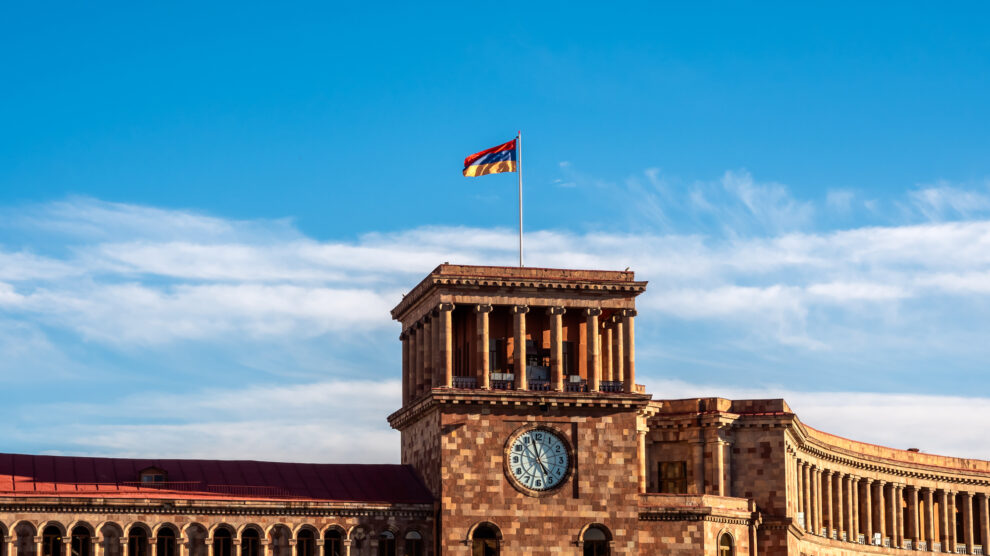
Armenia’s economy is thriving as it loosens ties with Russia and looks towards Brussels. That may be no coincidence.
It was, even by the standards of what passes as Kremlin diplomacy, an extraordinary piece of theatre. On April 1, Vladimir Putin sat across from Nikol Pashinyan, Armenia’s prime minister, and told him bluntly that membership in both the EU and the Russian-led Eurasian Economic Union (EAEU) was impossible. He dangled the price of Russian gas (177.50 US dollars per thousand cubic metres, against more than 600 US dollars in Europe) as a reminder of what Yerevan stood to lose. Pashinyan did not flinch. When the time comes to choose, he replied, the citizens of Armenia will make that decision.
The exchange would have been unthinkable a few years ago. Armenia was, for three decades after independence, firmly within Moscow’s orbit: a member of the EAEU and the Collective Security Treaty Organisation (CSTO), host to a Russian military base, dependent on Russian gas and arms. What changed everything was Azerbaijan’s reconquest of the Karabakh region in 2023. Russia, Armenia’s nominal security guarantor, did nothing. Pashinyan has not forgiven this, and nor have ordinary Armenians. The country suspended its CSTO membership in 2024. Its parliament passed an EU accession law in March 2025. And this March Pashinyan stood before the European Parliament in Strasbourg and declared that Armenia’s path led to Brussels.
The economy, meanwhile, is giving him cover. The World Bank’s latest economic update, published in March, paints a picture of robust health. Economic activity grew by 7.6 per cent year on year in January, powered by an 18.7 per cent surge in construction and a 25.2 per cent jump in mining. Retail expanded by 7.9 per cent. Tourist arrivals were up 28.6 per cent. The financial system looks solid: the capital adequacy ratio stands at 20.3 per cent and non-performing loans at just 1.3 per cent. A budget surplus equivalent to 0.9 per cent of projected annual GDP was recorded. Gross reserves reached 5.5 billion dollars at the end of February, enough to cover 4.1 months of imports.
Dig beneath the headline figure and the story gets more interesting. Exports and imports both fell sharply in January (by 13.5 and 11.2 per cent respectively), largely because the re-export boom in precious stones and appliances that accompanied Russia’s war in Ukraine is winding down. Strip those categories out and exports actually rose by eight per cent. Armenia’s economy, in other words, is weaning itself off the sanctions-arbitrage windfall that briefly inflated its trade figures in 2022 and 2023. Mining exports (up 43 per cent) and a fast-growing technology sector are picking up the slack. Tech now accounts for roughly seven per cent of GDP, and the number of active high-tech companies surged from around 8,000 in 2024 to more than 10,700 in 2025. A 500 million US dollars partnership between Firebird, an American AI cloud start-up, NVIDIA and the Armenian government to build an AI computing facility may sound fanciful for a country of three million. But Armenia has deep roots in mathematics and semiconductor design stretching back to the Soviet era.
Manageable risks
Remittances tell a more complicated tale. Net non-commercial money transfers grew by 43.7 per cent in January, with Russia accounting for 52 per cent of inflows and the United States 38 per cent. Armenia remains tethered to Russian money, even as it drifts politically westward. Inflation, too, needs watching: it rose to 4.3 per cent in February, driven mostly by food prices (up 6.5 per cent). The central bank’s policy rate sits at 6.5 per cent, but food-price pressure in a country where groceries make up around 40 per cent of the consumption basket is not something any government can ignore before an election.
And an election is coming. Armenians go to the polls in June for parliamentary elections that will amount to a referendum on Pashinyan’s westward turn. Putin made his interest in the outcome plain at the Kremlin, expressing hope that ‘pro-Russian forces’ would be allowed to compete freely and noting that some of their representatives were in custody. He was referring to Samvel Karapetyan, a Russian-Armenian billionaire arrested last year after calling for the government’s ouster. Pashinyan’s reply was characteristically pointed: Armenian law bars dual citizens from standing for office. Moscow’s preferred candidates are welcome to run, provided they choose Armenia over Russia first.
The EU, for its part, is rolling out the welcome mat. A 270 million euros Resilience and Growth Plan for 2024 to 2027 is already in place. A new Strategic Agenda was adopted in December 2025. In May, Yerevan will host both the eighth European Political Community summit and the first ever EU-Armenia summit. Visa liberalisation talks are under way. And the EU monitoring mission deployed along the Armenia-Azerbaijan border since 2023, modest in size but potent in symbolism, is a quiet reminder that Europe has skin in the game.
None of this makes the path smooth. Armenia is landlocked, shares no border with the EU, and gets its gas from Russia at a fraction of European prices. Georgia, its only plausible land corridor to Europe, has its own fraught relationship with Brussels. The World Bank projects growth will moderate to around 4.6 per cent in 2026 as the post-invasion sugar rush fades. And Russian interference in the June elections is likely.
Pashinyan appears to have decided that these are manageable risks. His message to Putin was polite but unmistakable: Armenia is a democracy where social networks face no restrictions, where there are no political prisoners, and where citizens (not foreign presidents) determine the country’s direction. The formal EU membership application has not yet been submitted. The trajectory, though, is plain enough. Armenia’s future, its prime minister reckons, lies in Brussels, not in a customs union designed in Moscow. The numbers, so far, suggest he might be right.
Photo: Dreamstime.