

The Last Word: Reinvention is the ability to turn learning into a different path. It means changing what you do, and how you create value.
I read an interview with Natalia Hatalska, a futurologist, trendwatcher, researcher, and the founder and CEO of infuture.institute in Poland. Apparently, she does not like being called a fortune teller looking into a crystal ball. Fair enough, foresight is not fortune-telling, but after reading her answer to the question of what are the two most important competencies we should develop, I wondered whether a crystal ball might still have been useful.
Hatalska names emotional resilience and independent, critical thinking. The first helps us return to our chosen path after a setback, the second helps us make our own decisions in a world of AI, disinformation, deepfakes and manipulation.
I think both answers miss the point. Emotional resilience sounds sensible because nobody wants to break under pressure. We fall, dust ourselves off, and continue. The image is reassuring but it is also based on an increasingly dangerous assumption: that the path we were following before the fall is still the right one. What happens when it is not?
You lose your job because AI has changed your profession. Your company disappears because its market has moved elsewhere. A war changes where you can live or work. The skills that brought you this far lose their value. The plan you spent years building no longer matches the world around you.
Where exactly are you supposed to bounce back to? This, of course, sounds very catastrophic but isn’t it something some of us have experienced recently?
We are no longer living through occasional interruptions to an otherwise stable life. Disruptions overlap, interact and produce consequences that are difficult to separate. The International Monetary Fund’s World Uncertainty Index, which tracks uncertainty across 143 countries, shows how far uncertainty has moved from a temporary spike towards a persistent condition.
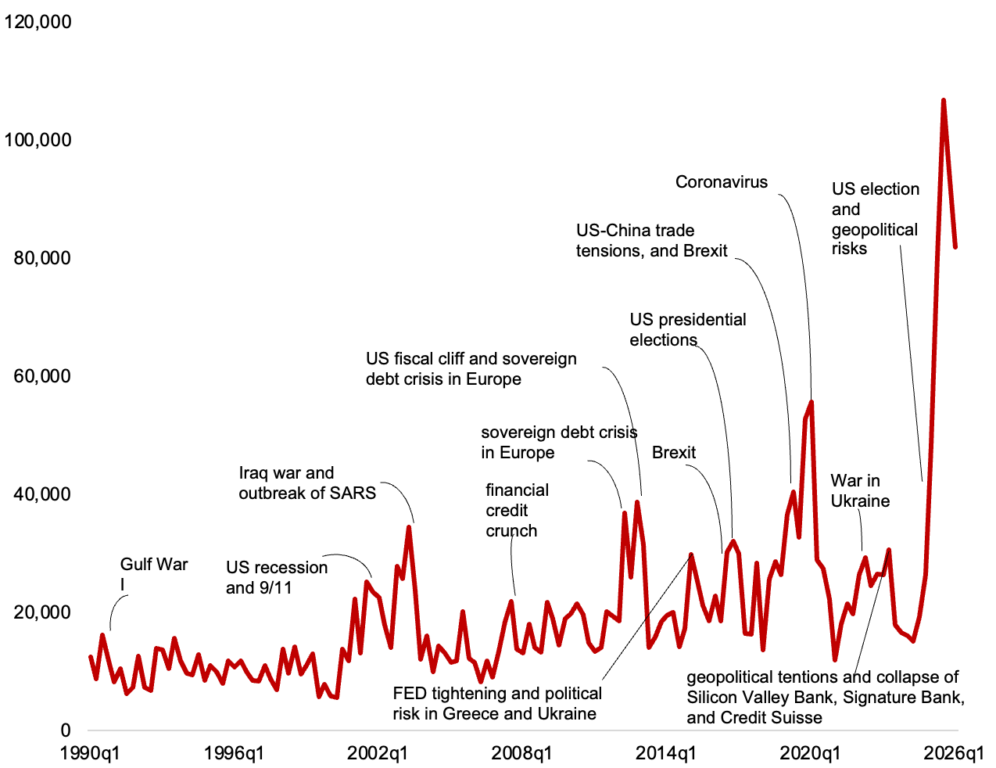
Source: IMF.
This is megaruption: not one crisis, but many disruptions arriving at once and amplifying one another. Under those conditions, returning to the previous path can be the worst possible response. You may recover emotionally only to continue confidently in the wrong direction.
Critical thinking is not the answer either. Of course we should question what we see, verify information and avoid being manipulated, but critical thinking is not a standalone future skill. It is one part of something more demanding: learnability.
Turn learning into a different path
Learnability is not simply the ability to acquire more knowledge. We already have unprecedented access to knowledge. It is the ability to recognise that what you know may no longer be enough, to question your expertise, learn to adopt new and disrupting technologies, unlearn an outdated method, absorb unfamiliar ideas and change your behaviour as a result.
Many people are willing to learn as long as the new knowledge confirms who they already are but real learnability asks more of us. It may require an experienced manager to become a beginner again. A specialist may need to move beyond the profession that has defined them, a leader may have to admit that the model which created yesterday’s success is producing today’s decline. That can be far harder than critical thinking because it is personal.
And learnability alone is still not enough. You can understand that the world has changed and continue doing nothing. You can read every signal correctly, complete another course and remain trapped in an identity or system whose time has passed. This is why the second essential competency is reinvention.
Reinvention is the ability to turn learning into a different path. It means changing what you do, how you create value and, sometimes, how you see yourself. Not once, after a dramatic collapse, but repeatedly and deliberately as conditions change, and perhaps before they change.
This applies to chief executives, but it also applies to everyone else. The employee whose role is being automated, the parent wondering what to teach a child, the professional whose qualifications are ageing, the person reaching the middle of a career and realising that stability was never guaranteed.
We keep preparing people to endure shocks and return to normal. I am not sure if you have noticed that but normal is doing a remarkable job of refusing to return. The two competencies we need are not resilience and critical thinking, they are learnability and reinvention: the capacity to understand that the path has changed, and the courage to choose another one.
The future will not punish us for failing to bounce back. It will punish us for bouncing back to a world that no longer exists.
Photo: Dreamstime.