
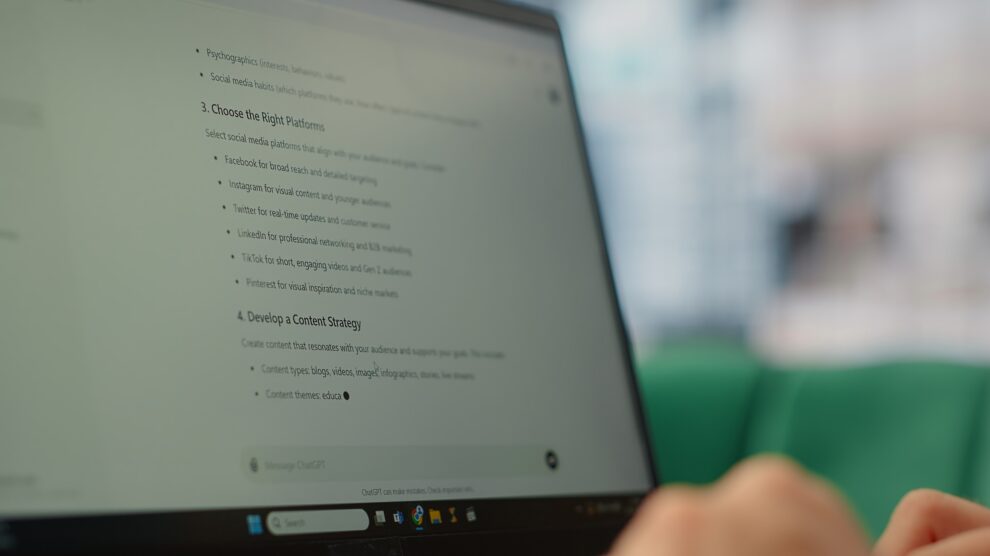
As online users increasingly put questions to AI, not Google, publishers and businesses built on referral traffic are paying the dearest.
Google became a verb in 1998 (mainly through informal use), was named the ‘most useful word’ in 2002, and was officially added to most major dictionaries in 2006. These days, however, ‘Ask Chat’ is just as likely to be used for the same purpose, namely finding something out (the best local restaurants, the filmography of a movie star), quickly and (hopefully) accurately.
While the proliferation of online chatbots such as ChatGPT and Claude (which all offer easy to use smartphone apps) means that there are people who no longer use Google as their first port of call, even those who do are more often than not unlikely to click on any results. In most markets, an AI-generated answer now sits at the top of Google’s search page, with the links that made the company’s fortune and reputation beneath it, receiving little attention. A study from SparkToro, an audience research firm, using data from Similarweb, claimed in June that more than 68 per cent of American searches ended without users making a single click. Back in 2019, the figure was 49 per cent.
While Gen Z, those born from 1997 to 2012, is steering the trend, the phenomenon is not confined to the young. Pew found in February that just under half of all American adults now use AI chatbots, up from a third in 2024, and a third of the under-50s consult one every day. An AP-NORC poll last July revealed that 74 per cent of the under-30s use AI to look things up, but for all adults, the figure drops only to 60 per cent. Anyone looking at Gen Z alone as the killer of traditional search would do well to rethink their assumptions.
What this means for search engines, and for publishers, not to mention businesses, is anyone’s guess, given that the market appears to be in so much flux that drawing any reasonable conclusions just now would be impossible. Google itself is still bullish, with Liz Reid, its head of search, writing last year that clicks to websites are holding steady and that, “third-party reports that inaccurately suggest dramatic declines in aggregate traffic [are] often based on flawed methodologies”. The giant is clearly betting that its AI Overview (which it merged in May with AI Mode) will preserve its market share. The problem is that there is not yet any real evidence to suggest that Google is the world’s go-to AI tool. For now, that appears to be ChatGPT, or Claude. Just as Google became synonymous with search, ChatGPT and Claude are becoming the default AI chat tools and it is their names, not Google’s, entering the lexicon.
The rise of GEO
Google’s boss, Sundar Pichai, told investors in July that search was still sending out billions of clicks a week, with queries at a record high during the recent football World Cup. Both things can of course be true while publishers and businesses still suffer, not least as total query volume and Google’s advertising revenue (up 19 per cent in the first quarter of this year), are not the same as the visits a website receives.
Axios, a publisher, said in March that page views from Google Search fell 34 per cent from December 2024 to December 2025, with smaller publishers (those receiving 1,000–10,000 daily page views) experiencing the steepest declines in traffic. “This is a gut punch to all of us who operate online because people who search arrive with specific needs and intent, so they tend to be more valuable than a random passer-by from X or Facebook,” says Jim VandeHei, founder and CEO of Axios.
Which brings us to new buzz-acronym GEO (Generative Engine Optimisation), which now gets as much attention as SEO (Search Engine Optimisation). The name comes from a paper posted by Pranjal Aggarwal and colleagues at Princeton, Georgia Tech and IIT Delhi in November 2023 and presented at the KDD conference the year after. Testing nine tactics across 10,000 queries, they found that citing sources, adding statistics, and working in quotations could raise a page’s visibility in machine-written answers by as much as 40 per cent.
All well and good, although the speed at which AI tools are developing, however, means that creating any definitive guide to GEO soon will likely be a Sisyphean task. That hasn’t prevented some firms, such as Semrush, from trying. As a small publisher ourselves, they carry our best wishes.
Photo: Dreamstime.