
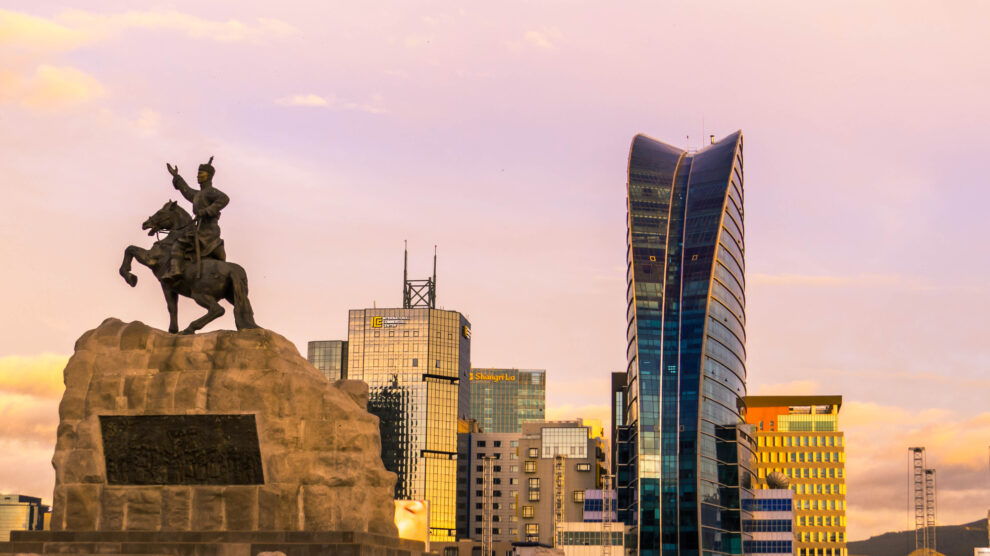
Mongolia has a bold plan, a surplus, and good demographics. The economy still runs on copper, however, and the copper boom is part of why.
In May 2025, Mongolia’s State Training Fund announced a change to the country’s overseas-study loans. Until then, the most promising Mongolian school-leavers could spend four years at a foreign university on the public purse. From the 2025-26 academic year, two of those years would have to be served at a Mongolian institution first. The reason, stated with unusual candour by officials, was that too many state-funded scholars never came home. The rule is a verdict, and not a flattering one, on the universities Mongolia has and on the country it has yet to become.
Our first article in this series, Going overground, reckoned that Mongolia had had a good 2025. Moody’s and S&P bestowed modest credit-rating upgrades. The public finances posted a fourth consecutive surplus. Copper output from Oyu Tolgoi, the giant underground mine in the South Gobi, plus a sharp agricultural rebound after consecutive dzud winters, did almost all the heavy lifting. The piece closed on a question deliberately left open: whether Ulaanbaatar would use its fiscal breathing room to build something more durable. The early answer is unsatisfactory.
Reinvantage’s IT Competitiveness Index, which assessed 32 countries in its 2026 edition, placed Mongolia 26th overall and 30th out of 32 for business environment. Between 2017 and 2025, Mongolian start-ups attracted just 14 million US dollars in investment, a sum a single Berlin or Warsaw company might raise in one round. ICT services exports amounted to 0.26 per cent of GDP in 2024, against a regional average closer to 2.3 per cent. Mongolia has climbed from 74th to 46th in the UN’s E-Government Development Index since 2020, a creditable jump. The same state apparatus has not yet built the conditions for a private digital industry to grow alongside it.
Easy money
Coal and copper royalties pushed budget revenues to a record 39.2 per cent of GDP in 2024 and held them at 35.3 per cent in 2025, even after the coal rout. The Bank of Mongolia raised its policy rate by 200 basis points in March 2025 to contain inflation, and the government cut spending hard, finishing the year with a fiscal surplus of 1.5 per cent of GDP. That is exactly the kind of discipline a sovereign credit-rating agency rewards. It is also the climate under which Mongolian legislators feel least pressed to overhaul the corporate tax code, the bankruptcy regime or the licensing rules that strangle non-mining firms. A finance ministry that does not need the money has limited appetite for political fights over what comes after the money.
Gross enrolment in Mongolian higher education tops 70 per cent, a figure that puts the country ahead of many far richer ones. ICT student numbers grew almost 45 per cent between 2020 and 2024. But just 41.2 per cent of fifth-graders met proficiency standards in mathematics in the most recent national assessment, and the urban-rural learning gap is wide enough to drive a bus through. Of the roughly 30,000 to 40,000 secondary-school graduates Mongolia produces each year, 91 per cent enrol at institutions in Ulaanbaatar and nine per cent everywhere else. Research output has historically been thin. Higher-education institutions and the country’s research academies developed largely in isolation from each other, producing credentials rather than capability.
Bolor-Erdene Battsengel, a former vice-minister of digital development, was at Davos in January 2025 promoting AI Academy Asia, her venture to train 500 teachers to bring artificial intelligence to rural classrooms. Mongolia’s National Statistics Office, separately, now ranks 11th globally and second in East Asia on the Open Data Inventory, an achievement worth pausing over. The start-ups, software houses and research labs that ought to be feeding off such groundwork are conspicuously absent.
On paper
Vision 2050, the long-term development policy approved by Mongolia’s parliament in May 2020, lists nine goals and 47 objectives. It targets a knowledge economy, a multi-pillared export base, an internationally recognised sovereign wealth fund and competitive small and medium-sized enterprises. The Five-Year Development Guideline running to 2030 adds renewable energy and AI to the list. On paper, this is fine.
The Digital Nation programme, in train since 2022, has built genuinely impressive front-end infrastructure for citizens; the e-Mongolia app now offers more than 990 services. It has not produced a pipeline of private-sector spin-offs. StartupBlink’s 2025 rankings list 75 Mongolian start-ups, placing the country 80th globally and fifth in East Asia, with growth at minus five per cent year-on-year. Edtech, the biggest sub-sector, has 13 firms. Average ICT salaries reached 673 euros in 2024, just six per cent above the economy-wide average and one of the smallest premiums in any country Reinvantage surveyed. Where ICT is meant to be a leading sector, in Mongolia it pays only marginally better than the rest of the labour market.
The 2026 minerals law amendments target 11 strategic materials, lithium, cobalt and graphite among them, where Mongolia is geologically promising but largely unexplored. Royalty rates have been tweaked to attract smaller, specialist firms. In January 2026 a Mongolian national took the chief executive job at Oyu Tolgoi for the first time in the mine’s history, a quietly significant signal to investors. Processing those minerals on Mongolian soil, rather than railing concentrate over the border to Erlian and Tianjin, would extract considerably more value. Doing so would require trained metallurgists, reliable power supply and industrial capacity Mongolia has yet to build.
The coal price slide of 2025, a 38 per cent fall as China’s power sector tilted towards renewables, was a useful preview of what awaits. Total budget revenues fell from 39.2 per cent of GDP to 35.3 per cent in a single year; the government cut hard to preserve its surplus, and the bond market rewarded it for doing so. The copper price will eventually move next. Whether Mongolia’s policymakers feel the urgency to spend the current windfall on the slower, less photogenic work of educational reform, regulatory cleanup and capital-market deepening is the test that matters. On past form, boom-time is precisely when the answer to that test is no.
Photo: Dreamstime.