
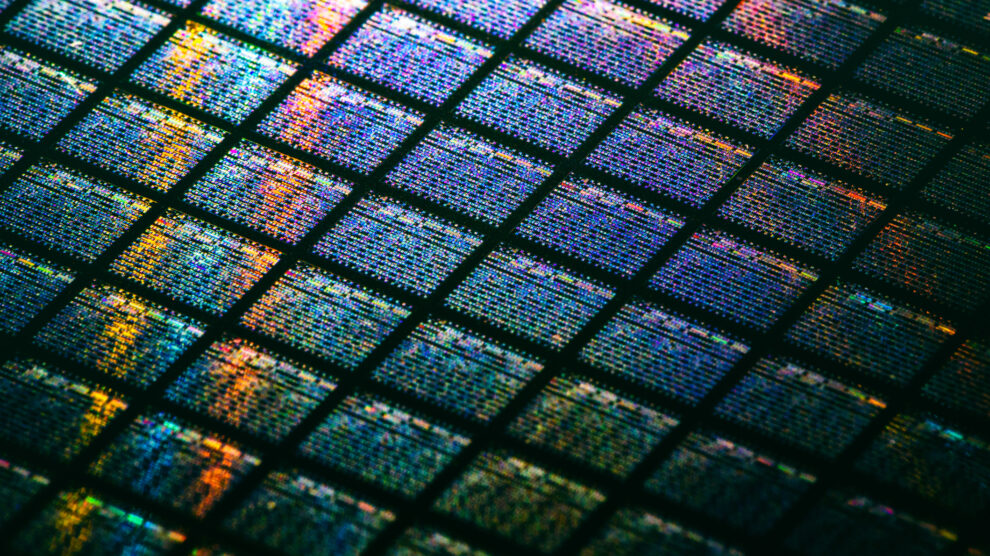
The memory crunch is a fab story. The quieter squeeze, one step later, in advanced packaging, runs through a few makers of ultrafast lasers.
Tim Cook told the Wall Street Journal on June 17 that Apple’s position had become unsustainable, and eight days later the company raised the price of every Mac and iPad, some by as much as 300 dollars. Microsoft lifted Xbox prices within hours, and Sony, Dell and HP have signalled the same. Apple blamed memory chips, saying it had never seen a component price rise so far, so fast. Morgan Stanley told clients on June 3 that memory prices had climbed roughly sixfold in a year, a shift it labelled chipflation. Data centres built for artificial intelligence swallowed close to 70 per cent of the world’s high-end DRAM this year.
Nikolajus Gavrilinas broke ground on a new factory in Vilnius on June 17, the same day as Cook’s warning. His start-up, LITILIT, builds femtosecond lasers, which fire pulses lasting a quadrillionth of a second and strip away material without heating what sits beside it. On an advanced chip, Gavrilinas says, “even sub-microscopic thermal damage makes a component unusable”, so manufacturers have turned from blades to light. He expects demand for chips to outrun the supply of the tools that shape them. The Vilnius plant is designed to make 3,000 lasers a year, making it the highest-capacity femtosecond laser facility in the world.
Coherent, an American laser-maker, launched its Monaco femtosecond platform in 2025 to drill through glass and dice wafers thinned to a fraction of a millimetre. AI accelerators now run so hot that older plastic packaging warps and cracks the joints beneath, which has pushed the industry towards glass. Intel displayed a chip built on a glass core at a trade fair in Japan in January and said it had cured the micro-cracks that once made glass unworkable. Samsung and the SK group are racing to match it, with mass production pencilled in for this year. Every through-glass via, the vertical wire that carries a signal, starts as a hole punched by an ultrafast laser.
Hagen Zimer, who runs TRUMPF’s laser business, brought the German group’s first industrial kilowatt-class ultrafast laser to a congress in Aachen in April. The market he works in is narrow: worth 2.56 billion US dollars in 2025, on figures from SNS Insider, and forecast to reach 12.24 billion by 2035. Coherent holds a fifth to a quarter of it, with TRUMPF and France’s Amplitude close behind. Fewer than 15 firms supply most of the world’s ultrafast lasers, and the patents behind them sit with a smaller group still. Three memory-makers, Samsung, SK Hynix and Micron, control about 90 per cent of the chips whose scarcity began the panic.
From Lithuania to the world
Kestutis Regelskis, a physicist at Vilnius’s Center for Physical Sciences and Technology, patented a new way to generate ultrashort pulses in 2014 and then co-founded LITILIT to sell it. Light Conversion, spun out of the same university in 1994, has for years held between 70 and 80 per cent of the market for scientific femtosecond lasers, and its machines now cut smartphone glass and drill diesel injectors. Ekspla, a neighbour in Vilnius, exports to more than 80 countries. Optics and laser firms cluster around the two, most within a short drive of the university that seeded them. From a country of 2.8 million people, Lithuanian lasers now reach every continent except Antarctica.
Henna Virkkunen, the European Commission’s vice-president for tech sovereignty, proposed a second Chips Act on June 3, reviving a target to raise Europe’s share of global chipmaking from 10 to 20 per cent by 2030. The first act, passed in 2023, is running far behind, the European Court of Auditors found this year. Virkkunen’s plan singles out photonics as one of the few links in the chain where Europe already leads. To date Brussels has approved 13 first-of-a-kind semiconductor projects worth more than 32 billion euros in public and private money.
Niclas Poitiers and Tobias Schenk, two economists at Bruegel, a Brussels think-tank, warned in May that Europe risks spreading its money too thinly in a chase for self-sufficiency it cannot reach. Their warning fits the laser claim as well. Memory is scarce because there are too few fabs and too little wafer capacity, not because the world has run out of lasers. The tools matter one step later, in the packaging that stacks and wires the finished chips, and that step rests on a narrow base of suppliers. LITILIT expects its first Vilnius line to turn out 1,000 lasers next year.
Photo: Dreamstime.