
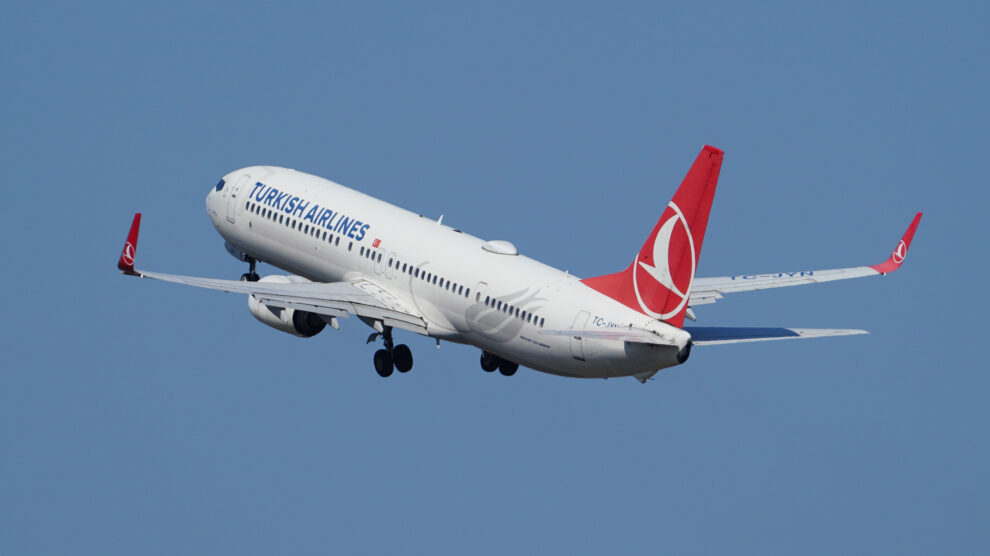
Turkish Airlines is currently the biggest winner of the US and Israeli war on Iran.
The airline disruption caused by the US and Israeli war on Iran is enormous. Emirates, Etihad and Qatar Airways, hitherto the holy trinity of East-West transit, have been hamstrung by attacks on their hub airports, forcing one of the biggest groundings of commercial aircraft since the Covid-19 pandemic. At the height of the crisis, Emirates alone had grounded nearly 250 wide-body aircraft, while Qatar’s Hamad airport remained closed for days.
The undisputed winner of all this is Turkish Airlines, which continues to operate unaffected from its Istanbul hub, cheerfully scooping up stranded passengers and rerouted bookings as its Gulf rivals scramble to rebuild shattered schedules.
None of this is entirely surprising to anyone who has watched Istanbul transform itself into the world’s most strategically placed aviation hub. Perched at the junction of Europe, Asia and the Middle East, Turkish Airlines sits close enough to the chaos to profit from it, and far enough away to keep flying. That geography has never been more useful.
Winged diplomacy
Turkish Airlines has long understood that politics is no reason not to fly. While Western carriers rushed to suspend Russian routes following the invasion of Ukraine in 2022, Turkey’s flag carrier expanded them, becoming one of the few remaining bridges between Russia and the outside world. It flew more and larger aircraft to Russian cities, meeting the surge in demand from tourists and businessmen cut off from other options. It does the same in Afghanistan. It does it in Syria, having relaunched Damascus services in January 2025 after a decade’s absence, days after the Assad regime fell.
Turkish Airlines now flies to 131 countries, more than any other airline on earth, a record certified by Guinness since 2012. It serves over 350 destinations from Istanbul Airport alone, more non-stop routes from a single hub than any competitor can claim. In Africa, where French carrier Air France reaches 18 destinations, Turkish Airlines serves more than 64. What’s more, destinations are often chosen with at least one eye on Ankara’s geopolitical agenda.
The airline’s chairman has been candid enough to frame all this in terms of soft power, and so have academics. A paper published in The Arab World Geographer in 2017 described Turkish Airlines as Turkey’s “new face of transportation and a major facilitator” of its international reputation. Routes, in short, are not just commercial decisions; they are foreign policy by other means. Every time a new airport gets a Turkish Airlines connection, Turkey gets a foothold. And every time rivals are grounded by wars they cannot sidestep, that foothold deepens.
The airline’s financial model helps sustain this approach. With labour costs denominated in Turkish lira but revenues largely in euros and dollars, the structural depreciation of the lira over the past decade has been, paradoxically, a competitive boon. Low operating costs mean Turkish Airlines can afford to serve routes that others cannot justify.
Over Ararat
Which brings us to Yerevan. On March 11, Turkish Airlines completed its first scheduled flight from Istanbul to Zvartnots International Airport, becoming the latest (and most symbolically weighty) carrier to connect the two countries. A daily service is now operating, with frequencies set to increase to 14 flights per week by mid-year. Turkey’s special envoy for Armenia normalisation, Serdar Kılıç, who announced the route on social media in December, called it “another new step”. That is an understatement.
Armenia and Turkey have no diplomatic relations. Their shared land border has been closed since 1993. The history between them, rooted in the mass killings of Armenians under the Ottoman Empire during the First World War, which Armenia and most historians call a genocide and Turkey contests, has kept them apart for more than a century. For decades, flying between the two countries required routing through a third. Low-cost carrier FlyOne Armenia and budget carrier Pegasus Airlines had already broken that particular taboo, operating direct Istanbul-Yerevan services since 2022. But when a flag carrier makes the same journey, it means something different. A Turkish Airlines flight from Istanbul to Yerevan is, unmistakably, a statement.
The two countries have been edging toward normalisation since Azerbaijan retook the disputed Nagorno-Karabakh territory between 2020 and 2023, with Turkish backing. Armenia’s Prime Minister Nikol Pashinyan, having drawn the pragmatic conclusion that his country’s security now rests on economic integration and regional connectivity rather than isolation, has been cautiously warming relations with Ankara. He describes his foreign policy goal as transforming Armenia into a “Crossroads of Peace”, a transit hub rather than a geopolitical dead end. A daily connection to Istanbul Airport, one of the world’s great aviation gateways, is a tangible step in that direction.
There are practical dividends too. Armenian passengers will gain access to Turkish Airlines’ enormous global network. For the large Armenian diaspora in the United States, concentrated around Los Angeles and Glendale, communities that have historically been among the most vocal opponents of Turkish-Armenian reconciliation, the airline is already in talks about a potential Yerevan to Los Angeles route via Istanbul. If that route materialises, it will force an interesting choice on diaspora Armenians: take a political stand, or take a flight.
None of this, of course, resolves the fundamental disputes. The land border remains closed, formal diplomatic ties are absent, and the historical reckoning over 1915 has not happened. The route will not, by itself, accomplish what decades of failed diplomacy have not. But aviation has a habit of making reconciliation feel ordinary. Once enough people are flying between Istanbul and Yerevan—for business, tourism, family visits—hostility becomes a little harder to maintain.
Turkish Airlines, for its part, is doing what it always does: flying to places others find complicated, and letting the routes do the talking. While the Gulf carriers pick through the wreckage of the Iran war, the Istanbul hub grows a little busier, a little more indispensable. Above the fray, and expanding.
Photo: Dreamstime.