
Conferences spent decades selling the big idea. Now, the business has learned that what people pay for is access, and is rebuilding to suit.
When Eric Newcomer hosted the first Cerebral Valley AI Summit in March 2023, he borrowed an empty office from Max Child and James Wilsterman, two founders of a voice-gaming startup, and spent the day shushing billionaires. Stability AI’s Emad Mostaque divided the audience over whether he was a visionary or a huckster. One guest left and put more than a billion US dollars into AI stocks. The talks drew people in, but the organisers now claim theirs is the only AI gathering to have sparked a 1.3 billion US dollars acquisition. When the summit first crossed to London in June 2025, Uber’s Dara Khosrowshahi and Figma’s Dylan Field were among those on stage, and a few hundred founders and investors paid to sit with them. It returned to the city this June.
The opposite experiment had just fallen apart. Johnny Boufarhat founded Hopin in London in 2019 to move conferences online, and the pandemic turned it into the fastest-growing start-up Europe had produced, worth 7.75 billion US dollars by August 2021, by which point Boufarhat had sold about 195 million US dollars of his own shares. The reopening that followed Covid, and the urge for human contact that came with it, did for Hopin. Companies went back to meeting in person, the streaming product lost its market, and in August 2023 Boufarhat sold the events business to Vlad Shmunis of RingCentral for a figure reported at around 50 million US dollars. “Nobody expected virtual events to go away as fast as they did,” said Julius Solaris, an events consultant who had worked there. What remained went into liquidation in in February 2024.
Sam Parr charged for the lesson Hopin had learnt the hard way. With Joe Speiser he had built Hampton, a paid network for company founders, around small groups that meet in person rather than around a stage. In August 2024 the pair raised the bar to entry, demanding three million US dollars of revenue rather than one, while holding membership at 8,500 US dollars a year; the dues now bring in around eight million US dollars, and Parr wants 10,000 members by 2030. Carolyn Childers and Lindsay Kaplan had reached for the same prize with Chief, a network for senior women they founded in 2019. CapitalG, Alphabet’s venture arm, valued it at 1.1 billion US dollars in 2022. In April 2023 the two founders cut staff, leaving about 262 employees.
The biggest names increasingly choose the smaller room. At Newcomer’s San Francisco summit in November 2024, Dario Amodei of Anthropic shared an afternoon stage with Alexandr Wang of Scale AI, and Databricks’ Ali Ghodsi appeared the same day. The crowd numbered a few hundred by invitation, against the tens of thousands who fill Web Summit in Lisbon each November. Newcomer runs the gathering twice a year and vets the guest list himself.
The corridor economy
In March 2023 Fortune interviewed 15 Chief members and found that several valued the network mainly for the introductions it made, and little beyond. Alison Moore, who took over as Chief’s chief executive in January 2025, widened its membership that October to admit founders and consultants, and folded clubhouse access into the base fee. The same calculation runs through the conference floor. Jason Lemkin’s SaaStr, founded in 2014, now books ‘Meet a VC’ matchmaking for thousands of delegates, pairing founders with investors by appointment rather than leaving them to find each other. Even exercise has been pressed into service: some businesswomen have swapped the evening cocktail mixer for a standing 6am run club, reasoning that the same faces each week build a trust no single evening can.
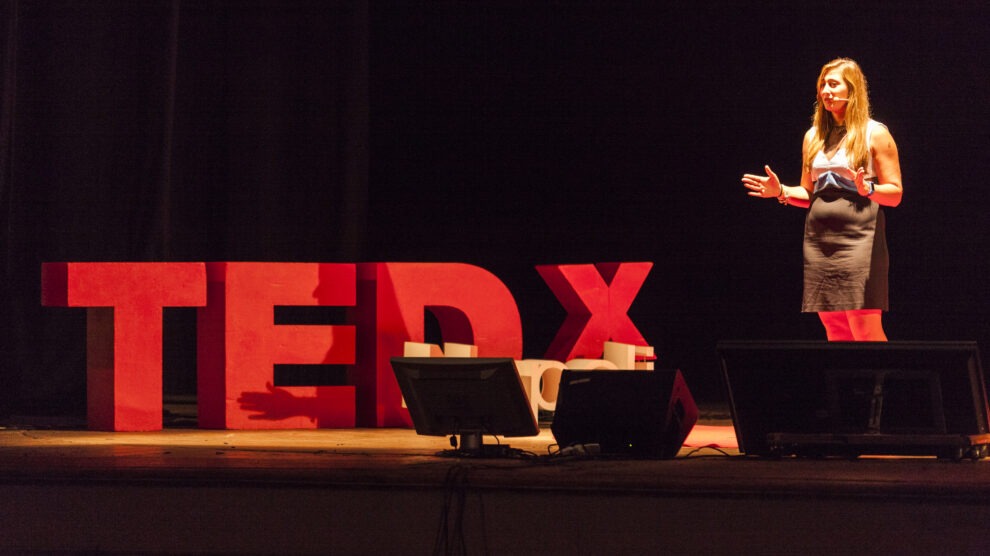
TED, meanwhile, which built the modern conference around a single big idea, is changing hands. Chris Anderson, who ran it for 25 years, put the organisation up for new stewardship in February 2025 and, in October, handed it to Sal Khan of Khan Academy, with Logan McClure Davda as chief executive. Anderson had already been hedging the format he built: alongside the flagship event, TED added TEDNext in 2024 and single-topic salons meant to bring the same delegates back rather than gather a fresh audience each time. He kept the talks free online, as he had promised. The 2026 conference in Vancouver will be the last held there before the gathering moves to California.
Photo: Dreamstime.